

The textbook flash sale design is a clean whiteboard exercise. Shopify runs it for real, continuously, for over a million merchants — and on Black Friday / Cyber Monday (BFCM) their platform peaks at millions of requests per minute and tens of billions of dollars of sales in a weekend. When a celebrity drops a limited product, a single store can go from a handful of orders a minute to a flood in an instant. This case study looks at how they hold it together, and which course patterns it maps onto.
The problem, Shopify-scale
A flash sale concentrates two kinds of stress at once:
- A traffic spike — a burst far larger than steady-state, arriving in seconds.
- Extreme contention on a scarce resource — the inventory count for one hot product, which must never oversell.
Shopify’s twist is that it is multi-tenant: thousands of unrelated stores share the same platform. A naive design would let one store’s viral moment consume shared capacity and degrade everyone’s checkout. So on top of the usual flash-sale problem, Shopify must contain the blast radius.
The architecture
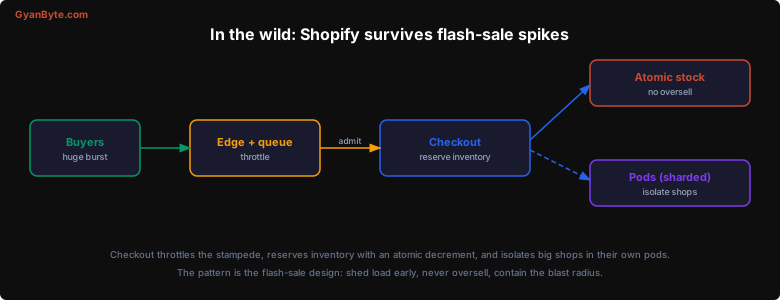
Three ideas do the heavy lifting, each a pattern you already know.
1. Shed load at the edge with a checkout throttle
Shopify does not let the stampede reach the core. Storefront reads (the product page, images, the “sale is live” banner) are served and cached aggressively at the CDN edge, so the majority of traffic — people just watching the page — never touches origin.
The checkout itself is protected by a throttle: a server-side queue (Shopify has written about a Lua-scripted Redis queue at the edge of checkout) that admits buyers at a controlled rate. Instead of three million people hitting “complete order” simultaneously, the throttle lets a sane trickle through and shows everyone else a “you’re in line” experience. This is exactly the virtual waiting room / admission control from the flash-sale lesson and the back-pressure idea from Scaling Pitfalls: when the downstream is saturated, reject or queue early rather than buffer unboundedly.
2. Reserve inventory atomically — never oversell
When a buyer is admitted, the purchase decrements inventory. With concurrent buyers racing for the last units, a “read stock, then write” sequence oversells. Shopify’s inventory system treats the decrement as an atomic, conditional operation — the database equivalent of UPDATE ... SET stock = stock - 1 WHERE stock > 0, backed by row-level guarantees — so the count can never go below zero no matter how many requests arrive at once.
This is the correctness core from Dealing with Contention: put the check and the mutation in a single atomic step on the hot row, and let the database (or Redis) serialise it, rather than coordinating in application code.
3. Pods: contain the blast radius
This is Shopify’s signature move and the reason one store’s sale does not sink the platform. Shopify shards its merchants across many isolated units called pods. A pod is a self-contained slice of the platform — its own database shard and supporting infrastructure — serving a subset of stores. A store lives entirely within one pod.
The payoff is bulkheading: if a flash sale saturates a pod, the damage is contained to the stores in that pod; every other pod is unaffected. Shopify can also move a merchant expecting a huge drop onto a pod with more headroom (or its own pod) ahead of time, and they can fail a pod over independently. This is the bulkhead pattern from Scaling Pitfalls applied at the architecture level — partition the system so a failure or hotspot is a local event, not a global one.
Why this is a great interview model
| Course pattern | How Shopify applies it |
|---|---|
| Admission control / back-pressure | Checkout throttle (server-side queue) admits a controlled rate |
| Atomic decrement (contention) | Conditional inventory reservation — never oversell |
| Edge caching / CDN | Storefront reads served and cached at the edge |
| Bulkheading / blast radius | Pods isolate merchants onto independent shards |
| Capacity planning | Pre-provisioning big merchants onto roomy pods before a drop |
If an interviewer asks you to “design Shopify’s checkout for Black Friday,” you can answer with structure: shed load at the edge, make the inventory decrement atomic, and — the senior-level insight — isolate tenants so one store’s spike cannot become everyone’s outage.
Key Takeaways
- Flash-sale survival is load-shedding plus an atomic decrement — the same two jobs as the textbook design, just at platform scale.
- The edge is your first and cheapest line of defense. Cache storefront reads; throttle checkout with a server-side queue so the core sees a trickle, not a flood.
- Never oversell with a single atomic, conditional operation on the inventory row — not a read-then-write in application code.
- Pods are bulkheading. Sharding tenants into isolated units contains a hotspot or failure to one slice of the platform, which is what lets a multi-tenant system survive one tenant’s viral moment.
- Plan capacity for known spikes. When you can see a huge drop coming, move that merchant to headroom in advance — scaling is not only reactive.