

The design lessons in this course teach patterns in the abstract. This “In the Wild” case study shows what those patterns look like when a real company runs them at enormous scale. Discord has written publicly about storing trillions of messages, and nearly every decision maps back to something you have already learned — wide-column data modeling, partitioning, and the chat-system design.
The problem
Discord is organized into servers and channels, and a channel is essentially a long, append-only conversation. The dominant operations are simple:
- Append a new message to a channel (write-heavy, constant).
- Read a window of a channel’s recent messages when you open it, then page backward as you scroll.
The scale is what makes it hard: billions of messages a day, some channels nearly idle and others blasting thousands of messages a minute, and users who expect a channel to open instantly no matter how much history it holds.
Modeling for the access pattern
The single most important decision is the one the data modeling lesson insists on: design the schema around the query you must answer cheaply. Here that query is “give me the most recent N messages in this channel, and let me page backward.”
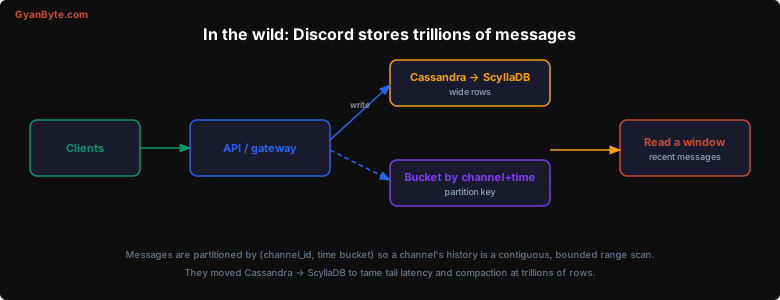
Discord stores messages in a wide-column store, partitioned by a compound key:
partition key:  (channel_id, bucket)      # bucket = a fixed time window, e.g. ~10 days
clustering key:  message_id (a Snowflake)  # sorts within the partition by time
Two ideas are doing the work:
- Partition by channel. All of a channel’s messages live together, so reading a channel never touches another channel’s data.
- Bucket by time. Without buckets, a busy channel’s partition would grow without bound — and a single unbounded partition is the classic wide-column anti-pattern (it blows up memory, compaction, and tail latency). Splitting a channel into fixed time buckets keeps every partition bounded. Because message IDs are Snowflake IDs (a timestamp-prefixed, roughly sortable 64-bit id — see the Unique ID Generator lesson), they sort by time within a bucket for free, and the bucket for any timestamp is computable directly.
Reading a channel becomes: compute the current bucket, range-scan it in descending ID order, and walk back to the previous bucket if you need more. It is a bounded, contiguous read — exactly what a wide-column store is fast at.
Why a wide-column store
Discord’s requirements line up precisely with what wide-column databases are built for, which is why “SQL vs NoSQL” here resolves cleanly:
| Requirement | Why wide-column fits |
|---|---|
| Massive, constant write volume | LSM-tree storage absorbs high write throughput (see Databases Deep-Dive) |
| Linear horizontal scale | Partitioned by channel; add nodes to add capacity |
| Read a recent window | Clustering by message id makes “latest N” a cheap range scan |
| No cross-channel transactions | They never need a multi-partition transaction, so giving up that guarantee costs nothing |
They started on Cassandra. It served the workload for years, but at their scale the operational pain grew: latency spikes during compaction, the cost of keeping a large cluster healthy, and garbage-collection pauses on the JVM hurting the tail. They later migrated to ScyllaDB — a Cassandra-compatible store written in C++ with a shard-per-core architecture — and reported dramatically better tail latency and a large reduction in node count for the same workload. The data model did not change; the engine underneath it did. That is a useful interview point: the schema is the hard, durable decision; the specific database can be swapped.
The hot-partition problem
A handful of channels are enormous — an announcement channel in a server with millions of members. Those are the hot keys / celebrity problem from the scaling-pitfalls lesson, and Discord hits them in two ways:
- Hot partitions on write/read. Time bucketing already caps how large any one partition gets, which spreads a busy channel’s load across many partitions over time rather than concentrating it in one ever-growing row.
- Thundering herds on read. When a huge channel gets a burst of activity, many servers can ask for the same recent messages at once. Discord fronts the store with a layer that coalesces concurrent identical reads — one request goes to the database and the rest wait for its result — which is the single-flight defense against a cache stampede.
Reads, caching, and pagination
The read path is the product: opening a channel must feel instant. The design serves the most recent bucket first (the overwhelmingly common request), pages backward by bucket as the user scrolls, and leans on caching for the hottest channels. Because message IDs are time-sortable, pagination needs no offset counting — “give me messages before this id” is a clean cursor, the cursor-pagination pattern from the API design lesson.
What to take from this
Discord’s architecture is not exotic — it is the textbook chat-system and wide-column patterns, applied with discipline and tuned relentlessly. In an interview, the lesson is not “use ScyllaDB.” It is:
- Model for the access pattern first. The partition and clustering keys are the design.
- Keep partitions bounded. Time bucketing is the standard trick for an append-only, per-key stream.
- The engine is replaceable; the data model is not. Pick the storage shape for your queries, and you keep your options open underneath.
Key takeaways:
- Partition by channel and bucket by time so each read is a bounded, contiguous range scan.
- Snowflake message IDs give free time-ordering and clean cursor pagination within a partition.
- Wide-column (Cassandra, then ScyllaDB) fits the write-heavy, linearly-scaling, no-cross-partition-transaction workload.
- Huge channels are hot partitions; bounded buckets plus single-flight read coalescing tame them.
- The durable decision is the schema; the database engine underneath can be swapped as operational needs change.