

A search engine is one of the most complex distributed systems ever built. Google processes over 8.5 billion searches per day, indexing hundreds of billions of web pages across a petabyte-scale inverted index. In an interview, you won’t design the full Google — but you need to demonstrate mastery of the core components: crawling, indexing, query processing, and ranking.
Understanding the Problem
Functional Requirements
- Web search by keywords — User types a query, gets ranked results
- Autocomplete suggestions — As-you-type query suggestions
- Paginated results — 10 results per page, with next/previous
- Spell correction — “Did you mean: running shoes”
- Snippet generation — Show relevant text excerpt from each result
- Freshness — New content indexed within hours, not days
Non-Functional Requirements
| Requirement | Target |
|---|---|
| Query latency (p99) | < 200ms |
| Index freshness | New pages indexed within 2-4 hours |
| Index size | Billions of documents |
| Query throughput | 100K+ QPS |
| Availability | 99.99% |
| Relevance | First-page results satisfy 90%+ of queries |
Scale Estimation
- 100 billion indexed pages, average 50KB each = 5 PB raw content
- Inverted index is ~10% of raw content = 500 TB index data
- 100K QPS at peak, each touching ~10 index shards = 1M internal RPCs/sec
- Crawl rate: ~1 billion pages/day to maintain freshness
Core Entities and APIs
Data Model
-- Document metadata (stored separately from index)
CREATE TABLE documents (
    doc_id      BIGINT PRIMARY KEY,
    url         TEXT UNIQUE,
    title       VARCHAR(500),
    content_hash CHAR(64),     -- SHA-256 for dedup
    page_rank   FLOAT DEFAULT 0.0,
    crawled_at  TIMESTAMP,
    indexed_at  TIMESTAMP
);

-- The inverted index is NOT in SQL — it's a custom
-- data structure optimized for term lookups.
-- Conceptually:
--   term → [(doc_id, term_frequency, [positions]), ...]
API Design
# Search
GET /api/v1/search?q=distributed+systems&page=1&size=10
response:
  total_results: 142000000
  results:
    - title: "Designing Data-Intensive Applications"
      url: "https://example.com/ddia"
      snippet: "A guide to the big ideas behind reliable, scalable..."
      score: 0.94
    - ...
  suggestions:
    spell_correction: null
    related_searches: ["distributed systems book", "system design"]

# Autocomplete
GET /api/v1/suggest?prefix=distrib
response:
  suggestions:
    - "distributed systems"
    - "distributed computing"
    - "distributed database"
    - "distributed lock"

# Index (internal API, not public)
POST /internal/v1/index
  body: { url, title, content, crawled_at }
High-Level Design
A search engine has two distinct pipelines that share the inverted index.
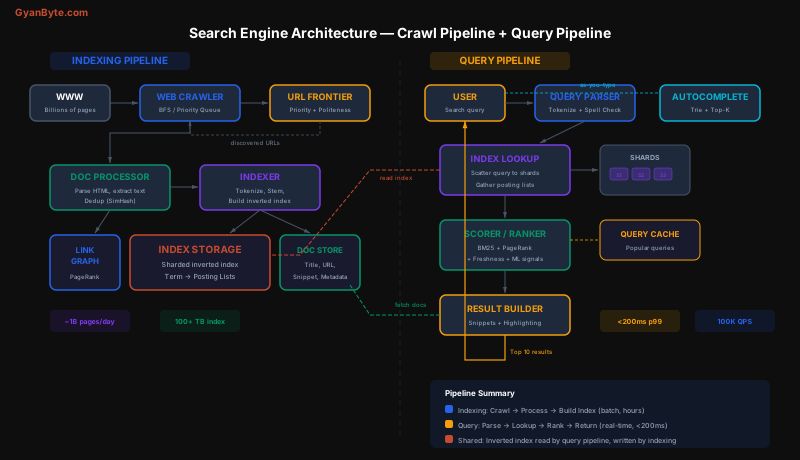
Indexing Pipeline (Offline/Batch)
- Web Crawler — Fetches pages from the internet using BFS. A URL frontier manages priority (important sites first) and politeness (don’t DDoS anyone).
- Document Processor — Parses HTML, extracts text, detects language, deduplicates via SimHash/MinHash.
- Indexer — Tokenizes text, applies stemming, builds inverted index entries, computes term frequencies.
- Index Storage — Writes sharded inverted index to disk. Computes PageRank from the link graph.
Query Pipeline (Online/Real-Time)
- Query Parser — Tokenizes the query, applies spell check, removes stop words, stems terms.
- Index Lookup — Scatters the query to relevant index shards, gathers posting lists.
- Scorer/Ranker — Computes relevance score per document using BM25 + PageRank + freshness + ML signals.
- Result Builder — Fetches document metadata (title, URL), generates snippets, formats the response.
Deep Dive: Inverted Index
The inverted index is the heart of any search engine. It maps every term to the list of documents containing that term.
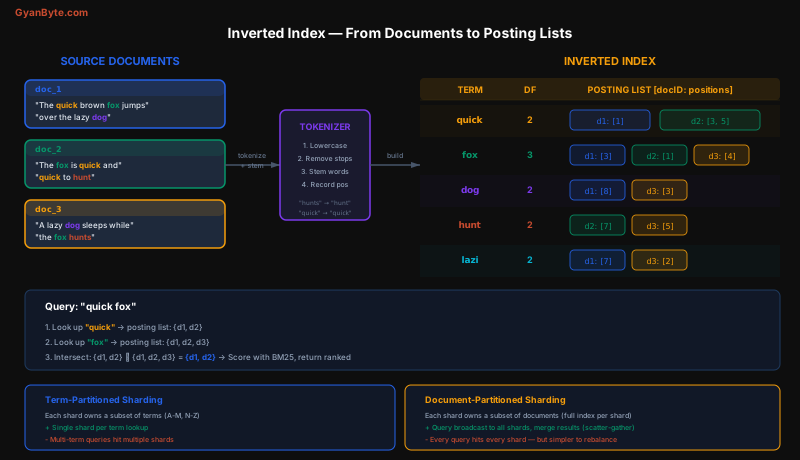
Structure
Term Dictionary:
  "distributed" → PostingList
  "system"      → PostingList
  "design"      → PostingList
  ...

PostingList for "distributed":
  [
    { doc_id: 1042, tf: 5, positions: [3, 15, 42, 89, 123] },
    { doc_id: 2891, tf: 2, positions: [7, 56] },
    { doc_id: 5420, tf: 8, positions: [1, 12, 28, 33, 67, 91, 104, 118] },
    ...
  ]
Each posting list entry contains:
- doc_id — Which document contains this term
- tf (term frequency) — How many times the term appears
- positions — Where in the document the term appears (enables phrase queries like “distributed systems”)
Building the Index
def build_inverted_index(documents):
    """
    Build an in-memory inverted index from a batch of documents.
    In production, this writes to a sorted on-disk format (SSTable-like).
    """
    index = defaultdict(list)  # term → list of PostingEntry

    for doc in documents:
        tokens = tokenize(doc.content)       # split on whitespace/punctuation
        tokens = [t.lower() for t in tokens] # lowercase
        tokens = remove_stop_words(tokens)   # remove "the", "is", "a"
        tokens = [stem(t) for t in tokens]   # "running" → "run"

        # Count term frequencies and record positions
        term_positions = defaultdict(list)
        for pos, token in enumerate(tokens):
            term_positions[token].append(pos)

        for term, positions in term_positions.items():
            index[term].append(PostingEntry(
                doc_id=doc.id,
                tf=len(positions),
                positions=positions
            ))

    # Sort posting lists by doc_id for efficient intersection
    for term in index:
        index[term].sort(key=lambda e: e.doc_id)

    return index
Sharding the Index
There are two fundamental strategies for distributing the index across machines:
Document-Partitioned (Uber’s Elasticsearch uses this):
- Each shard holds a complete index for a subset of documents
- Every query is broadcast to all shards (scatter-gather)
- Each shard returns its local top-K, coordinator merges
- Simpler to rebalance, easier to add capacity
Term-Partitioned:
- Each shard owns a subset of terms (e.g., A-M, N-Z)
- A single-term query hits exactly one shard
- Multi-term queries hit multiple shards, then intersect
- Better for single-term lookups, harder to manage
For most interviews, go with document-partitioned sharding. It’s what Elasticsearch, Solr, and most modern search systems use. The scatter-gather overhead is acceptable because each shard responds in parallel.
# Scatter-gather pseudocode
async def search(query, num_shards=1000, top_k=10):
    # Parse and prepare
    terms = parse_query(query)

    # Scatter: send to all shards in parallel
    futures = []
    for shard_id in range(num_shards):
        futures.append(
            shard_clients[shard_id].search(terms, top_k=top_k)
        )

    # Gather: collect local top-K from each shard
    shard_results = await asyncio.gather(*futures)

    # Merge: global top-K from all shard results
    heap = []
    for results in shard_results:
        for doc_id, score in results:
            heapq.heappush(heap, (score, doc_id))
            if len(heap) > top_k:
                heapq.heappop(heap)

    return sorted(heap, reverse=True)
Deep Dive: Query Processing Pipeline
A raw user query goes through several transformations before it hits the index.
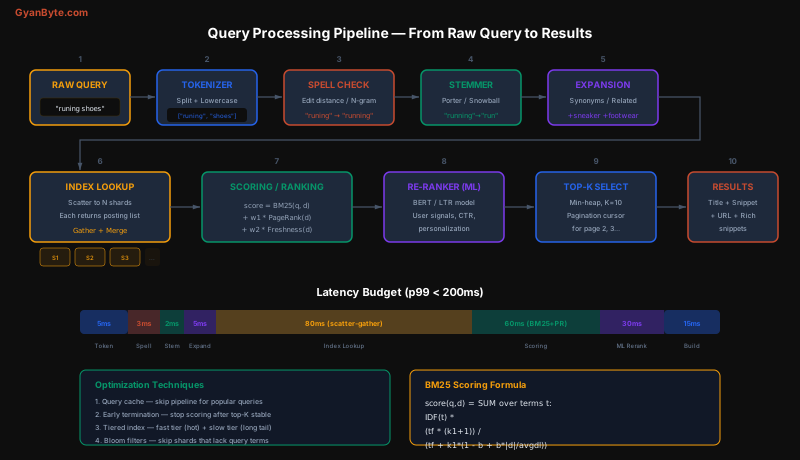
Step 1: Tokenization
Split the raw query into individual terms, normalize case, handle special characters.
def tokenize(query):
    # "New York restaurants -fast-food" →
    # ["new", "york", "restaurants", "-fast-food"]
    tokens = re.split(r'\s+', query.lower().strip())
    return tokens
Step 2: Spell Correction
Check each term against a dictionary. For unknown terms, find the closest known term using edit distance or a pre-built n-gram index.
def spell_check(term, dictionary, max_edit_distance=2):
    if term in dictionary:
        return term

    # Generate candidates within edit distance
    candidates = []
    for dict_term in dictionary.get_candidates(term[:3]):  # prefix filter
        dist = levenshtein_distance(term, dict_term)
        if dist <= max_edit_distance:
            candidates.append((dict_term, dist, dictionary.frequency(dict_term)))

    if not candidates:
        return term  # Unknown term, keep as-is

    # Rank by (edit_distance ASC, frequency DESC)
    candidates.sort(key=lambda c: (c[1], -c[2]))
    return candidates[0][0]

# "runing" → edit distance 1 from "running" → correct
Step 3: Stemming
Reduce words to their root form so that “running”, “runs”, “ran” all match documents containing any of these forms.
# Porter Stemmer examples:
# "running"   → "run"
# "computers" → "comput"
# "arguing"   → "argu"
# "agreed"    → "agre"
Step 4: Query Expansion
Add synonyms and related terms to improve recall:
def expand_query(terms):
    expanded = list(terms)
    for term in terms:
        synonyms = synonym_dict.get(term, [])
        # Add top 2 synonyms with reduced weight
        for syn in synonyms[:2]:
            expanded.append((syn, boost=0.5))
    return expanded

# "shoes" → ["shoes", ("footwear", 0.5), ("sneakers", 0.5)]
Step 5: Index Lookup (Scatter-Gather)
The parsed query is broadcast to all index shards. Each shard performs a local search:
- Look up each query term in the shard’s inverted index
- Intersect posting lists (for AND queries) or merge them (for OR queries)
- Score each matching document locally
- Return the top-K results to the coordinator
Step 6: Scoring with BM25
BM25 (Best Matching 25) is the industry-standard relevance scoring function. It’s an improvement over TF-IDF that handles document length normalization:
import math

def bm25_score(query_terms, doc, index, corpus_stats):
    """
    BM25 scoring for a single document against query terms.

    k1 = 1.2  (term frequency saturation)
    b  = 0.75 (document length normalization)
    """
    k1 = 1.2
    b = 0.75
    score = 0.0

    N = corpus_stats.total_docs
    avgdl = corpus_stats.avg_doc_length
    dl = doc.length  # number of terms in this document

    for term in query_terms:
        # df = number of documents containing this term
        df = index.doc_frequency(term)

        # IDF component: rare terms are more important
        idf = math.log((N - df + 0.5) / (df + 0.5) + 1)

        # TF component with saturation and length normalization
        tf = doc.term_frequency(term)
        tf_norm = (tf * (k1 + 1)) / (tf + k1 * (1 - b + b * dl / avgdl))

        score += idf * tf_norm

    return score
BM25 captures two crucial intuitions:
- IDF: A term appearing in 90% of documents (“the”) is nearly worthless. A term appearing in 0.01% of documents (“kubernetes”) is highly discriminative.
- Saturating TF: Mentioning “database” 50 times in a document doesn’t make it 50x more relevant than mentioning it once. The score saturates around tf=5-10.
Step 7: Combining Signals
BM25 alone isn’t sufficient. Modern search engines combine multiple signals:
def final_score(doc, query, bm25):
    return (
        0.40 * bm25                           +  # Text relevance
        0.25 * doc.page_rank                   +  # Link authority
        0.15 * freshness_score(doc.crawled_at) +  # Newer is better
        0.10 * click_through_rate(doc, query)  +  # User engagement
        0.10 * domain_authority(doc.url)           # Trust signal
    )
PageRank measures a page’s authority based on the link graph. A page linked to by many important pages gets a high PageRank. It’s computed offline during the indexing pipeline.
Deep Dive: Autocomplete
Autocomplete must return suggestions within 50-100ms of each keystroke. The data structure of choice is a Trie (prefix tree) combined with pre-computed top-K results per prefix.
class TrieNode:
    def __init__(self):
        self.children = {}
        self.top_suggestions = []  # Pre-computed top 10 for this prefix
        self.is_end = False

class AutocompleteTrie:
    def __init__(self):
        self.root = TrieNode()

    def insert(self, phrase, score):
        node = self.root
        for char in phrase:
            if char not in node.children:
                node.children[char] = TrieNode()
            node = node.children[char]
            # Update top-K suggestions at each prefix node
            self._update_top_k(node, phrase, score)
        node.is_end = True

    def suggest(self, prefix):
        node = self.root
        for char in prefix:
            if char not in node.children:
                return []
            node = node.children[char]
        return node.top_suggestions  # O(1) lookup!

    def _update_top_k(self, node, phrase, score, k=10):
        node.top_suggestions.append((phrase, score))
        node.top_suggestions.sort(key=lambda x: -x[1])
        node.top_suggestions = node.top_suggestions[:k]
The key optimization: pre-compute the top-K suggestions at every trie node. When a user types “dist”, we traverse to the “d”→“i”→“s”→“t” node and return its pre-computed list immediately — no DFS traversal needed at query time.
The trie is rebuilt periodically (e.g., hourly) from query logs, weighted by query frequency.
Deep Dive: Freshness vs. Completeness
A tension exists between two goals:
- Freshness: Index breaking news within minutes
- Completeness: Have a comprehensive index of the entire web
The solution is tiered indexing:
Tier 1 (Hot):
  - Top 10M most important URLs
  - Re-crawled every 1-4 hours
  - Served from fastest SSD-backed shards
  - Breaking news, popular sites

Tier 2 (Warm):
  - Next 1B URLs
  - Re-crawled every 1-7 days
  - Served from standard storage

Tier 3 (Cold):
  - Long-tail: 100B+ URLs
  - Re-crawled every 30-90 days
  - Served from high-density storage
  - Only queried if tiers 1+2 don't satisfy
For breaking news, a separate real-time indexing pipeline processes new content from RSS feeds, social media, and news APIs. It pushes updates to Tier 1 within minutes.
Deep Dive: Index Serving at Scale
With 500 TB of index data and 100K QPS, you need careful capacity planning.
Index Size:     500 TB
Shard Size:     ~50 GB per shard (fits in RAM on 64GB machines)
Num Shards:     10,000
Replicas:       3 per shard (availability)
Total Machines: 30,000 index servers

Query Fan-out:  Each query hits all 10,000 shards
                But shards are grouped into ~100 "rows"
                Each row holds a full copy of the index
                Query hits 1 shard per row = 100 RPCs per query

At 100K QPS:    100K * 100 = 10M internal RPCs/sec
Per shard:      ~1K queries/sec (manageable with SSD + RAM cache)
Bloom filters optimize this further: each shard maintains a Bloom filter of its terms. The query coordinator checks the Bloom filter first and skips shards guaranteed not to have any of the query terms.
Key Takeaways
| Component | Choice | Why |
|---|---|---|
| Index structure | Inverted index with posting lists | Standard for full-text search, supports AND/OR/phrase queries |
| Sharding | Document-partitioned | Simpler rebalancing, each shard is self-contained |
| Query pattern | Scatter-gather | Broadcast to all shards, merge top-K results |
| Scoring | BM25 + PageRank + freshness | BM25 for text relevance, PageRank for authority |
| Autocomplete | Trie with pre-computed top-K | O(1) suggestion lookup per prefix |
| Freshness | Tiered indexing (hot/warm/cold) | Important pages re-crawled hourly, long-tail monthly |
| Spell check | Edit distance + n-gram index | Fast candidate generation with frequency-weighted ranking |
| Crawling | BFS with priority + politeness | Crawl important pages first, respect robots.txt |
The search engine design tests your understanding of data structures at scale (inverted index, tries), distributed query processing (scatter-gather), and relevance engineering (BM25, PageRank). In the interview, start with the two-pipeline architecture, then let the interviewer guide which deep dive they want.