

If you have done the Options Trading for Programmers course, this is its wild cousin. Crypto takes everything from that course — calls, puts, the Greeks, Black-Scholes, strategies — and drops it into a market that is open 24/7, four to five times more volatile, largely unregulated, and almost entirely API-driven. For a programmer that combination is intoxicating: free real-time data, open exchange APIs, and a market that never closes. It is also genuinely dangerous, in ways equity markets are not. This course teaches both halves honestly.
A very serious note — please read it twice. This is educational material, not financial advice and not a recommendation to trade or to buy any coin. Crypto is extremely high-risk: prices move 20–50% in a day, leverage liquidates accounts in minutes, exchanges have collapsed with customer funds (FTX, Mt. Gox), “stablecoins” have gone to zero (UST), and the whole space is full of scams. In India, crypto gains are taxed at a flat 30% plus 1% TDS, with losses not set off against other income, and the regulatory position is still evolving. You can lose everything — including to risks that have nothing to do with whether your analysis was right. Learn first, use testnets, risk only what you can truly afford to lose, and treat survival as the goal.
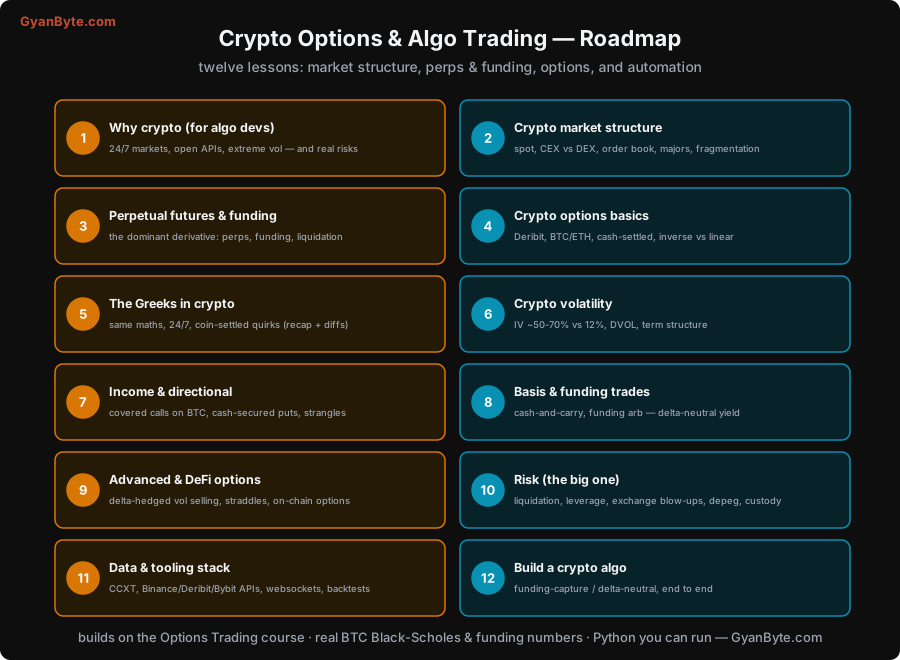
What makes crypto different (and why coders love it)
Three things set crypto apart from the equity options you may know. First, perpetual futures — not options — are the dominant instrument, and their funding rate is the single most important number in the market (Lesson 3). Second, the volatility is enormous: BTC implied vol runs 50–70% against a Nifty’s ~12%, so options are expensive and moves are violent (Lesson 6). Third, it is the most programmable market on earth: open, free, real-time APIs over WebSocket, a 24/7 order book, and one library (CCXT) that talks to 100+ exchanges. The flip side of all that openness is that there is no SEBI, no circuit breaker, no clearing house standing between you and disaster. The tooling is a joy; the discipline is entirely on you.
What this course covers
| # | Lesson | What you will learn |
|---|---|---|
| 1 | Why Crypto (for Algo Devs) | The appeal, the mindset, and the very real risks |
| 2 | Crypto Market Structure | Spot, perps, futures, options; CEX vs DEX; fragmentation |
| 3 | Perpetual Futures & Funding | How perps work, the funding rate, leverage, liquidation |
| 4 | Crypto Options Basics | Deribit, BTC/ETH, cash-settled, inverse vs linear |
| 5 | The Greeks in Crypto | What carries over from the Options course, and what differs |
| 6 | Crypto Volatility | IV 50–70%, DVOL, term structure, sizing for violence |
| 7 | Income & Directional | Covered calls on BTC, cash-secured puts, strangles |
| 8 | Basis & Funding Trades | Cash-and-carry, funding capture — delta-neutral yield |
| 9 | Advanced & DeFi Options | Delta-hedged vol selling, straddles, on-chain options |
| 10 | Risk (the Big One) | Liquidation, exchange failure, depeg, custody, 24/7 |
| 11 | Data & Tooling Stack | CCXT, exchange APIs, WebSockets, backtesting crypto |
| 12 | Build a Crypto Algo | A delta-neutral funding-capture bot, end to end |
It assumes the options fundamentals from the Options Trading for Programmers course (do that first if options are new to you), and layers the crypto-specific parts on top — perps, funding, basis, DeFi, and a risk landscape all its own. Real BTC Black-Scholes and funding numbers throughout, Python you can run, plain Indian English, and every lesson ends with the pitfalls and a quick recap.
Start with Lesson 1: Why Crypto (for Algo Devs).
For related material, see the Options Trading for Programmers course, the Low-Latency Trading Systems course, and the algo trading vocabulary.