If you skip everything else, do not skip this. In the options course, the risk lesson was about your own mistakes — sizing, naked selling, time decay. In crypto, those all still apply, and then a whole extra layer is stacked on top — a layer that can take your money regardless of whether your trade was right. This is the lesson that keeps you solvent.
The ways crypto wipes you out
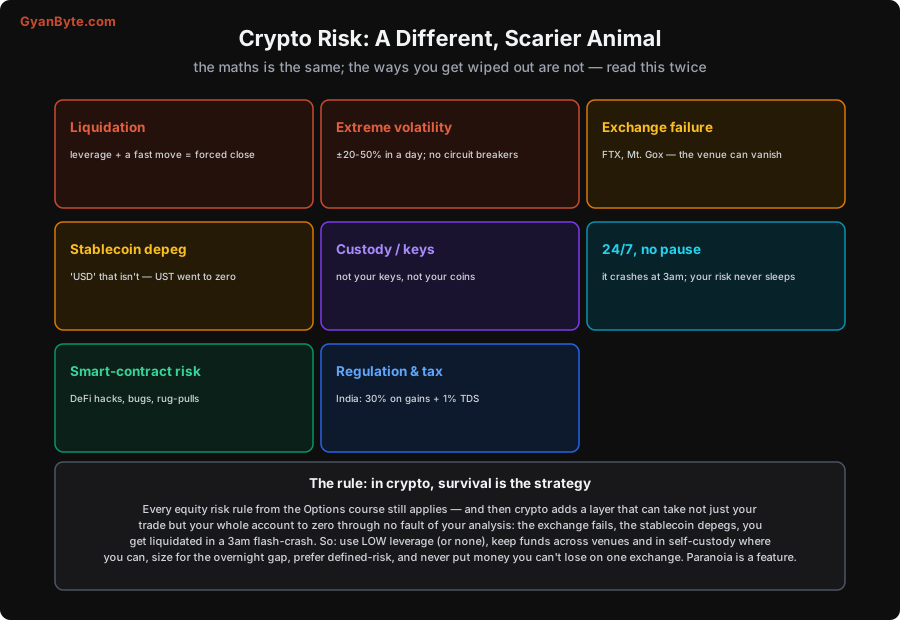
- Liquidation. Leverage plus a fast move equals a forced close at the worst price. The single most common way leveraged crypto accounts die. Low leverage is the cure.
- Extreme volatility. ±20–50% in a day is a real possibility, and there are no circuit breakers to pause the fall. Size for moves that would be unthinkable in equities.
- Exchange failure. FTX and Mt. Gox both collapsed and took customer funds with them. The venue holding your money is itself a risk — “not your keys, not your coins.”
- Stablecoin de-peg. A token meant to be worth $1 that isn’t. UST went to zero in days, taking fortunes with it. Know exactly what backs any stablecoin you hold.
- Custody / keys. Self-custody removes exchange risk but adds your own risk — lose your keys or get phished and the money is gone forever, with no support desk to call.
- 24/7, no pause. The worst crashes love 3am on a Sunday. Your risk management has to run when you are asleep.
- Smart-contract risk. In DeFi, bugs, exploits and rug-pulls can drain funds instantly. Code is law — including the bugs.
- Regulation & tax (India). A flat 30% tax on gains + 1% TDS, with no set-off of losses. The tax itself is a real drag you must plan around, and the regulatory ground keeps shifting.
Notice how many of these have nothing to do with your analysis. You can be completely right about BTC’s direction and still lose everything because the exchange failed, the stablecoin depegged, or you got liquidated in a flash-crash wick. That is what makes crypto risk different in kind, not just degree.
The survival rules
Every risk rule from the options course still applies (size small, define max loss, prefer defined-risk, mind liquidity and costs). Crypto adds these, and they are non-negotiable:
- Use low leverage — or none while learning. Leverage is the fastest route to liquidation in a market that moves 20% in a day. Many pros use 2–3x at most.
- Spread funds across venues, and self-custody where you can. Never keep more on a single exchange than you can afford to lose entirely. For long-term holdings, use a hardware wallet.
- Size for the overnight gap. Assume a 30–50% move can happen while you sleep, and make sure that cannot ruin you.
- Prefer defined-risk. Spreads over naked options; delta-hedged over directional; small over large.
- Automate your risk, with a kill-switch. In a 24/7 market your stops and your flatten-everything button must run without you (Lesson 12).
- Keep clean tax records. 30% + 1% TDS, no loss set-off — track everything from day one.
The mindset: paranoia is a feature
In crypto, survival is the strategy. The upside is real, but the environment is actively hostile in ways regulated markets are not, and the people who last are the paranoid ones — the ones who assumed the exchange could fail, kept keys to themselves, used little leverage, and sized for the unthinkable move. Be that person. Boring and alive beats clever and liquidated.
Pitfalls
- Treating an exchange balance as safe cash. It’s an IOU that has gone to zero before. Diversify venues; self-custody.
- Any meaningful leverage in a 24/7 market. A sleeping 10x position is a liquidation waiting for a 3am wick. Low leverage, automated alerts.
- Forgetting the tax. 30% + 1% TDS with no loss offset changes the maths of active trading in India. Model it in.
Recap
Crypto risk is a different animal: liquidation, ±20–50% days with no circuit breakers, exchange failure (FTX), stablecoin depeg (UST), custody risk, 24/7 markets, smart-contract exploits, and a harsh Indian tax regime — many of which can wipe you out regardless of your analysis. The survival rules: low/no leverage, spread funds and self-custody, size for the overnight gap, prefer defined-risk, automate risk with a kill-switch, and keep tax records. In crypto, paranoia is a feature.
Next: Lesson 11 — Data & Tooling Stack, where the programmer’s edge comes fully into play.