Now we apply the strategy toolkit. The payoff shapes are exactly the ones from the Options Trading course — covered calls, cash-secured puts, strangles — just on BTC and ETH, at crypto volatility. Let me show the shapes and then the two crypto-specific adjustments.
The strategies
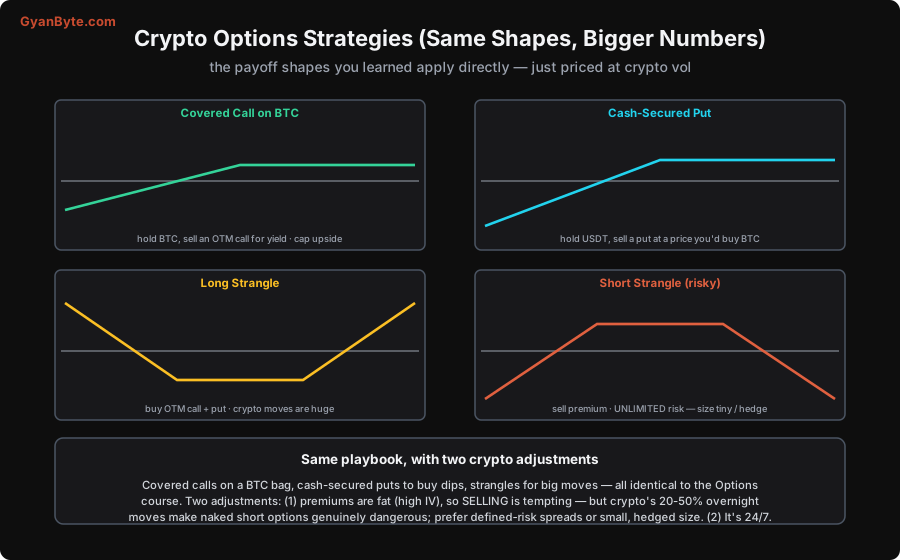
- Covered call on a BTC holding. You hold BTC for the long term (a “bag”) and sell an OTM call against it each week/month, collecting premium as income. If BTC stays below the strike, you keep the premium and your coins; if it rips above, your upside is capped at the strike. A very popular way to earn yield on a long-term crypto holding — just know you have agreed to sell if it moons.
- Cash-secured put. You hold stablecoin (USDT) and sell a put at a strike where you would be happy to buy BTC. If BTC stays up, you keep the premium; if it falls to the strike, you buy at an effective discount (strike − premium). You are literally paid to place your dip-buy order. The catch is the same as always: only do it at prices you genuinely want to own.
- Long strangle. Buy an OTM call and an OTM put. Crypto’s enormous moves mean these can genuinely pay off when a big move comes — but fat premium and theta are the cost, and (Lesson 6) IV is usually already high, so you need a really big move. Best when DVOL is low and a catalyst looms.
- Short strangle. Sell an OTM call and put to collect premium, profiting if BTC stays range-bound. This is where crypto bites: the premium is fat and tempting, but a 20–50% overnight move is a real possibility, and a naked short strangle has open-ended risk on both sides. Treat it with extreme caution.
The two crypto adjustments
The strategies are unchanged; only two things about applying them differ:
- Fat premium makes selling tempting — and dangerous. Because IV is ~55%, selling options pays well, and it is very easy to fall in love with the steady income. But the whole reason the premium is fat is that crypto can gap violently. Naked option selling in crypto is genuinely dangerous. Strongly prefer defined-risk spreads (buy a further-out wing so your loss is capped) or keep short positions small and delta-hedged (Lesson 9). The traders who blow up selling crypto premium almost always did so naked and over-sized.
- It is 24/7. A position can move hard against you at 3am on a Sunday with no market close to save you. Your stops, alerts and (ideally) automated risk management must be running around the clock, not just when you are awake.
# covered-call yield on a BTC holding (illustrative)
btc_held       = 1.0
call_premium   = 2000          # $ collected for selling a 30d OTM call
monthly_yield  = call_premium / (btc_held * 90000)     # ~2.2% / month on the holding
# attractive — but you've capped your upside at the strike, and in a rip you miss it
Pitfalls
- Naked short strangles for the fat premium. The single most common crypto-options blow-up. A gap move takes the lot. Defined-risk or small+hedged only.
- Covered calls in a bull run. You cap your upside and watch BTC moon without you. Fine if you expected sideways; painful in a rally.
- Selling cash-secured puts on coins you don’t want. If assigned on a falling knife you didn’t actually want, the “income” was a trap. Only on BTC/ETH you’re happy to hold.
Recap
The strategies are identical to equities — covered calls for income on a BTC bag, cash-secured puts to buy dips, strangles for big moves. Two crypto adjustments: fat premium makes selling tempting but dangerous (prefer defined-risk or small+hedged, never naked), and 24/7 markets mean your risk must run around the clock. Same shapes, much more respect for the tail.
Next: Lesson 8 — Basis & Funding Trades, the delta-neutral yield trades that are crypto’s real “algo” money.