Before trading anything, you need the map: what instruments exist, where they trade, and how the plumbing differs from the equity world. This structure shapes every strategy later.
The four instruments
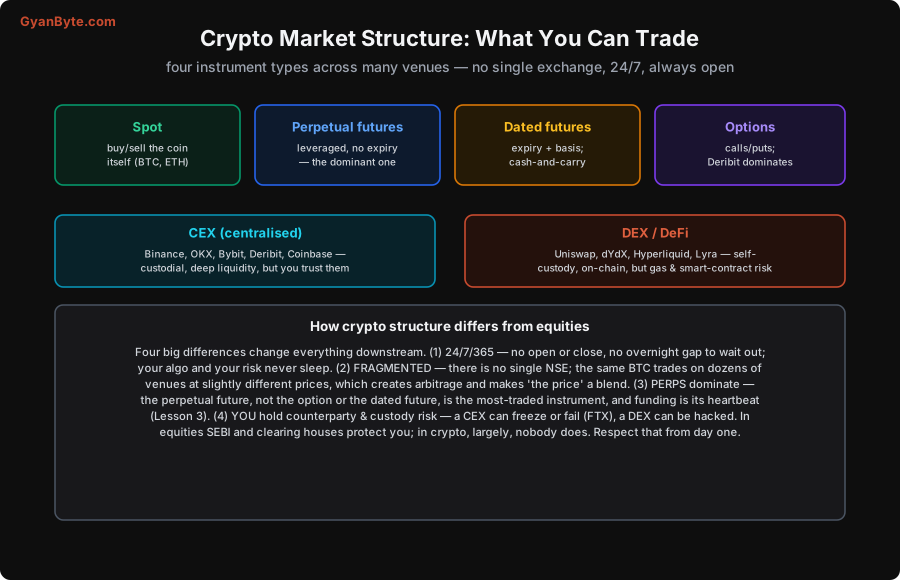
- Spot — buying and selling the coin itself (BTC, ETH). No leverage, no expiry. You own the asset.
- Perpetual futures (“perps”) — leveraged futures with no expiry date, kept near the spot price by a funding rate. These are the most-traded instrument in all of crypto by a mile, and the next lesson is entirely about them.
- Dated futures — futures with a real expiry (quarterly is common). The gap between the future’s price and spot is the basis, which powers the cash-and-carry trade (Lesson 8).
- Options — calls and puts, overwhelmingly on Deribit for BTC and ETH (Lesson 4). A smaller but growing part of crypto volume.
The two kinds of venue
- CEX (centralised exchange) — Binance, OKX, Bybit, Deribit, Coinbase. They hold your funds (custodial), offer deep liquidity and fast matching engines, and expose excellent APIs. The catch: you are trusting them with your money, and crypto history is littered with exchanges that abused that trust.
- DEX / DeFi (decentralised) — Uniswap, dYdX, Hyperliquid, Lyra. You trade from your own wallet (self-custody), on-chain or via on-chain settlement. You keep your keys, but you take on gas fees, latency, and smart-contract risk (a bug or hack in the protocol can drain funds).
Most algorithmic trading still happens on CEXs because of liquidity and API quality, but DeFi venues (especially for perps and options) are growing fast and worth knowing.
Four differences that change everything
Coming from equities, four structural facts about crypto will reshape how you think:
- 24/7/365. There is no open, no close, no overnight gap to sleep through. Prices move at 3am on Sunday. Your strategy and your risk management must account for a market that never pauses — including your own code’s uptime and your exposure while you sleep.
- Fragmentation. There is no single NSE. The “same” BTC trades on dozens of exchanges at slightly different prices simultaneously. This means arbitrage exists between venues, “the price” is really a blend, and your data and execution often span multiple exchanges.
- Perps dominate. Unlike equities (where cash/spot dominates), the perpetual future is the most-traded instrument in crypto, and its funding rate is the market’s heartbeat. If you understand one thing deeply, make it perps and funding (Lesson 3).
- You carry counterparty and custody risk. In equities, SEBI, exchanges and clearing houses protect you. In crypto, largely, nobody does. A CEX can freeze withdrawals or fail; a DEX can be hacked; a stablecoin can de-peg. Where your money sits is itself a risk you must manage.
Pitfalls
- Assuming one price. With fragmentation, prices differ across venues; always know which exchange’s price your algo is using, and mind the spread between them.
- Treating a CEX balance as “safe cash”. It isn’t — it is an IOU from the exchange. Don’t keep more there than you can lose.
- Ignoring DeFi’s hidden costs. Gas fees, slippage on thin pools, and smart-contract risk can quietly make an on-chain strategy unprofitable.
Recap
Crypto offers four instruments — spot, perps, dated futures, options — across centralised (custodial, liquid) and decentralised (self-custody, on-chain) venues. Four structural differences drive everything downstream: it is 24/7, fragmented across many exchanges, dominated by perps and funding, and leaves counterparty/custody risk with you. Keep this map in mind as we go deeper.
Next: Lesson 3 — Perpetual Futures & Funding, the single most important mechanism in crypto.