Good news if you did the Options Trading course: you already know most of this. Options are options — the maths does not change because the underlying is Bitcoin. This lesson is just the crypto-specific wrapper around that familiar core.
What is the same (almost everything)
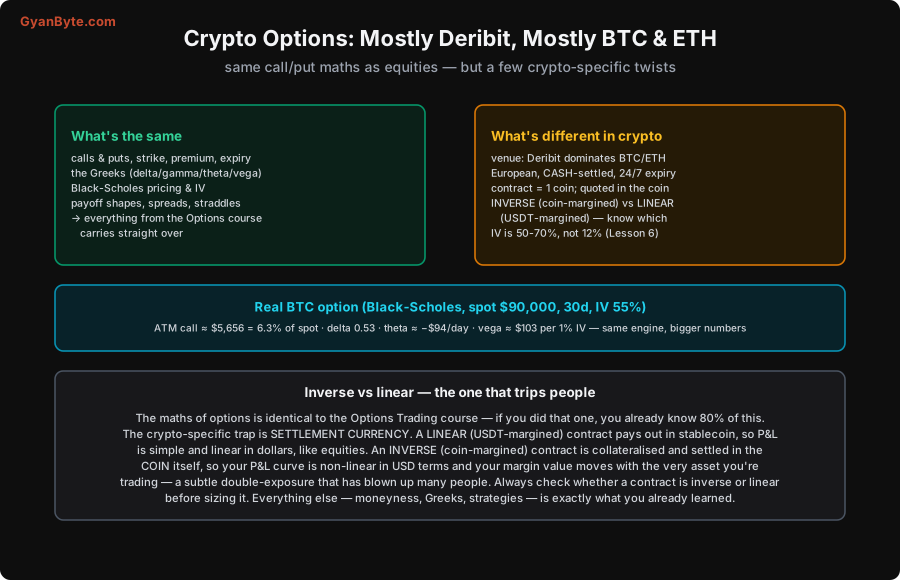
Calls and puts, strike, premium, expiry, moneyness, intrinsic vs time value, the Greeks, Black-Scholes, implied volatility, payoff shapes, spreads, straddles, condors — all of it carries over unchanged from the Options Trading course. If options are new to you, go and do that course first; this lesson assumes it. Here we only cover what crypto adds.
What is different in crypto
- The venue: Deribit. For BTC and ETH options, Deribit dominates liquidity (with Binance, OKX and on-chain venues like Lyra growing). If you trade crypto options, you will almost certainly be on Deribit or reading its data.
- European and cash-settled. Crypto options are generally European (exercised only at expiry) and cash-settled (you receive the cash difference, no delivery). Expiries run 24/7 like everything else — daily, weekly, monthly, quarterly.
- Contract size. One option contract is typically 1 coin (1 BTC, 1 ETH), and prices are often quoted in the coin rather than dollars on Deribit — a quoting style that confuses newcomers.
- The big trap: inverse vs linear. This is the one crypto-specific thing you must get right.
Inverse vs linear — the trap
Crypto derivatives come in two flavours, and they behave very differently:
- Linear (USDT-margined). Collateralised and settled in a stablecoin (USDT/USDC). Your P&L is simple and linear in dollars, exactly like equity options. Easy to reason about.
- Inverse (coin-margined). Collateralised and settled in the coin itself (BTC/ETH). Now two things move at once: the option’s value and the dollar value of your coin-denominated collateral. The result is a non-linear USD P&L and a subtle double-exposure — you are implicitly long the coin just by posting it as margin. This has blown up many people who treated an inverse contract like a linear one.
Always check whether a contract is inverse or linear before sizing it. On an inverse contract, “I’m short this option” does not mean what you think in dollar terms, because your collateral is swinging with the asset too.
Real numbers (same engine, bigger figures)
The same Black-Scholes from the options course, applied to BTC (spot $90,000, 30 days, IV 55%):
ATM call  ≈ $5,656   = 6.3% of spot
delta     ≈ 0.53
theta     ≈ −$94 / day
vega      ≈ $103 per 1% change in IV
Notice the pattern: identical formulas, but the numbers are large because crypto IV (~55%) is four to five times an index’s (~12%). A BTC straddle costs ~13% of spot versus ~1.3% for a Nifty weekly. The machinery is the same; the scale is not — which drives everything in Lesson 6.
# the same black_scholes() from the Options course, on BTC inputs
price = black_scholes(S=90000, K=90000, T=30/365, r=0.0, sigma=0.55, call=True)
# -> ~5656  (use r≈0 or a USD rate; IV is the real driver)
Pitfalls
- Mixing up inverse and linear. The #1 crypto-options mistake. Inverse contracts have non-linear USD P&L and hidden coin exposure. Check every time.
- Forgetting coin-quoting. Deribit often quotes option prices in the coin; convert to dollars so you actually know what you’re paying.
- Applying equity position sizes. BTC IV is ~4–5× an index’s, so the same notional is far riskier. Size down (Lesson 6).
Recap
Crypto options are the same instrument you already know — Deribit is the main venue, contracts are European, cash-settled, usually 1 coin each. The one crypto-specific thing to master is inverse (coin-margined) vs linear (USDT-margined): inverse contracts have non-linear USD P&L and hidden coin exposure. The Black-Scholes engine is identical; the numbers are just bigger because IV is ~55%.
Next: Lesson 5 — The Greeks in Crypto, a quick recap of what carries over and what the 24/7, coin-settled world changes.