If you remember one difference between crypto options and equity options, make it this: the volatility is enormous. Everything downstream — prices, breakevens, position sizes, risk — flows from that one fact.
The numbers
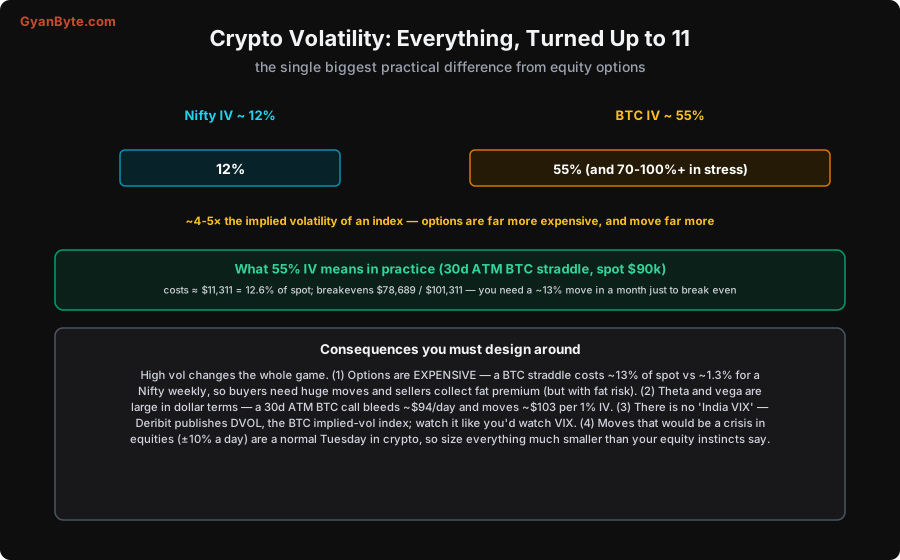
Put the two side by side: a Nifty weekly trades around 12% implied volatility; BTC runs around 55%, and spikes to 70–100%+ in stressed markets. That is 4–5× the IV of an index. Options are a bet on movement, so this changes everything about how they are priced and traded.
What does 55% IV actually cost? A 30-day ATM BTC straddle (spot $90,000) prices at:
straddle = ATM call + ATM put ≈ $5,656 + $5,656 = $11,311  = 12.6% of spot
breakevens: $78,689  /  $101,311
→ you need a ~13% move in a MONTH just to break even
Compare that to a Nifty weekly straddle costing ~1.3% of spot. A BTC option is roughly ten times more expensive in percentage terms — because BTC genuinely moves roughly ten times more.
The consequences you must design around
- Options are expensive. Buyers need big moves to profit (and crypto delivers them, but you must time it). Sellers collect fat premium — but with correspondingly fat risk. The high premium is compensation for real danger, not free money.
- Theta and vega are large in dollars. ~$94/day of decay and ~$103 per 1% IV on a single ATM BTC call. Vega especially matters — a move in DVOL moves your P&L a lot even if BTC sits still.
- There is no India VIX — there is DVOL. Deribit publishes DVOL, the BTC implied-volatility index (its “VIX”). Watch it as your daily read on whether options are cheap or expensive and whether fear is rising. When DVOL is high, premium-selling is tempting (but dangerous); when low, options are cheap to own.
- Size much smaller than your equity instincts say. A ±10% day is a crisis in equities and a normal Tuesday in crypto. Whatever size feels right from equity experience, cut it substantially.
Volatility is still mean-reverting — around a higher mean
The good news: the core principle from the options course still holds. Crypto volatility is mean-reverting — big DVOL spikes (panic, liquidation cascades) calm down, and long quiet stretches eventually break. So the same logic applies: sell premium when IV/DVOL is high (and likely to fall), buy or go long vol when it is low. The difference is only that the “mean” is 50–60% instead of 12%. Use IV rank / DVOL percentile the same way you used it for Nifty — just on crypto’s much higher scale.
# is BTC IV high or low right now? (DVOL percentile over the last year)
def dvol_percentile(dvol_history, dvol_now):
    below = sum(1 for v in dvol_history if v < dvol_now)
    return below / len(dvol_history)      # 0.8 => IV is near the top of its range
Pitfalls
- Bringing equity position sizes. BTC moves ~4–5× an index. The same notional is far riskier — size down hard.
- Selling premium just because it’s fat. High IV is fat for a reason: crypto can gap 20–50%. Fat premium = fat risk. Defined-risk or small/hedged only.
- Ignoring DVOL. Trading crypto options without watching the vol index is like trading blind. It’s your cheapest daily signal.
Recap
Crypto’s defining trait is volatility ~4–5× an index’s (BTC IV ~55% vs ~12%). Options are expensive (a 30d BTC straddle ≈ 13% of spot, needing a ~13% move to break even), theta/vega are large in dollars, and there is no India VIX — watch DVOL. Volatility is still mean-reverting, so sell high and buy low — around a much higher mean. Above all: size much smaller.
Next: Lesson 7 — Income & Directional Strategies, applying the payoff shapes you know to BTC and ETH.