If you learn one thing in this course deeply, make it this lesson. The perpetual future is the most-traded instrument in crypto, and its funding rate is the market’s heartbeat — it shows up in pricing, in strategy, and in risk everywhere.
What is a perpetual future?
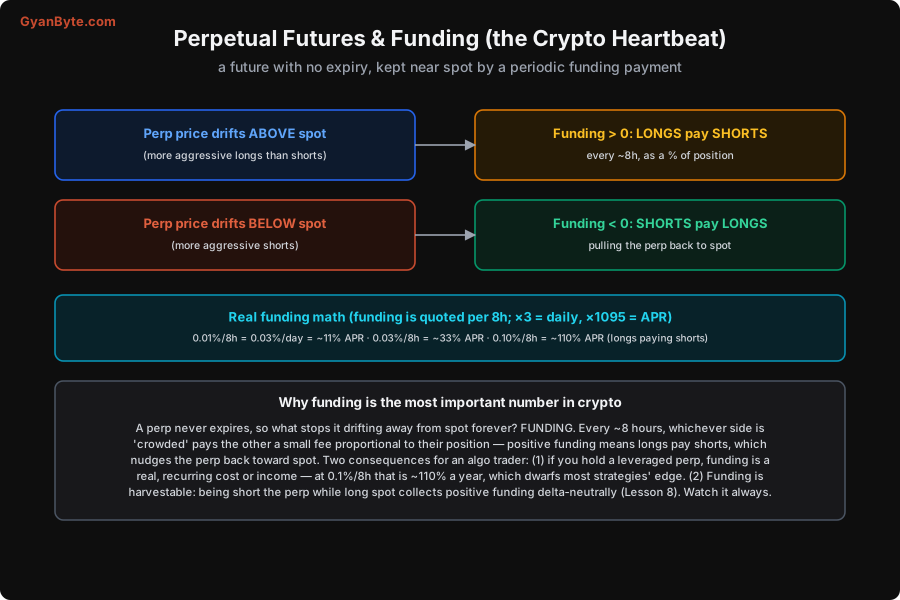
A normal future has an expiry date, and at expiry its price must converge to spot. A perpetual future has no expiry — you can hold it forever. That is convenient, but it raises a puzzle: with no expiry forcing convergence, what stops the perp price drifting away from spot and never coming back? The answer is a clever mechanism: the funding rate.
How funding works
Every ~8 hours (the interval varies by exchange), a funding payment is exchanged directly between traders — the exchange just facilitates it:
- When the perp trades above spot (more aggressive buyers), funding is positive and longs pay shorts. This makes being long slightly costly and being short slightly rewarding, nudging the perp back down toward spot.
- When the perp trades below spot, funding is negative and shorts pay longs, nudging it back up.
So funding is a self-correcting tether between the perp and spot. The rate is small per interval but adds up. It is quoted per 8 hours, so to annualise: rate × 3 (per day) × 365:
0.01% / 8h  =  0.03% / day  ≈   11% APR
0.03% / 8h  =  0.09% / day  ≈   33% APR
0.10% / 8h  =  0.30% / day  ≈  110% APR      (longs paying shorts)
Those are large numbers. For a leveraged holder, funding is a real, recurring cost or income that can easily dwarf whatever directional edge you think you have. In a hot bull market, longs can pay 50–100%+ annualised just to hold — which is also the opportunity behind the delta-neutral funding-capture trade (Lesson 8).
# annualise a funding rate (per 8h) seen on the exchange
def funding_apr(rate_8h):
    return rate_8h * 3 * 365     # 3 funding windows a day

funding_apr(0.0001)   # 0.01%/8h -> 0.1095  (~11% APR)
Leverage, mark price and liquidation
Perps are traded with leverage — you post a fraction of the position as margin and the exchange lends you the rest. 10x leverage means a 10% move against you wipes out your margin. This is the fastest way crypto accounts die.
Two mechanics keep leverage honest:
- Mark price. Your P&L and liquidation are calculated off a mark price — an index derived from multiple spot exchanges — not the perp’s last trade. This stops a single manipulated print on one venue from unfairly liquidating people. Always know the difference between last price and mark price.
- Liquidation. If the market moves enough that your margin can no longer cover your losses, the exchange liquidates you — force-closes the position, usually at a bad price, and charges a liquidation fee. Your liquidation price is the level at which this happens, and watching it is a core survival skill. Higher leverage = closer liquidation price = less room to breathe.
The lesson that keeps you alive: use low leverage. The volatility of crypto (Lesson 6) means even “modest” leverage liquidates easily on a normal 10–20% day. Many experienced crypto traders use 2–3x at most, and watch their liquidation distance constantly.
Pitfalls
- Underestimating funding. At 0.1%/8h, funding alone costs ~110% a year. A “winning” leveraged long can still lose to funding. Always check the current rate before holding.
- High leverage in a 24/7 market. A 3am wick can liquidate a 10x position before you wake up. Low leverage, with alerts on your liquidation price.
- Confusing last price and mark price. Liquidation runs off mark price; a fast last-trade spike isn’t the whole story.
Recap
A perpetual future is a leveraged future with no expiry, held near spot by the funding rate — longs pay shorts when positive, shorts pay longs when negative, every ~8h. Funding annualises to large numbers (11–110%+ APR), so it is a major cost/income and a harvestable edge. Perps use leverage with a mark price and a liquidation level; low leverage and watching your liquidation distance are survival skills.
Next: Lesson 4 — Crypto Options Basics, where the options knowledge from the other course meets crypto’s quirks.