Finally, the part that is ours. Crypto is, honestly, the best market there is to learn algorithmic trading on — not because it is safe (it is not), but because it is the most programmable. Open APIs, free real-time data, 24/7 uptime, and one library that talks to everything.
The stack
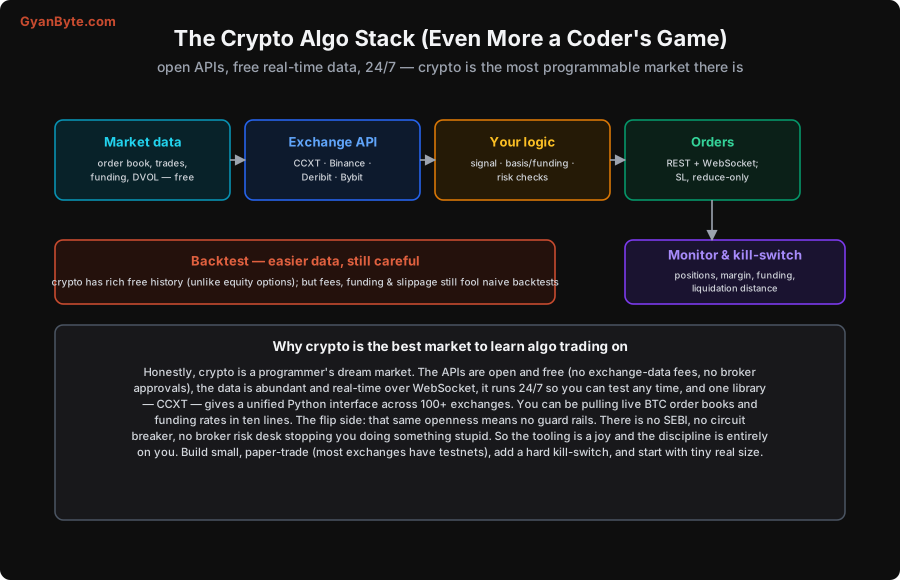
The components you will build:
- Market data — order book, trades, funding rate, DVOL, and the options chain. All available free, in real time, over WebSocket from the exchanges themselves.
- Exchange API — CCXT is the key tool: one unified Python (and JS) interface across 100+ exchanges for market data and orders. For deeper features (options on Deribit, perp-specific order types) you may use the exchange’s native SDK too — Binance, Deribit, Bybit, OKX all have good ones.
- Your logic — the signal (funding threshold, basis, a vol condition), plus risk checks.
- Orders — place/modify/cancel over REST + WebSocket, using reduce-only flags and stop types. Handle rejects and partial fills.
- Monitor — positions, margin and liquidation distance, funding accrual, P&L — and a kill-switch that flattens everything.
REST vs WebSocket, and a CCXT taste
For live trading, use WebSocket for streaming data (order book, trades, your fills) rather than polling REST in a loop — it is faster, lighter, and won’t hit rate limits. Use REST for one-off actions (placing an order, fetching history).
import ccxt

ex = ccxt.binance()                       # or deribit(), bybit(), okx()...
ob     = ex.fetch_order_book("BTC/USDT")  # live order book
ticker = ex.fetch_ticker("BTC/USDT")      # last, bid, ask, volume
funding = ex.fetch_funding_rate("BTC/USDT:USDT")   # perp funding (unified)

best_bid, best_ask = ob["bids"][0][0], ob["asks"][0][0]
spread = best_ask - best_bid
# ten lines and you have live BTC data from any of 100+ exchanges
That is the edge in a snippet — abundant, free, real-time data behind a clean API, something equities make slow and expensive.
Backtesting crypto (easier, still tricky)
Here is a genuine advantage over equity options: crypto has rich, free historical data — years of candles, and often order-book and funding history. So backtesting is more accessible than the painful world of historical equity option chains. But do not get complacent:
- Fees on crypto are not tiny, and on multi-leg or high-frequency strategies they dominate. Model them.
- Funding must be included in any perp backtest — ignoring it can turn a losing strategy into a fake winner.
- Slippage and liquidity — the backtest assumes fills that live trading won’t always give, especially in size or on thin venues.
- Survivorship — exchanges and tokens vanish; a backtest over only survivors flatters you.
As always, forward paper-trading on an exchange testnet beats a pretty backtest.
The discipline
The tooling is a joy precisely because there are no guard rails — no regulator, no circuit breaker, no broker risk desk stopping you doing something stupid. So the discipline is entirely yours:
- Build small — a data feed and risk monitor first.
- Paper-trade on a testnet for weeks (Binance, Deribit, Bybit all have them).
- Add a hard kill-switch that flattens every position and stops trading on any error or weird state.
- Go live tiny, and scale extremely slowly — only if it genuinely works after fees and funding.
Pitfalls
- Polling REST for live data. You’ll hit rate limits and lag. Use WebSocket streams for anything real-time.
- Backtests that ignore fees and funding. The two biggest ways a crypto backtest lies. Include both, always.
- Going live without a tested kill-switch. In a 24/7 market a bug can bleed money while you sleep. The flatten-everything button is non-negotiable.
Recap
The crypto stack — market data → exchange API → your logic → orders → monitor — is all open, free, real-time code, with CCXT unifying 100+ exchanges. Use WebSocket for live data. Backtesting is easier than equity options thanks to free history, but fees, funding, slippage and survivorship still fool the careless. Build small, paper-trade on testnets, add a kill-switch, go live tiny. The openness is a gift; the discipline is on you.
Next: Lesson 12 — Build a Crypto Algo, putting it all together into a delta-neutral funding-capture bot.