Now the trades that feel most like proper quant work — and that are, honestly, where a lot of disciplined crypto money is actually made. These are delta-neutral: they do not bet on BTC going up or down. Instead they harvest a structural yield that exists because crypto is so hungry for leverage.
The two trades
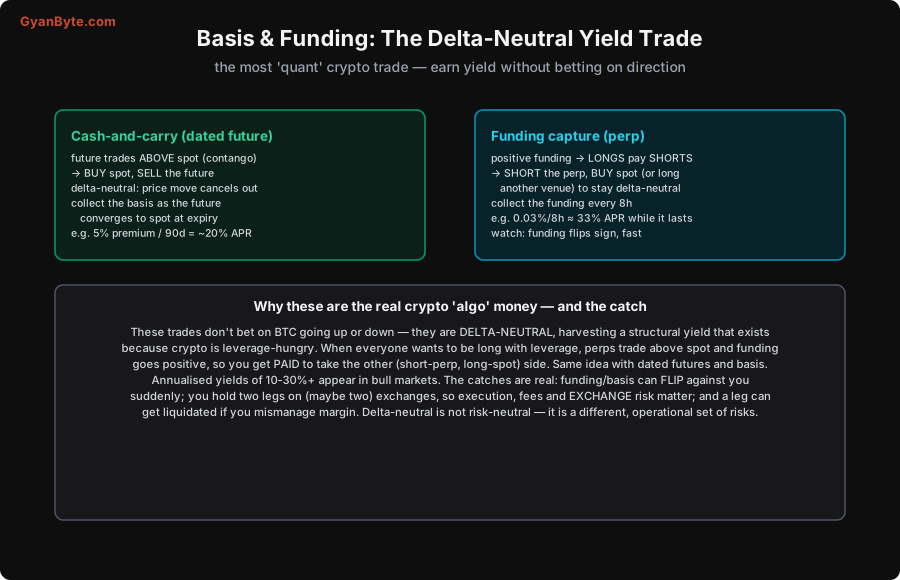
Cash-and-carry (dated futures)
When a dated future trades above spot (a state called contango), you can lock in that gap:
- Buy spot BTC and sell the dated future in equal size.
- This is delta-neutral: if BTC rises, your spot gains and your short future loses the same — they cancel. You are not betting on direction at all.
- At expiry the future converges to spot, and you collect the basis (the premium you sold) as pure yield.
Future trades 5% above spot, 90 days to expiry:
  annualized yield = 5% × (365 / 90) ≈ 20% APR,  delta-neutral
Funding capture (perps)
The same idea using perps and funding (Lesson 3):
- When funding is positive (longs pay shorts), short the perp and buy an equal amount of spot (or go long on another venue) to stay delta-neutral.
- You collect the funding payment every 8 hours while remaining market-neutral.
Funding 0.03% / 8h held delta-neutral:
  ≈ 0.09% / day ≈ 33% APR  (while the rate stays positive)
Why the yield exists (and why it’s not free)
This is not magic or a mispricing — it is a structural yield. Crypto is full of traders who desperately want to be long with leverage. To do that, they buy perps and dated futures, pushing those above spot and funding positive. Someone has to take the other side, and that someone gets paid for it. So cash-and-carry and funding capture are really you providing leverage to the crowd and collecting the fee. In bull markets these yields reach 10–30%+ annualised.
But delta-neutral is not risk-neutral — the risks are just different, and operational:
- Funding/basis can flip. Positive funding can turn negative suddenly (a sharp sell-off), and now you are paying. You must monitor and be ready to exit.
- Two legs, maybe two exchanges. You hold spot on one venue and the perp/future on another. Execution, transfer latency, fees on both legs, and — crucially — exchange risk on each venue all apply. Fees alone can eat the whole edge if you are not careful.
- Liquidation. The short-perp leg uses margin. A sharp rally can liquidate it if you run too much leverage or don’t top up margin — and a half-closed hedge is suddenly a naked directional bet.
- Capital efficiency and transfers. Moving collateral between venues takes time and costs money; during that window you may be unhedged.
So the trade is “simple” in idea and demanding in execution — which is exactly why it suits a careful programmer with good risk code, and punishes a casual one.
Pitfalls
- Ignoring fees. Two legs, entry and exit, on two venues — fees can exceed the funding/basis you collect. Model them precisely before trading.
- Over-leveraging the perp leg. A rally liquidates your short and leaves you long spot only — now you’re directional and probably losing. Keep leverage low, watch the liquidation price.
- Assuming funding stays positive. It flips, sometimes violently. Have an exit rule and automate it — this is a 24/7 trade.
Recap
Cash-and-carry (buy spot, sell a dated future, collect the basis) and funding capture (short the perp, long spot, collect funding) are delta-neutral yield trades, earning 10–30%+ APR in bull markets because crypto is leverage-hungry and you get paid to take the other side. The catches are operational: funding/basis can flip, you juggle two legs across venues, fees eat the edge, and the perp leg can be liquidated. Delta-neutral is not risk-neutral.
Next: Lesson 9 — Advanced & DeFi Options, including delta-hedged volatility selling and on-chain options.