Low-Latency Trading Systems & Algo Trading — From the Order Book to a Live Retail Algo
How electronic trading systems really work and how to build an algo responsibly: the limit order book and matching engine, market data (ticks vs depth, WebSocket practices), the low-latency engineering (ring buffers, lock-free vs thread locks, C++ vs Python — all measured), the latency stack and co-location, ultra-low-latency hardware (FPGA, kernel bypass, microwave, direct lines), a real system architecture (React, Python, C++, Redis, PostgreSQL), a multi-broker framework, honest backtesting, strategies including options selling, transaction costs and slippage, trading psychology, and taking a retail algo from paper to live — and onto crypto. Grounded in real, reproducible measurements. Educational, not financial advice.


Almost everything written about high-frequency trading is either breathless (“microseconds! millions!”) or secretive (“the firms won’t tell you”). This course takes a different path: it explains how electronic markets and trading systems actually work, as engineering, and then helps you build an algo you can realistically run — a retail algo in India, on a broker API, with the discipline and risk controls that separate a system from a gamble.
Two honest framings shape the whole thing. First, real HFT is mostly out of reach — it runs on C++, FPGAs, co-located servers and microsecond budgets, and the best firms keep their methods private. I’ll explain that world accurately from public knowledge (and you’ll understand it deeply), but I won’t pretend to teach “how Jane Street does it”. Second, retail algo trading is something you genuinely can do — and that’s where the hands-on parts live: market data, an order book, a matching engine, backtesting, strategies, costs, and a live system you build and run. Covering both sides is what makes this useful and truthful.
It’s written in plain Indian English with Indian markets in mind (NSE/BSE, F&O, SEBI’s retail-algo rules, broker APIs like Zerodha Kite Connect), and it’s grounded in real measurements I ran on a plain machine — a working order book at ~825k orders/sec, a C++ vs Python hot loop (~257× difference), the cost of a contended thread lock, and backtests where a “money printer” turns into a loss once the cheating stops. Every lesson closes with pitfalls and a quick recap. Code is runnable in Python, with C++ where latency is the point.
One thing stated plainly and repeated throughout: this is educational material about building systems, not financial advice. Markets can take all your money. Nothing here is a recommendation to trade or a promise of profit.
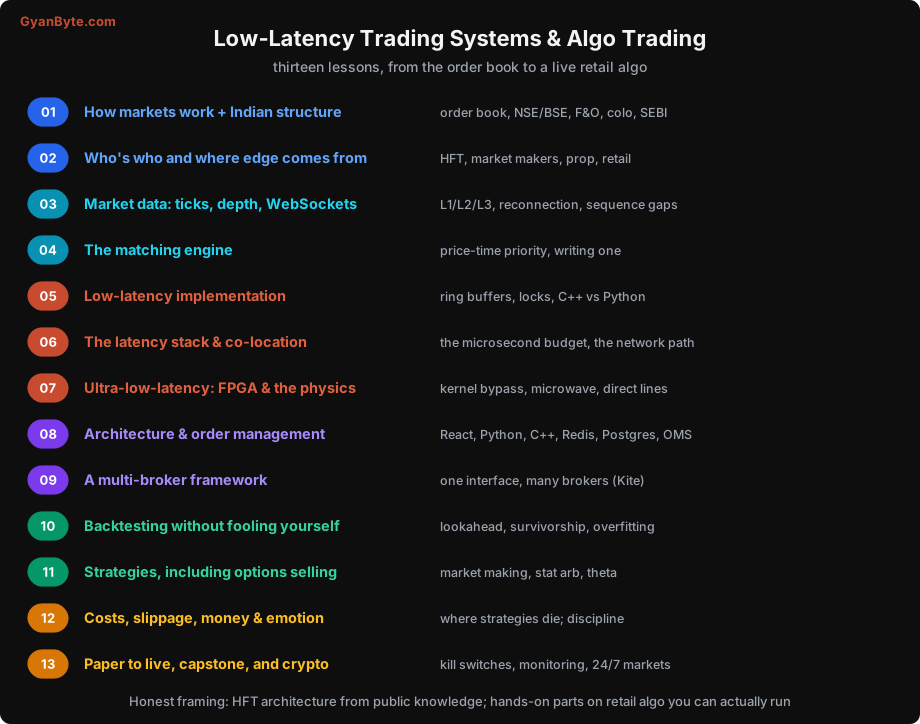
What This Course Covers
| # | Lesson | What you will learn |
|---|---|---|
| 1 | How Markets Work + Indian Structure | The limit order book, order types, NSE/BSE, F&O, colo, SEBI’s algo rules |
| 2 | Who’s Who and Where Edge Comes From | HFT, market makers, prop desks, retail — and the honest line |
| 3 | Market Data: Ticks, Depth, WebSockets | L1/L2/L3, building a book, reconnection and sequence gaps |
| 4 | The Matching Engine | Price-time priority, and writing a small one |
| 5 | Low-Latency Implementation | Ring buffers, lock-free vs thread locks, C++ vs Python (measured) |
| 6 | The Latency Stack & Co-location | The tick-to-trade budget and the network path |
| 7 | Ultra-Low-Latency: FPGA & the Physics | Kernel bypass, FPGAs, microwave links, direct lines |
| 8 | Architecture & Order Management | React, Python, C++, Redis, PostgreSQL; OMS, risk, kill switches |
| 9 | A Multi-Broker Framework | One interface, many brokers (Kite Connect as the example) |
| 10 | Backtesting Without Fooling Yourself | Lookahead, survivorship, overfitting — with live demos |
| 11 | Strategies, Including Options Selling | Market making, stat arb, momentum, and a short-straddle example |
| 12 | Costs, Slippage, Money & Emotion | Where strategies die; best practices, money and discipline |
| 13 | Paper to Live, Capstone, and Crypto | Promotion gates, monitoring, a mini system, and the same algo on crypto |
Who Is This For?
- Backend/systems engineers curious how electronic trading actually works, as engineering
- Aspiring retail algo traders who want to build it right — with real risk controls, not hope
- Anyone who’s read HFT hype and wants the honest, technical version
- Developers who want a concrete, measured take on C++ vs Python, lock-free data structures, and low-latency design
How to Use It
Read it in order the first time — it builds from the order book up to a running system. Then use it as a reference: when you’re designing the data path (Lesson 3), writing the engine (Lessons 4–5), choosing hardware (Lesson 7), laying out the architecture (Lesson 8), or validating a strategy (Lessons 10–12), come back to that lesson. Keep the pitfalls sections handy — trading is mostly a story of expensive, avoidable mistakes.
Let’s start where every market starts: with the order book.