Now the part everyone wants: the strategies. But notice we got here last among the strategy-adjacent lessons — after data, engines, architecture, and especially honest backtesting (Lesson 10) — because a strategy is worthless without the discipline to evaluate it and the system to run it safely. With that foundation, let’s look at the classic strategy families and what each really bets on, then spend real time on options selling, which dominates Indian retail algo trading and deserves a careful, honest treatment because its risks are so easily underestimated.
The usual reminder, and it’s especially pointed here: this is educational material about how strategies work, not financial advice or a recommendation to trade any of them. Every strategy below can and does lose money.
The Four Classic Families
Most systematic strategies are variations on four themes. Each is a bet on a different behaviour of markets, with a different risk when that behaviour fails — and each only works if it has a real, nameable edge (Lesson 2).
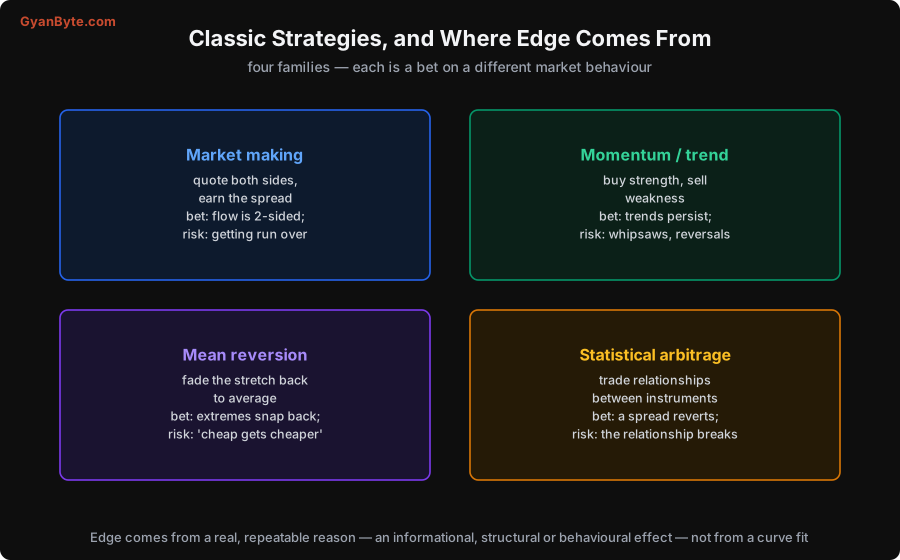
- Market making. Quote both a bid and an ask, aiming to earn the spread from the flow that trades against you (Lesson 1, Lesson 2). The bet: order flow is two-sided and you’ll buy low and sell high repeatedly. The risk: getting “run over” — the market moves hard one way, everyone trades against you in that direction, and you’re left holding a losing position (adverse selection / inventory risk). This is a structural edge (you’re paid to provide liquidity) but it’s speed-sensitive, so the pure fast version is HFT territory (Lesson 2).
- Momentum / trend following. Buy what’s going up, sell what’s going down. The bet: trends persist — a move tends to continue. The risk: whipsaws — choppy, directionless markets where you keep buying tops and selling bottoms, and sharp reversals. A behavioural edge (people chase trends and underreact to news).
- Mean reversion. Fade extremes — sell what’s stretched far above its average, buy what’s fallen far below, betting it snaps back. The bet: prices revert to a mean. The risk: “cheap gets cheaper” — sometimes the extreme is the start of a big move, not a reversal, and fading it is catastrophic. Also a behavioural edge (people overreact).
- Statistical arbitrage. Trade the relationship between instruments — e.g. two historically correlated stocks drifting apart, betting the spread reverts (pairs trading). The bet: a statistical relationship holds. The risk: the relationship breaks (the companies diverge for a real reason) and the “reverting” spread just keeps widening.
Notice momentum and mean reversion are opposites — one bets moves continue, the other that they reverse. Both can work, on different instruments and timeframes, because they exploit different behaviours in different conditions. The art is knowing which regime you’re in and having a real reason to expect your chosen behaviour. Without a nameable edge (Lesson 2), none of these is anything but a coin flip paying costs.
Options Selling: a Serious, Honest Look
In India, options — especially index options with weekly expiries — are where enormous retail algo activity lives (Lesson 1), and a lot of it is options selling. It deserves careful treatment because it has a seductive, dangerous profile: it feels like easy, steady income, right up until it isn’t. Let’s use the classic example, a short straddle.
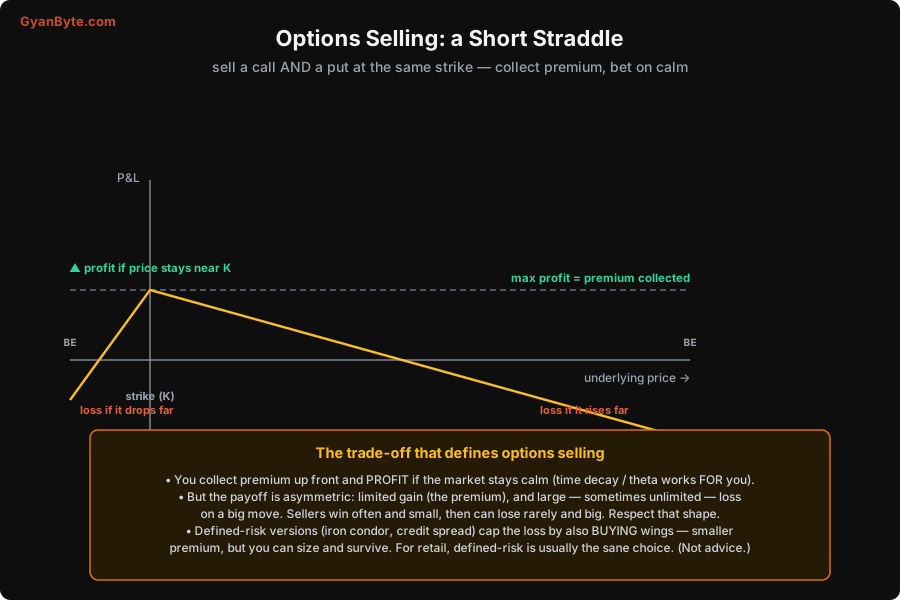
A short straddle: you sell a call and sell a put at the same strike (K), collecting premium from both. Read the payoff diagram:
- You collect premium up front — that’s your maximum profit, earned if the price stays near the strike at expiry.
- As time passes with the market calm, the options lose value and you keep more of the premium — time decay (theta) works for you. This is why sellers describe it as “getting paid to wait.”
- But the payoff is dangerously asymmetric: your gain is capped at the premium, while your loss grows the further the price moves from K in either direction — and for a naked straddle that loss is large, potentially unlimited on the upside and very large on the downside. Past the breakevens (strike ± premium), you’re losing money, and a violent move can lose many times the premium you collected.
The profile this creates is the crux: sellers win often and small, then lose rarely and big. Most expiries, the market stays calm-ish and you pocket the premium — a steady stream of small wins that feels like a reliable income and breeds overconfidence. Then one day the market gaps (a shock, a result, a global event) and a single move wipes out months of those small gains and more. This is the structural edge of options selling (you’re paid premium for bearing the risk of large moves — Lesson 2), and the losses are simply that risk showing up. The premium isn’t free money; it’s compensation for a real, occasionally brutal risk.
Because of that shape, two things are non-negotiable for anyone selling options:
- Position sizing and risk limits are everything (Lesson 8, Lesson 12). Size so that the rare big loss is survivable — not so that a calm month’s income is maximised. The seller’s graveyard is full of people who sized for the good months.
- Prefer defined-risk structures. Instead of a naked straddle, structures like an iron condor or credit spread also buy further-out options (“wings”) that cap the maximum loss. You collect less premium, but your worst case is known and bounded, so you can size sensibly and survive the bad day. For retail, defined-risk is usually the sane choice — the capped downside is worth the smaller premium many times over. (Still not advice — options can lose money fast, and even defined-risk positions carry real risk.)
The broader lesson options selling teaches, which applies to every strategy: understand the shape of your payoff, especially the tail. A strategy that wins 95% of the time can still be a long-term loser if the 5% is catastrophic. Always ask: what’s my worst case, how often does it happen, and can I survive it?
Choosing and Combining Strategies
A few closing principles that apply across all of the above:
- Every strategy needs a nameable edge (Lesson 2). “It backtested well” is not an edge; “I’m paid premium for bearing jump risk” or “people overreact to earnings” is.
- Match the strategy to your constraints. As retail (Lesson 1, Lesson 6), pick horizons where you’re not racing HFT. Market making’s fast version isn’t for you; a slower mean-reversion or a sized, defined-risk options strategy might be.
- Diversify behaviours. Momentum and mean reversion suffer in opposite conditions; running uncorrelated strategies smooths your equity curve — if each has a real edge.
- Costs decide everything (Lesson 12). A strategy’s gross edge means nothing until it survives brokerage, charges and slippage. Many of the above look great gross and lose net — which is exactly the next lesson.
Pitfalls to Avoid
- A strategy with no nameable edge. Market making, momentum, mean reversion and stat arb each need a real reason (structural/behavioural). Without one it’s a coin flip paying costs.
- Treating options-selling premium as free money. It’s compensation for tail risk. Sellers win often and small, then lose rarely and big.
- Naked options selling without defined risk. Uncapped loss can wipe out months of gains in one move. Prefer defined-risk structures (condors, spreads).
- Sizing for the good months. Size so the rare big loss is survivable, not so calm-month income is maximised (Lesson 8, Lesson 12).
- Ignoring the tail of the payoff. A 95%-win strategy can still be a long-term loser if the 5% is catastrophic. Know your worst case.
- Fighting your own regime. Momentum in chop and mean reversion in a trend both bleed. Know which behaviour you’re betting on and whether conditions suit it.
- Forgetting costs. Gross edge is not net edge (Lesson 12). A strategy isn’t real until it survives realistic costs and slippage.
Quick Recap
- Four families, each a bet on a behaviour: market making (earn the spread), momentum (trends persist), mean reversion (extremes snap back), stat arb (a relationship reverts) — each needs a nameable edge (Lesson 2).
- Options selling (big in India): a short straddle collects premium and profits if the market stays calm (theta works for you), but the payoff is asymmetric — limited gain, large/unlimited loss.
- Sellers win often and small, lose rarely and big; the premium is pay for bearing tail risk, not free money.
- Size for survival and prefer defined-risk structures (iron condor, credit spread) that cap the loss — the sane retail choice.
- Always understand your payoff’s tail. Costs decide everything (next). Educational, not financial advice.
Next lesson: the thing that quietly kills more strategies than any other — transaction costs and slippage — plus the money habits and emotional discipline that decide who survives.