Two things kill far more trading strategies than bad signals: costs and emotions. A strategy can have a genuine edge and still lose money because costs eat it, or because the human running it panics, overrides it, or revenge-trades after a loss. This lesson is about both — the unglamorous arithmetic of costs and slippage that decides net profitability, and the psychology and money habits that decide whether you survive long enough for a real edge to pay off. It’s less exciting than strategy design, and far more important to your actual results.
A Gross Edge Is Not a Net Edge
Here’s the arithmetic that humbles every beginner. Your backtest shows a tidy average profit per trade — a “gross edge.” Then reality takes its cut, three times over, before you keep anything. I measured a realistic (illustrative) example to show how brutal this is.
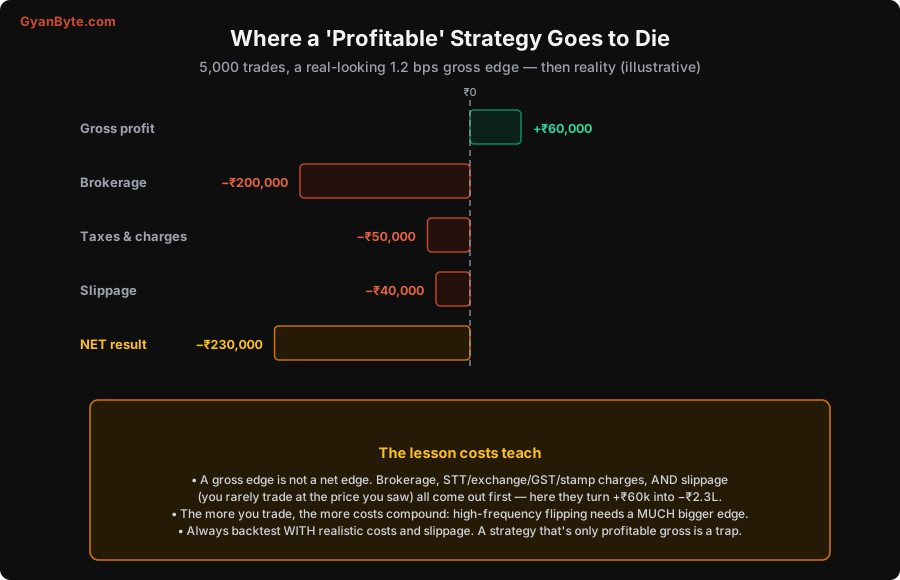
The example: 5,000 trades, ₹100,000 each, with a real-looking 1.2 basis-point gross edge per trade. The gross profit is +₹60,000 — looks like a working strategy. Then:
- Brokerage: −₹200,000. Even flat per-order fees add up fast across thousands of trades.
- Taxes & charges: −₹50,000. In India that’s STT, exchange transaction charges, GST, stamp duty — small per trade, large in aggregate.
- Slippage: −₹40,000. You rarely trade at the exact price you saw (Lesson 4): the market moves, your market order walks the book, your limit order fills at a worse average. This gap is a real, recurring cost.
Net result: −₹230,000. A strategy that looked profitable by ₹60k is actually a loss of ₹2.3 lakh once costs are honest. Nothing changed about the “edge” — only that we stopped ignoring what it costs to trade.
Three lessons from this:
- Always backtest with realistic costs and slippage (Lesson 10). A backtest that ignores them is science fiction. Most “edges” are smaller than their costs.
- The more you trade, the more costs compound. Costs scale with the number of trades, so high-frequency flipping needs a much bigger per-trade edge to overcome them. This is a core reason retail should favour fewer, higher-conviction trades over churning.
- Slippage is worst exactly when you most want to trade — in fast, volatile markets, on thin books. Model it pessimistically, and prefer liquid instruments with tight spreads (Lesson 1).
Costs are not a footnote; they’re often the whole game. Reducing them — trading less, paying less, slipping less — is itself one of the most reliable edges available to retail (Lesson 2).
Protecting Your Money, and Managing the Mind
Even with a real net edge, two human-sized forces decide whether you keep it: your money habits and your emotions.
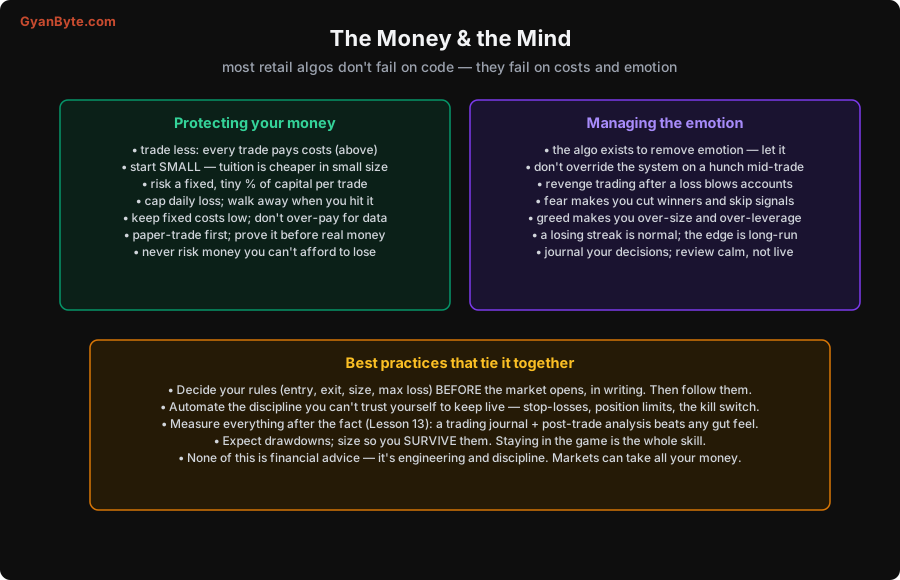
Protecting your money — the habits that keep you in the game:
- Trade less. Every trade pays costs (above). Fewer, better trades beat churning.
- Start small. Your first live money is tuition — pay the least for it. Scale up only as the system proves out (Lesson 13).
- Risk a fixed, tiny percentage per trade. Never bet so much on one trade that a loss hurts badly. Small, consistent risk per trade lets the edge play out over many trades without ruin.
- Cap your daily loss and walk away. A hard daily-loss limit (enforced automatically, Lesson 8) stops a bad day from becoming a disaster — and stops you from revenge-trading.
- Keep fixed costs low. Don’t over-pay for fancy data or tools you don’t need; those costs come straight out of returns.
- Paper-trade first (Lesson 13). Prove it on simulated money before risking real.
- Never risk money you can’t afford to lose. The oldest rule, and the most ignored. Markets can take all of it.
Managing the emotion — the forces that wreck even good systems:
- The algo exists to remove emotion — so let it. The entire point of systematic trading is to act without fear and greed. Overriding your own system on a live hunch defeats the purpose and is usually worse than following it.
- Don’t revenge-trade. After a loss, the urge to “win it back” with a bigger, impulsive trade has blown up more accounts than any strategy flaw. The daily-loss limit exists partly to save you from this.
- Watch fear and greed. Fear makes you cut winners early and skip valid signals; greed makes you over-size and over-leverage. Both turn a winning system into a losing one.
- Expect losing streaks. Even a genuine edge loses many times in a row sometimes — that’s normal, and the edge is a long-run average. People abandon good systems during a normal drawdown, locking in the losses and missing the recovery.
- Journal and review calm, not live. Keep a record of your decisions; review them when the market’s closed and your head is clear, not in the heat of a drawdown.
Best Practices That Tie It Together
The habits that turn all of the above into a durable practice:
- Decide your rules before the market opens, in writing — entry, exit, size, maximum loss — and then follow them. Decisions made calm, in advance, beat decisions made live, under pressure.
- Automate the discipline you can’t trust yourself to keep. This is the deepest reason to build a system: encode your stop-losses, position limits, daily-loss cap and kill switch (Lesson 8) in code, so they execute even when your live self would flinch. Automation’s real gift isn’t speed; it’s discipline.
- Measure everything after the fact (Lesson 13). A trading journal plus honest post-trade analysis — real slippage vs expected, which rules helped, where you deviated — beats any gut feeling about how you’re doing.
- Size so you survive drawdowns. Expect them, and size positions so the inevitable bad stretch doesn’t end you. Staying in the game is the whole skill — a modest edge compounds over years only if you’re still there.
And the honest frame, one more time: none of this is financial advice. It’s engineering and discipline. Even a well-built, well-tested system can lose money, and markets can take all of it. The goal of this lesson isn’t to promise profit; it’s to make sure costs and emotions don’t quietly destroy whatever edge you might have.
Pitfalls to Avoid
- Mistaking a gross edge for a net edge. Costs and slippage come out first and can turn profit into loss. Backtest with realistic costs always.
- Over-trading. Costs scale with trade count; churning needs a far bigger edge. Favour fewer, higher-conviction trades.
- Modelling slippage optimistically. It’s worst when you most want to trade. Be pessimistic; prefer liquid instruments.
- Risking too much per trade / no daily-loss cap. One oversized loss or one bad day can ruin you. Fixed tiny risk per trade; hard daily-loss limit, enforced in code.
- Overriding the system on a hunch, or revenge-trading. The algo exists to remove emotion; defeating it live is how good systems lose. Let it run; automate the discipline.
- Abandoning a good system in a normal drawdown. Losing streaks are expected; the edge is long-run. Size to survive them and stay in the game.
- Risking money you can’t afford to lose. Markets can take all of it. This is not financial advice.
Quick Recap
- A gross edge is not a net edge: measured, a +₹60k gross edge became a −₹230k net loss after brokerage, charges and slippage. The more you trade, the more costs compound.
- Protect your money: trade less, start small, risk a fixed tiny % per trade, cap daily loss, keep costs low, paper-trade first, never risk what you can’t lose.
- Manage emotion: let the algo remove it — don’t override on a hunch, don’t revenge-trade, don’t let fear/greed take over; losing streaks are normal.
- Best practice: decide rules in writing before the open, automate the discipline (stops, limits, kill switch), measure after the fact, and size to survive drawdowns.
- Staying in the game is the whole skill. Educational, not financial advice.
Next lesson, the last: putting it all together — taking a retail algo from backtest to paper to live carefully, monitoring and post-trade analysis, a capstone mini-system, and reusing the whole framework on crypto.