Before you build a strategy, you should know who’s on the other side of your trades and how they make money — partly so you’re realistic about what you can and can’t do, and partly because understanding how the professionals earn their keep teaches you where real edges come from. The single most valuable attitude this lesson can give you is honesty: about speed you can’t buy, and about “edges” that are really just curve-fit noise. That honesty will save you more money than any clever strategy.
The Four Kinds of Participants
Markets are a mix of players with very different tools, time horizons and sources of profit. Four broad groups cover most algorithmic activity.
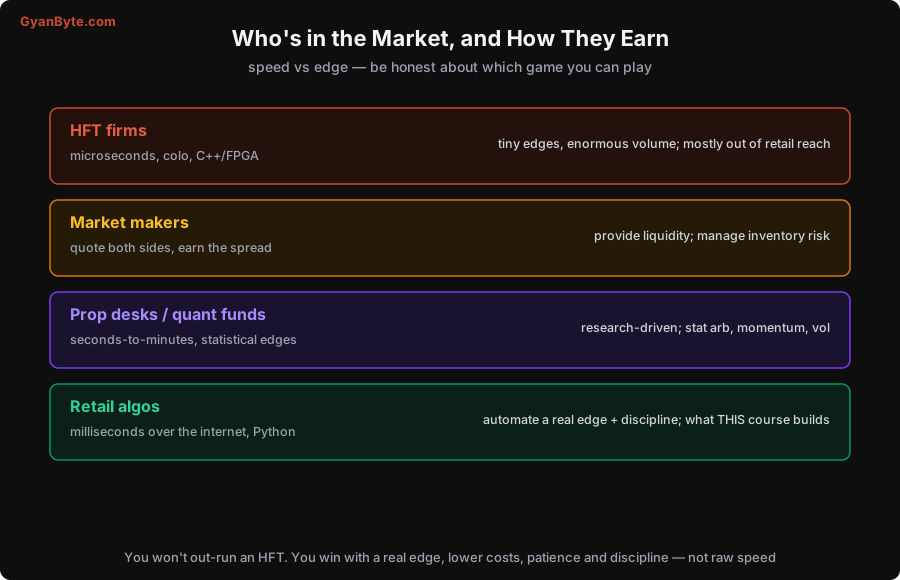
- HFT firms play the speed game: microseconds, colocation, kernel bypass, C++ and FPGAs (Lessons 6–7). They make a tiny amount per trade but trade an enormous number of times, profiting from fleeting price discrepancies, latency arbitrage, and ultra-fast market making. This world is essentially closed to retail — the capital and infrastructure barriers are huge — but understanding it tells you which games not to try to play.
- Market makers continuously quote both a bid and an ask, aiming to earn the spread (Lesson 1) on the flow that trades against them. They provide liquidity (a genuinely useful service) and manage inventory risk — the danger of being left holding a position when the price moves. Some HFT firms are market makers; so are dedicated firms. The principle (get paid the spread for providing liquidity) is one retail options sellers echo in Lesson 11.
- Prop desks and quant funds trade their own capital on statistical edges over horizons from seconds to days — statistical arbitrage, momentum, volatility strategies, relative value. They’re research-driven, hunting for repeatable patterns with real analytical work, and they operate at speeds where being fast helps but isn’t the whole game.
- Retail algos — you. You trade over the public internet in milliseconds, usually in Python, automating a strategy a single person or small team has researched. Your advantage isn’t speed or scale; it’s the ability to automate a real edge and, crucially, your own discipline (Lesson 12), running a tested system without emotion. That’s what this course builds.
The Honest Truth About Competing
Here’s the message to internalise before you write a line of strategy code: you will not out-run an HFT, so don’t build a strategy that requires it. If your edge depends on reacting to a price change faster than everyone else, you’ve already lost — someone with a colocated FPGA saw it microseconds before your packet even left your ISP. Trying to win the latency race from a laptop is the single most common way beginners waste time and money.
So what can you compete on? Four things, none of which is raw speed:
- A real edge — a repeatable reason your strategy makes money (below). This is the big one.
- Lower costs — trading less, paying less, slipping less (Lesson 12). Costs quietly decide who’s profitable; being disciplined about them is an edge in itself.
- Patience — picking horizons (minutes, hours, days) where you’re not competing with microsecond players, and waiting for genuinely good setups rather than overtrading.
- Discipline — following a tested system without the fear, greed and revenge-trading that wreck human traders (Lesson 12). Automation’s real gift is removing emotion.
This isn’t a consolation prize. Plenty of edges live at slower horizons where HFT doesn’t operate, and plenty of retail traders lose not because they’re slow but because they have no real edge and poor discipline. Fix those two and speed rarely matters.
Where Edge Actually Comes From
This is the most important idea in the lesson, and the one most beginners get wrong. An edge is a reason your strategy makes money more often than not — and a real edge always traces back to one of three sources:
- Informational edge — you know something relevant faster or better than the market has priced in. For HFT that’s seeing an order flow microseconds early; for a slower trader it might be better data, better analysis, or a faster read on news. Hard to come by, and the fast version is closed to retail.
- Structural edge — you’re paid to do something useful or to bear a risk others don’t want. Market makers earn the spread for providing liquidity; option sellers earn premium for bearing the risk of large moves (Lesson 11). The edge is compensation for a real service or risk, not a free lunch.
- Behavioural edge — you exploit a consistent human bias: people overreact to news (mean reversion), chase trends (momentum), or misprice fear (volatility). These edges exist because human behaviour is predictable in aggregate — but they’re crowded and they decay as others find them.
Here’s the test that will save you from countless bad strategies: if you can’t name the economic reason your edge exists — informational, structural, or behavioural — you probably don’t have an edge; you have an overfit backtest. A pattern you found by searching thousands of parameter combinations, with no story for why it should work, is almost always noise that won’t repeat with real money (Lesson 10 shows this happening, measured). Before you trust any strategy, ask: who is paying me, and why would they keep doing it? If there’s no good answer, walk away.
A Realistic Self-Assessment
So where does that leave you as a retail algo builder? In a genuinely workable spot, as long as you’re honest:
- Pick slower horizons (minutes to days) where you’re not racing HFT.
- Base every strategy on a nameable edge with an economic reason, not a fitted curve.
- Win on costs and discipline — trade less, pay less, slip less, and let the system remove your emotions.
- Respect the professionals — they’re smart, well-resourced, and on the other side of your trades. Humility keeps you solvent.
That’s not pessimism; it’s the mindset that lets a retail algo actually work instead of quietly bleeding money. The rest of the course gives you the tools — but this honesty is the foundation.
Pitfalls to Avoid
- Trying to win on speed. You can’t out-run an HFT from a laptop. Choose horizons and strategies where speed isn’t the edge.
- Having an “edge” with no reason. If you can’t name it as informational, structural, or behavioural, it’s probably overfit noise (Lesson 10).
- Ignoring costs and discipline as edges. Lower costs and emotion-free execution are real, durable advantages — don’t overlook them.
- Underestimating the competition. The other side is often a well-resourced professional. Respect that; trade humbly.
- Overtrading for excitement. Patience is an edge; churning trades just feeds costs (Lesson 12).
- Mistaking understanding for a licence to trade. Knowing how markets work is not financial advice or a profit guarantee.
Quick Recap
- Four players: HFT (microseconds, tiny edges × huge volume), market makers (quote both sides, earn the spread), prop/quant (statistical edges, seconds-to-days), retail algos (automate a real edge + discipline).
- You won’t out-run an HFT — compete on a real edge, lower costs, patience and discipline, not speed.
- A real edge has a reason: informational, structural, or behavioural. No reason → it’s almost certainly an overfit backtest.
- Ask of any strategy: who pays me, and why would they keep paying? If there’s no answer, walk away.
- Educational only — not financial advice.
Next lesson: the raw material of every strategy — market data. We’ll cover ticks vs depth, building an order book from a live feed, and the WebSocket practices that keep that feed honest.