

Every field has a vocabulary you must own before anything else makes sense, and algorithmic trading is worse than most: it is dense with jargon, and a lot of it is used loosely. The good news is that almost all of it hangs off one picture — the limit order book — plus a handful of order-type words. Learn this page and the rest of these articles (and most trading writing) will read easily. Keep it as a reference.
A note up front: this is educational material about how markets and trading systems work — not financial advice, and not a recommendation to trade. Markets can take all your money.
The one picture: the limit order book
A modern electronic market is a limit order book — a live list of all the resting buy and sell orders, sorted by price. It is the single most important thing to understand, because every term below is defined in relation to it.
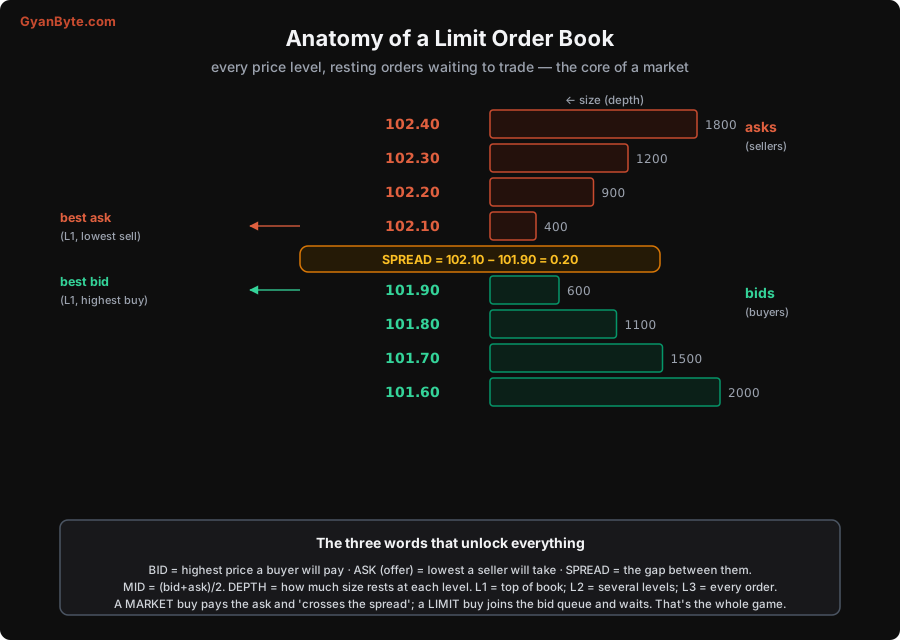
The words you must know, all visible in that picture:
- Bid — the highest price a buyer is currently willing to pay.
- Ask (or offer) — the lowest price a seller is willing to accept.
- Spread — the gap between best bid and best ask (
ask − bid). It is the instant cost of a round trip, and a core measure of liquidity: tight spread = liquid, wide spread = illiquid. - Mid — the midpoint,
(bid + ask) / 2. The usual “fair price” reference. - Depth — how much size (quantity) rests at each price level. A deep book absorbs big orders without moving much; a thin one jumps.
- Levels (L1 / L2 / L3) — how much of the book you can see. L1 is the top of book (best bid/ask + last trade). L2 is several levels of depth on each side. L3 is every individual order. More detail costs more money and storage (see the market-data sources article).
- Liquidity — loosely, how easily you can trade size without moving the price. High liquidity = tight spread + deep book.
That’s the heart of it. A trade happens when an incoming order crosses — a buy order priced at or above the best ask, or a sell at or below the best bid — and the exchange’s matching engine pairs it with resting orders by price-time priority (best price first; ties broken by who was there first).
The orders you actually send
You interact with that book by sending orders. There are only a few types, and the difference between them is the single most important practical choice in trading.
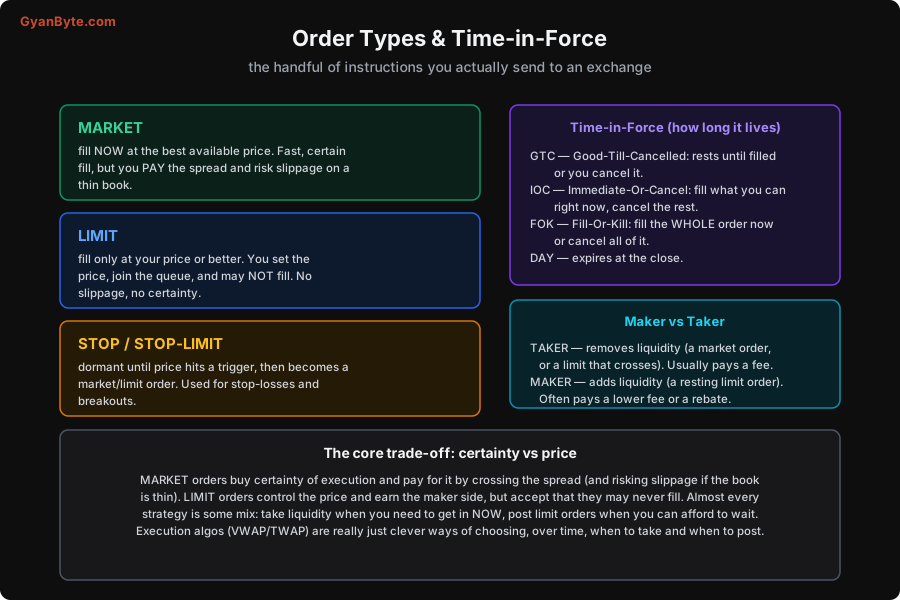
- Market order — “fill me now at the best available price.” You get a near-certain, immediate fill, but you pay the spread and risk slippage if the book is thin. You are a taker (you remove liquidity).
- Limit order — “fill me only at this price or better.” You control the price and join the queue at that level — but you might never fill if the market moves away. A resting limit order is a maker (you add liquidity), and often pays a lower fee or a rebate.
- Stop / stop-limit — a dormant order that activates when the price hits a trigger, then becomes a market or limit order. Used for stop-losses (get me out if it drops to X) and breakout entries.
Time-in-force (TIF) says how long an order lives:
- GTC — Good-Till-Cancelled: rests until it fills or you cancel it.
- DAY — expires at the market close.
- IOC — Immediate-Or-Cancel: fill whatever you can right now, cancel the rest.
- FOK — Fill-Or-Kill: fill the whole order immediately, or cancel all of it.
The core trade-off running through all of this: market orders buy certainty of execution and pay for it by crossing the spread; limit orders control the price but accept that they may not fill. Almost every strategy is some mix of the two, and execution algorithms like VWAP and TWAP are really just clever ways of deciding, over time, when to take and when to post.
The rest of the vocabulary, quickly
With the book and orders understood, the remaining terms are quick:
- Tick — the smallest price increment an instrument can move (e.g. ₹0.05). Also used loosely to mean “one trade/quote update.”
- Lot / contract — the standard trade unit (1 lot of a Nifty option, 100 shares, etc.).
- Slippage — the difference between the price you expected and the price you got. Caused by the spread, market impact, and latency. It quietly eats strategy returns (the trading course has a whole lesson on how it turns a gross profit into a net loss).
- Market impact — how much your own order moves the price against you. Big orders have more impact, which is why you slice them (execution algos).
- Latency — the time between an event and your reaction to it. In HFT it’s measured in microseconds; for most people it doesn’t matter nearly as much as they think.
- OHLCV — Open, High, Low, Close, Volume: a price “bar” or “candle” for a time window (1-minute, daily). The basic unit of most backtests.
- VWAP — Volume-Weighted Average Price: the average traded price over a period, weighted by volume. Both a benchmark (“did I beat VWAP?”) and an execution algorithm.
- TWAP — Time-Weighted Average Price: the simple average over time; also an execution schedule that trades evenly.
- Long / short — long = you own it and profit if it rises; short = you borrowed and sold it, profiting if it falls.
- Position / exposure — what you currently hold and how much you stand to gain or lose from a market move.
- PnL — Profit and Loss. Realised (from closed trades) vs unrealised (mark-to-market on open positions).
- Alpha — return from skill/edge, independent of the market. Beta — return that just comes from moving with the market. Strategies chase alpha.
- Sharpe ratio — return per unit of risk (volatility). Higher is better; it’s the headline score of a strategy. Above ~1 is good, above ~2 is excellent (and usually too good to be true in a backtest).
- Drawdown — the drop from a peak in your equity curve. Max drawdown is the worst peak-to-trough fall — the number that tells you whether you could actually have stomached the strategy.
- Backtest — simulating a strategy on historical data. Easy to do; easy to fool yourself with.
Where this fits
This cheat-sheet is the shared language for the rest of the series — the standard strategies (moving-average crossover, mean reversion, momentum), the execution algorithms, market making, position sizing, and the order-book imbalance signal — each with runnable Python. If you want the deeper, systems-level treatment (the matching engine, latency, co-location, building a live retail algo on an Indian broker), that’s the Low-Latency Trading Systems & Algo Trading course.
Bookmark this page, and when a term trips you up in the strategy articles, come back here. Once the order book and the order types are second nature, the rest of algo trading is just combinations of them.


