

You now have the whole toolkit: the signals interviewers score, the STAR structure, a story bank, the Leadership Principles, the question themes, the company playbooks, and the mistakes to avoid. This final lesson pulls it together — first by dissecting one full answer, then by giving you an exact plan to get ready.
A question, answered two ways
Take a question you will almost certainly be asked in some form:
“Tell me about a time you made a mistake that had a significant impact.”
The weak answer
“Hmm, let me think. So once we pushed a change and it caused some problems in production. We rolled it back and it was fine after that. I learned that you should test your code more carefully.”
Why it fails: no stakes you can feel, “we” throughout, no real action, no result, and a learning so generic it proves no self-awareness. The interviewer learns nothing about how you operate. Box unticked.
The strong answer, labelled
Here is the same kind of event told well. The labels in brackets are for you — you wouldn’t say them out loud, but you should be able to point to each part.
[Situation] “Early in my time on the billing team, I owned a change to how we calculated proration when customers upgraded mid-cycle. It passed review and tests and I shipped it on a Friday afternoon.
[Task] [signal: ownership] Over the weekend, support tickets started coming in about incorrect invoices. I was on call, and it was my change, so getting it right was on me.
[Action] [signal: bias for action, dive deep] I pulled the logs and confirmed my change had mis-rounded a currency conversion for a subset of upgrades — about 400 customers had been over-charged by small amounts. I rolled back immediately to stop the bleeding. Then, instead of just patching and moving on, I wrote a script to find every affected invoice, worked with finance to issue corrections, and personally drafted the customer notice so it was accurate and honest. [signal: earn trust] I also wrote the post-mortem the same week and owned it in the review without hedging.
[Result] [signal: impact, learn and be curious] All 400 customers were refunded within three days and we were transparent about it, so we lost no accounts over it. More importantly, I traced the root cause to us having no tests around currency rounding, so I added a property-based test suite for the money path and a rule that billing changes don’t ship on a Friday. In the two years after, we never had another proration incident.”
Notice what it proves: a real mistake with real stakes, total ownership, depth in the investigation, honesty under pressure, a measured result, and a concrete systemic fix. That is a strong answer to a failure question — far stronger than any “my weakness is I work too hard.”
A good answer runs two to three minutes. If yours runs longer, trim the Situation, never the Action or Result.
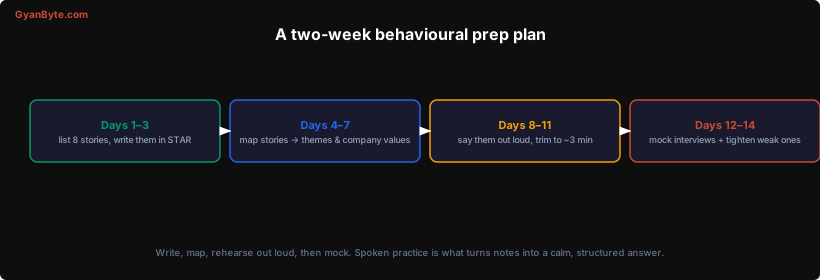
Your two-week prep plan
You don’t need months. Two focused weeks turns a pile of experiences into a confident, structured set of answers.
Days 1–3: Write your stories
Brainstorm the eight or so most significant things you’ve done — a launch you drove, a hard incident, a real disagreement, an ambiguous project you scoped, a mentoring win, a project that failed. Write each one out in full STAR. Writing matters: it forces you to find the Result and the specific actions. Dig up the real numbers now, while you have time to look them up.
Days 4–7: Map stories to themes and companies
Build the grid from Lesson 3: stories down the side, themes across the top (leadership, conflict, failure, ambiguity, impact, influence, prioritisation). Mark which story you’ll reach for on each. Fill any theme with no strong story. Then, for the specific company, map your best stories to its values — the Amazon Leadership Principles if it’s Amazon, or the emphasis from the company playbooks lesson otherwise.
Days 8–11: Say them out loud
This is the step most people skip, and it’s the one that works. Reading a story silently and telling it are completely different skills. Say each one out loud — to a friend, a camera, or an empty room — and trim it to about three minutes. You’ll hear the rambling, the missing result, and the stray “we” immediately. Practise the first fifteen seconds especially; a crisp opening sets the tone.
Days 12–14: Mock interviews
Have someone ask you questions cold, in a random order, with a follow-up or two (“why did you do it that way?”, “what would you do differently?”). Mocks reveal the gaps a solo rehearsal hides — the themes you’re thin on, the stories that collapse under a follow-up. Spend the last couple of days fixing those specific weak spots rather than polishing the ones that are already good.
The final-day checklist
- I have 8+ stories written in STAR, each with a concrete result.
- Every common theme has at least one strong story mapped to it.
- My stories map to the company’s values (Amazon LPs or equivalent).
- I can tell each story in ~3 minutes without a script.
- I lead with “I”, not “we”, and always land a result.
- My failure story is a genuine mistake with a real lesson.
- I have 2–3 questions ready to ask the interviewer at the end.
- I’ve done at least one full mock and fixed what it exposed.
You’ve finished the course
Behavioural interviews feel fuzzy and unfair until you see the structure underneath — and then they become as learnable as any algorithm. You now have the rubric, the STAR method, a story bank, the Leadership Principles, the question themes, the company playbooks, and the mistakes to avoid. The work from here is simple and it pays off: write your stories, map them, and say them out loud until they’re calm and tight.
This is the third pillar of your interview prep. Pair it with the Coding Interview Patterns course for the coding rounds and the Cracking the System Design Interview course for the design rounds, and you’ll walk into the full loop ready for every part of it. Good luck — you’ve got this.