

The list of behavioural questions floating around the internet is enormous and intimidating. “Tell me about a time you disagreed with your manager.” “Describe your biggest failure.” “When did you have to make a decision without all the information?” Trying to script a unique answer for each one is a losing game — there are hundreds of phrasings, and you’ll freeze the moment one is worded slightly differently from what you rehearsed.
The way out is to realise that nearly every behavioural question is a theme in disguise. There are only about six themes, each probing a specific signal. Prepare one strong story per theme, learn to recognise which theme a question belongs to, and you can field almost anything calmly.
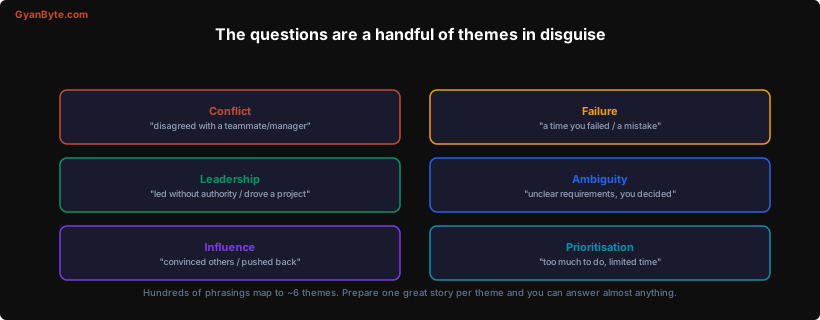
The six themes
1. Conflict
Example phrasings: “Tell me about a time you disagreed with a teammate / your manager.” · “Describe a conflict on your team and how you handled it.” · “When did you have to work with a difficult colleague?”
What it probes: Earn Trust, judgement, and emotional maturity. Can you disagree without being disagreeable? Do you attack the problem or the person?
How to answer well: Show that you sought to understand the other side first, brought data rather than opinion, found a path forward, and kept the relationship intact. Never badmouth the other person — the interviewer is imagining working with you, and a candidate who trashes colleagues is a risk.
2. Failure
Example phrasings: “Tell me about your biggest failure / a mistake you made.” · “Describe a time a project didn’t go as planned.” · “When did you miss a deadline?”
What it probes: Ownership, self-awareness, and whether you learn. This is the question candidates fear most, and the one where honesty wins.
How to answer well: Pick a real failure with genuine stakes — not a humblebrag like “I work too hard”. Own your specific part of it (not “the team”), explain what you learned, and show the concrete change you made so it wouldn’t happen again. The recovery and the lesson are the point.
3. Leadership
Example phrasings: “Tell me about a time you led a project.” · “When did you influence without authority?” · “Describe a time you drove something end to end.”
What it probes: Ownership and the ability to move a group, especially without formal power — the strongest signal for senior roles.
How to answer well: Show that you set direction, got buy-in, unblocked people, and were accountable for the outcome. Leading without authority (you weren’t the manager, but you drove it) is more impressive than leading because it was assigned to you.
4. Ambiguity
Example phrasings: “Tell me about a time the requirements were unclear.” · “When did you have to make a decision with incomplete information?” · “Describe a vague, open-ended problem you tackled.”
What it probes: Bias for Action and judgement under uncertainty. Senior engineers are expected to create clarity, not wait for it.
How to answer well: Show how you scoped the ambiguity — talked to stakeholders, made explicit assumptions, picked a reasonable path, and adjusted as you learned. The signal is that you moved forward sensibly instead of stalling.
5. Influence
Example phrasings: “Tell me about a time you convinced others of your idea.” · “When did you push back on a decision?” · “How did you get buy-in for a technical change?”
What it probes: Communication and the ability to drive change through persuasion, not mandate.
How to answer well: Show that you understood your audience’s concerns, built a case (often with a prototype or data), and brought people along. Ending with “and the approach is now the team standard” is a strong close.
6. Prioritisation
Example phrasings: “Tell me about a time you had too much to do.” · “How did you handle competing deadlines?” · “When did you have to say no to something?”
What it probes: Judgement about impact and the courage to make trade-offs.
How to answer well: Show that you ranked work by impact, communicated the trade-off to stakeholders, and consciously dropped or deferred the lower-value items. “I did everything and worked weekends” is a weaker answer than “I identified the two things that mattered and renegotiated the rest.”
Two mini worked answers
Failure (notice the ownership and the lesson):
“I owned the deploy of a caching change that I’d only tested on a small dataset. In production it evicted hot keys under real load and caused a 20-minute partial outage during peak traffic. I rolled it back, ran the incident review, and — this is the part I’d change — I realised I’d skipped load-testing because I was confident. I added a mandatory load-test gate to our deploy checklist and wrote a small traffic-replay harness the team still uses. We haven’t shipped a cache change without it since.”
Conflict (notice: understand first, data not opinion, relationship intact):
“A senior teammate wanted to build our own job scheduler; I thought we should use an existing one. Instead of arguing in the thread, I asked him to walk me through his requirements — and found he had a real concern about delayed-job precision that the off-the-shelf tool didn’t meet. So I prototyped both over two days and shared the numbers. The off-the-shelf tool was within tolerance for 95% of jobs, so we used it for those and built a tiny custom path only for the precision-critical ones. He was happy, we shipped faster, and we still pair on that service today.”
The pattern across all six themes is the same: a specific situation, your personal action, a real result, and — where relevant — a lasting improvement. Master the STAR structure, build one story per theme, and the “hundreds of questions” problem disappears.
Next: Lesson 6 — Company Playbooks.