

There are hundreds of possible behavioural questions and you cannot prepare an answer for each one. You don’t need to. The secret that separates calm, fluent candidates from flustered ones is simple: they prepared a small bank of stories, not a long list of answers. When a question comes, they recognise the theme and reach for the right story — adjusting the emphasis on the fly. This lesson shows you how to build that bank.
Why a bank beats a script
A memorised answer breaks the moment the question is phrased differently than you rehearsed, and it sounds robotic — which quietly costs you the communication signal. A story bank is robust: eight well-understood stories can cover the entire space of questions, because one story proves several signals and answers several themes.
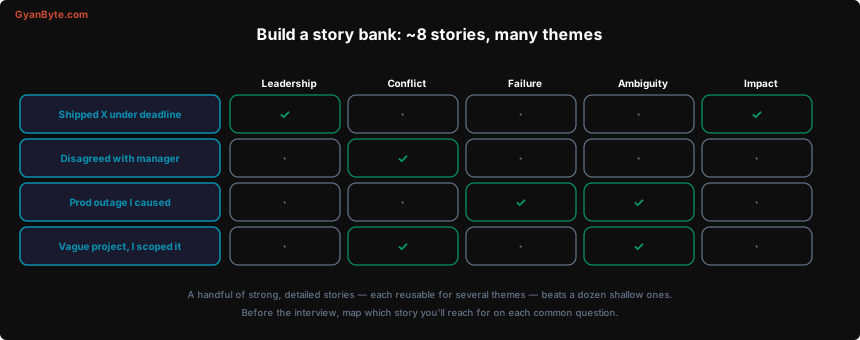
A single story about shipping SSO under a deadline can answer “a tight deadline,” “a time you made a build-vs-buy decision,” “a time you drove something cross-team,” and “your proudest project” — just by leading with a different sentence each time. That reuse is the whole point.
The eight stories to prepare
Pick real stories from your experience that, together, cover the common themes. Aim for roughly these eight. They overlap, which is good.
| # | Story | Primary themes it covers |
|---|---|---|
| 1 | A flagship project you owned end-to-end | Impact, ownership |
| 2 | A conflict with a peer or manager | Judgement, backbone, collaboration |
| 3 | A failure or mistake you genuinely owned | Ownership, growth |
| 4 | An ambiguous problem you scoped yourself | Judgement under ambiguity |
| 5 | A leadership / mentoring moment | Leadership, influence |
| 6 | A data-driven decision you made | Judgement, dive-deep |
| 7 | A tight-deadline delivery | Prioritisation, bias for action |
| 8 | A cross-team influence without authority | Influence, communication, scope |
A few selection rules:
- Favour recent and senior. Stories from the last two or three years, at the most senior scope you’ve operated at, are strongest. A great story from early in your career is fine as a backup, but your headline stories should reflect where you are now.
- Favour stories where you drove it. If your only role was “I implemented what was decided,” it’s a weak story for anything above mid-level. Pick moments where you saw the problem or made the call.
- Favour stories with a measurable result. If you can attach a number, it’s a stronger story. Dig through old dashboards, launch docs, and performance reviews to find the metrics — they’re worth the effort.
Write each one in STAR, once
For each story, write it out in full STAR (from Lesson 2): a one-sentence Situation, your specific Task, a detailed Action in the first person, and a quantified Result with a learning. Writing it forces you to find the metrics and the real decision points, and to notice which stories are thin.
Then compress each to a two-to-three-minute spoken version. Say it out loud and time it. If it runs long, the Situation is almost always the culprit — trim it.
Crucially, go one layer deeper than the script for each story. Jot down answers to the obvious follow-ups: Why that approach? What did you trade off? What would you do differently? How did the other person react? The interview is won in those follow-ups, so you need to know each story deeply, not just recite it.
Build the mapping
Once your stories exist, build the table that makes them usable under pressure: for each common question theme, note which story you’ll reach for (and a backup).
| Question theme | Primary story | Backup |
|---|---|---|
| Conflict / disagreement | #2 Conflict | #8 Cross-team |
| Failure / mistake | #3 Failure | #1 Flagship (a rough patch in it) |
| Leadership / driving | #5 Mentoring | #1 Flagship |
| Ambiguity | #4 Ambiguous problem | #7 Deadline |
| Influence / convincing | #8 Cross-team | #2 Conflict |
| Proudest / impact | #1 Flagship | #6 Data decision |
This mapping is the single most valuable artefact of your prep. In the interview you don’t search your whole career for an answer — you hear “conflict,” glance at the mental table, and reach for story #2. The cognitive load drops and you come across as composed and prepared.
Watch for gaps and overloads. If three themes all map to the same story, that story will get stale if you’re asked twice in a loop — build a second option. If a theme has no good story, that’s a signal to go find or develop one before the interview.
Keep it honest and specific
Two warnings. First, never invent a story. Experienced interviewers probe hard, and a fabricated story falls apart under two layers of follow-up — and an interviewer who smells fabrication will fail you outright. Use real events; you can choose which real event best fits, but don’t make one up. Second, specificity is credibility. Real details — the actual service, the real number, the name of the thing that broke — make a story believable in a way that generic phrasing never does. The more concrete, the stronger.
Tailor the lead, not the story
The same story works at different companies; you just change which signal you open with. For an Amazon loop you might lead your flagship-project story with ownership and bias for action; for a collaboration-heavy culture you might lead the same story with how you aligned three teams. We’ll cover these company-specific emphases in Lesson 6. For now, build the bank — it’s the foundation everything else sits on.
Key Takeaways
- Prepare a bank of ~8 stories, not a script per question — one story covers several themes.
- Choose recent, senior, driven, measurable stories; write each in full STAR once, then compress to 2–3 minutes.
- Build the theme → story mapping so you can reach for the right story instantly; fix gaps and overloads.
- Keep stories real and specific, and go a layer deeper than the script to survive follow-up questions.
Next: Lesson 4 — Amazon Leadership Principles, the most structured behavioural rubric of them all.