

If you are preparing for Amazon, the behavioural round is not a soft add-on to the technical interviews — it is often the deciding factor, and it is the most structured behavioural process in the industry. Where other companies evaluate “culture fit” loosely, Amazon evaluates against a published, specific rubric: the Leadership Principles. Knowing how that machine works, and preparing for it deliberately, is the single highest-leverage thing you can do for an Amazon loop.
How the Amazon loop actually works
In an Amazon interview loop, behavioural questions are not scattered randomly. The process is deliberately engineered:
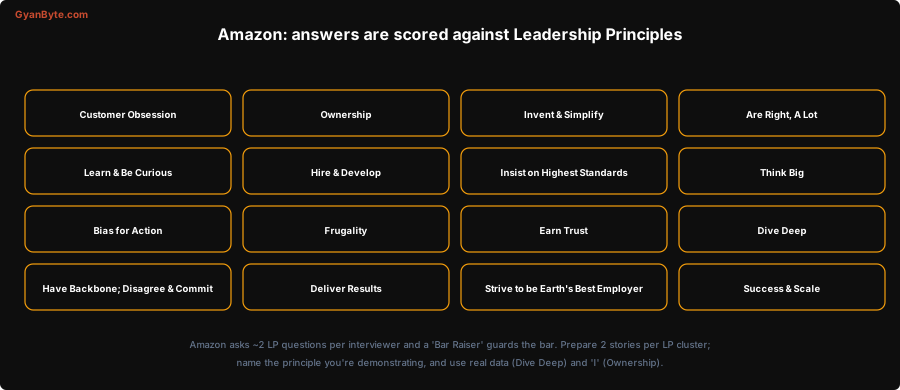
- Each interviewer is assigned a few Leadership Principles (typically two or three) and asks you questions designed to surface evidence for those principles. Across the whole loop, the interviewers collectively cover most of the 16 principles, so there is little room to coast on one or two strong stories.
- The Bar Raiser. One interviewer in every loop is a trained Bar Raiser — a senior employee from a different team whose job is to protect the long-term hiring bar, not to fill the immediate role. The Bar Raiser has an effective veto: a hiring manager cannot override them. They are specifically watching for depth, honesty, and whether you clear the bar on the principles.
- Written feedback with examples. After the loop, each interviewer writes up detailed notes citing the specific evidence you gave. Vague answers produce weak write-ups, and weak write-ups do not get offers.
The practical takeaway: you are not being asked to be likeable. You are being asked to provide quotable evidence that you operate the way the principles describe.
The 16 Leadership Principles
Here are the principles with a one-line gloss of what each is really asking you to demonstrate:
| Principle | What it’s really asking |
|---|---|
| Customer Obsession | You start from the customer and work backwards, not from internal convenience. |
| Ownership | You act for the whole company and the long term; you never say “that’s not my job”. |
| Invent and Simplify | You find new, simpler solutions and aren’t limited by “not invented here”. |
| Are Right, A Lot | You have strong judgement and seek diverse views to disconfirm your own beliefs. |
| Learn and Be Curious | You keep learning and explore new possibilities. |
| Hire and Develop the Best | You raise the performance bar and grow other people (mentoring, feedback). |
| Insist on the Highest Standards | You hold a relentlessly high bar, even when others think it’s too high. |
| Think Big | You set bold direction that inspires results, not incremental tweaks. |
| Bias for Action | Speed matters; you take calculated risks without needing excessive study. |
| Frugality | You accomplish more with less; constraints breed resourcefulness. |
| Earn Trust | You listen, speak candidly, and treat others respectfully even when it’s awkward. |
| Dive Deep | You operate at all levels, stay connected to the details, and audit the data. |
| Have Backbone; Disagree and Commit | You challenge decisions respectfully, then fully commit once decided. |
| Deliver Results | You focus on the key inputs and deliver them with quality and on time. |
| Strive to be Earth’s Best Employer | You create a safe, productive, empathetic work environment. |
| Success and Scale Bring Broad Responsibility | You consider the wider impact of your decisions on the world. |
You do not need a separate story for all 16. In practice they cluster, and a good story usually demonstrates two or three at once.
How to prepare for the LPs
Cluster, then build stories
Group the principles into a handful of themes and prepare roughly two stories per cluster so you never have to reuse the same example twice in one loop:
- Delivery & standards: Deliver Results, Insist on the Highest Standards, Bias for Action, Ownership.
- Judgement & conflict: Have Backbone; Disagree and Commit, Are Right A Lot, Earn Trust.
- Customer & invention: Customer Obsession, Invent and Simplify, Think Big.
- People & growth: Hire and Develop the Best, Learn and Be Curious.
- Depth & frugality: Dive Deep, Frugality.
The four habits that separate strong answers
- Say “I”, not “we”. The interviewer is scoring your actions. Describe the team’s context, then be relentlessly specific about what you personally did.
- Bring real data (Dive Deep). “We reduced p99 latency from 800 ms to 120 ms, cutting checkout drop-off by 6%” beats “we made it faster”. Amazon loves numbers, and the Bar Raiser will probe for them.
- Name the principle. It is completely fair to say, “This is an example of Have Backbone; Disagree and Commit.” It shows you understand the rubric.
- Be honest about trade-offs and failures. Trying to look flawless reads as a lack of self-awareness. Owning a real mistake and what you changed is itself strong evidence for several principles.
A worked example: Have Backbone; Disagree and Commit
Situation / Task: “Our team was about to ship a new payments flow on a hard deadline. I believed the rollback plan was unsafe — a failed migration could leave some customers double-charged.”
Action (what I did): “I pulled the migration script and reproduced the double-charge on a staging replica, so I had evidence rather than a hunch. I raised it directly with the tech lead and the EM in our go/no-go review and recommended a one-week slip to add idempotency keys. They disagreed — the deadline was committed to a partner. So I proposed a middle path: ship on time but behind a 5% feature flag with an automated reconciliation job watching for double-charges, and a full rollout only once it was clean for 48 hours. We agreed on that, and once the decision was made I owned the reconciliation job myself and fully committed.”
Result: “The flag caught 3 double-charge cases in the first day that the reconciliation job auto-refunded; we fixed the root cause, rolled out fully two days later, and shipped to the partner only one day late with zero customer impact. I wrote the idempotency pattern up as a template the team now reuses.”
Notice what that answer does: it is all “I”, it has evidence (reproduced on staging) and numbers (5% flag, 3 cases, 48 hours), it shows backbone and commitment, and it ends with a result plus a lasting improvement. That is exactly the shape a Bar Raiser can quote in a strong write-up.