

Engineers obsess over the coding and system design rounds and then wing the behavioural one — and it is often the round that actually sinks the offer. At senior and staff level it can carry as much weight as the technical rounds, and at Amazon a single “Bar Raiser” can veto a hire on it alone. The good news: the behavioural interview is just as learnable as the technical ones. It has a hidden rubric, a simple answer structure, and a small number of question themes. Prepare properly and you walk in calm, with the right story ready for whatever they ask.
This course is the third pillar of interview prep, alongside the Coding Interview Patterns and Cracking the System Design Interview courses.
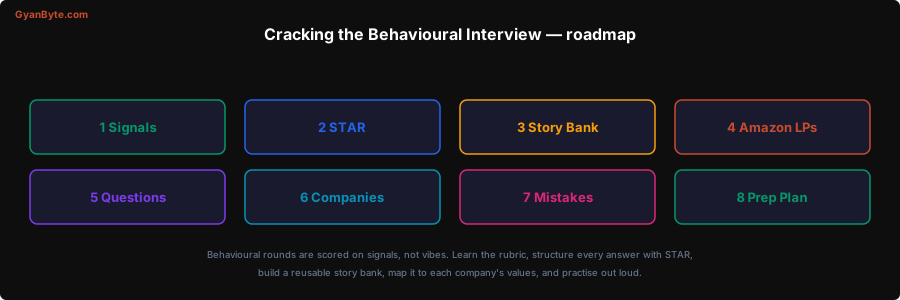
Why the behavioural round matters
A behavioural interviewer is not making small talk — they are filling a scorecard. They are looking for evidence that you take ownership, deliver measurable impact, work well with people, show judgement under conflict and failure, and communicate clearly. “Tell me about a time…” is not a memory test; it is a request for that evidence. Candidates fail this round not because their experience is weak, but because they ramble, hide behind “we”, skip the result, or give a vague answer that proves none of those signals.
What this course covers
| # | Lesson | What you’ll learn |
|---|---|---|
| 1 | What Behavioural Interviews Test | The hidden scorecard — the signals every answer should prove |
| 2 | The STAR Method | Situation, Task, Action, Result — structure every answer |
| 3 | Building Your Story Bank | ~8 strong, reusable stories mapped to the common themes |
| 4 | Amazon Leadership Principles | The 16 LPs, the Bar Raiser, and how to map stories to them |
| 5 | The Common Questions | Hundreds of questions are really ~6 themes in disguise |
| 6 | Company Playbooks | How Amazon, Google, Meta, Apple, Microsoft & Netflix differ |
| 7 | Mistakes That Sink You | The red flags interviewers quietly score against |
| 8 | Worked Example & Prep Plan | A full answer dissected, plus a two-week schedule |
Written in plain English for a working engineer, with a clear diagram per lesson and real, worked example answers you can adapt. By the end you’ll have your own story bank and the structure to deliver it under pressure.
Start with Lesson 1: What Behavioural Interviews Really Test.