

Most engineers prepare for the coding and system design rounds for weeks and then walk into the behavioural interview planning to “just be themselves.” That is a mistake. The behavioural round is often the one that decides the offer — and at senior and staff level it can carry as much weight as any technical round. The reassuring news is that it is every bit as learnable as the others. It has a hidden rubric, a simple structure, and a small set of recurring questions. This lesson is about the rubric.
The interviewer is filling a scorecard
When an interviewer says “Tell me about a time you disagreed with a teammate,” they are not curious about office politics. They are collecting evidence for a scorecard they will fill in the moment you leave the room. Every strong answer deposits evidence of one or two specific signals. Every weak answer leaves the boxes empty.
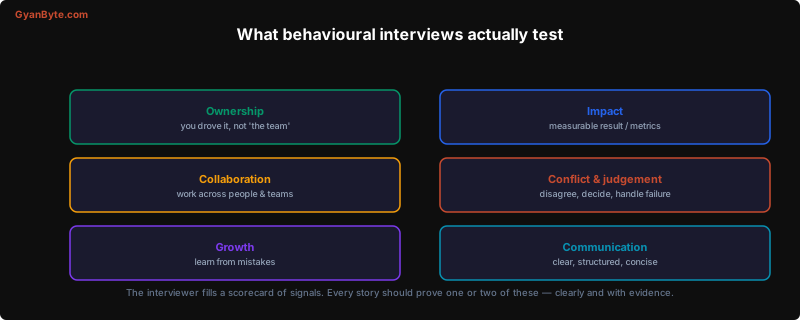
Here are the six signals nearly every company is really scoring:
| Signal | What they want to see |
|---|---|
| Ownership | You drove the outcome — not “the team,” you. You took responsibility beyond your assigned slice. |
| Impact | A concrete, ideally measurable result. Revenue, latency, users, time saved, an incident prevented. |
| Collaboration | You worked effectively with other people and teams, especially when incentives differed. |
| Judgement | You made a sound call under conflict, ambiguity, or failure — and can explain the trade-off. |
| Growth | You learned from a mistake and changed how you work. Self-awareness, not defensiveness. |
| Communication | The answer itself is clear, structured, and concise. The medium is part of the message. |
Notice that the last one is demonstrated by how you answer, not what you answer. A rambling story about great teamwork still scores low on communication.
Why “tell me about a time…” is an evidence request
The phrasing is deliberate. Interviewers ask for a specific past event because past behaviour is the best predictor of future behaviour — far better than hypotheticals like “what would you do if…“. A hypothetical lets you describe your best self; a real story forces you to reveal what you actually did.
This is why vague answers fail. Consider two responses to “Tell me about a challenging project.”
Weak: “We had this really hard migration last year. It was a big effort across the team and we all worked really hard. It went well in the end and everyone was happy.”
That proves nothing. Who did what? What was hard? What was the result? The scorecard stays blank.
Strong: “Our payments service was on a database that couldn’t handle Black Friday load. I owned the migration to a sharded setup. The hard part was doing it with zero downtime on a live system handling 3,000 payments a second, so I designed a dual-write phase with a reconciliation job to catch drift. We cut over with no customer-visible errors, and p99 latency dropped from 800ms to 120ms.”
Same project, completely different outcome — because the second answer deposits evidence of ownership (“I owned”), judgement (the dual-write design), and impact (zero errors, 800ms → 120ms).
The bar rises with seniority
The same question is scored against a different bar depending on the level you’re interviewing for. Know your target.
- Mid-level (e.g. L3/E4): You did solid, well-executed work. You can describe a task you were given and how you delivered it cleanly. The focus is competence and reliability.
- Senior (e.g. L5/E5): You drove work that was ambiguous or spanned teams. You didn’t wait to be told what to do; you identified the problem, scoped it, and pulled others along. The focus is ownership and scope.
- Staff+ (e.g. L6/E6): You showed leadership and judgement at organisational scale — influencing without authority, making calls with incomplete information that moved a whole team or product, mentoring others, setting technical direction. The focus is impact beyond your own hands.
If you are interviewing for senior but your stories are all “my manager asked me to build X and I built it well,” you will be levelled down. Pick stories where you saw the problem and you owned the outcome.
Decoding what a question is really probing
Behavioural questions come in endless phrasings but each is aimed at a signal. Train yourself to hear the signal behind the words, then steer your story to prove it.
| Question | Signal it’s probing |
|---|---|
| “A time you disagreed with your manager / a peer” | Judgement, backbone, collaboration |
| “A time you failed / a mistake you made” | Ownership, growth, self-awareness |
| “A project you’re most proud of” | Impact, ownership |
| “A time you had to work with limited information” | Judgement under ambiguity |
| “How did you convince someone / drive a decision” | Influence, communication |
| “A time you had too much to do” | Prioritisation, judgement |
When you hear “Tell me about a time you failed,” the trap is to pick a tiny, safe failure that wasn’t really your fault. But the signal is ownership and growth — so the best answer is a real mistake you genuinely owned, with a clear “here’s what I changed so it never happened again.” Answer the signal, not just the words.
How to use the rest of this course
Everything from here builds on this rubric:
- Lesson 2 gives you STAR — the structure that makes every answer land the evidence cleanly.
- Lesson 3 shows you how to build a small bank of stories that cover every signal, so you’re never caught without an answer.
- Lessons 4–6 cover Amazon’s Leadership Principles, the recurring question themes, and how different companies weight these signals.
- Lessons 7–8 cover the mistakes that quietly tank your score, and a two-week plan plus a fully worked answer.
The whole game is this: figure out which signal a question wants, then tell a specific, well-structured story that proves it. Do that consistently and the behavioural round stops being the scary one.
Key Takeaways
- The interviewer is filling a scorecard of signals: ownership, impact, collaboration, judgement, growth, and communication.
- “Tell me about a time…” asks for specific evidence, because past behaviour predicts future behaviour. Vague answers prove nothing.
- The bar rises with seniority — aim your stories at driving and leading, not just doing, if you’re targeting senior or staff.
- Every question targets a signal. Decode the signal and steer your story straight at it.
Next: Lesson 2 — The STAR Method, the structure that makes your evidence land.