

You should not build a different story bank for every company. The raw material — your real experiences — is the same everywhere. What changes is which signal you lead with and how you frame the result. A story about shipping fast under a tight deadline can emphasise Bias for Action at Amazon, move fast and impact at Meta, or dealing with ambiguity and craft at Apple. Same story, different spin.
This lesson is a quick playbook for the companies you’re most likely to interview with. Always do your own research on the specific team and the company’s stated values before the loop — these are the broad, publicly-known emphases, not a substitute for reading the room.
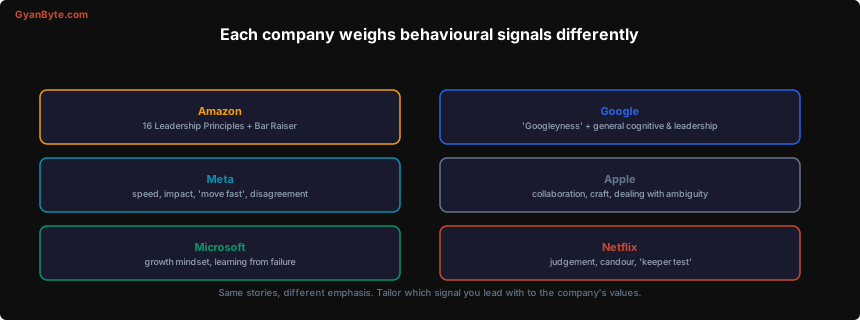
Amazon — the 16 Leadership Principles
The most structured behavioural bar in tech, covered in detail in the previous lesson. Every interviewer owns a couple of Leadership Principles, a Bar Raiser guards the long-term bar and can veto, and written feedback cites specific evidence. Lead with: ownership (“I”), concrete data (Dive Deep), and naming the principle you’re demonstrating. Prepare the most stories here — the bar is explicit and the coverage is wide.
Google — “Googleyness” and leadership
Google’s hiring rubric famously weighs general cognitive ability, role-related knowledge, leadership, and “Googleyness”. The behavioural portion is about the last two. “Googleyness” is loosely: comfort with ambiguity, collaboration and acting for the good of the broader group, intellectual humility, and bias to action without ego. The leadership they look for is “emergent” leadership — stepping up when needed and stepping back when you’re not the right person to lead. Lead with: collaboration, how you handled ambiguity, humility about what you didn’t know, and times you put the broader goal above your own.
Meta — speed, impact, and direct disagreement
Meta’s culture prizes speed and measurable impact (“Move Fast”, “Be Bold”). Behavioural interviewers look for engineers who ship, who can disagree directly and openly, and who drive change rather than wait for direction. Impact is expected to be quantified. Lead with: stories where you moved quickly, owned a measurable outcome, and pushed back on or reshaped a decision. Avoid answers that sound slow, consensus-bound, or process-heavy.
Apple — collaboration, craft, and ambiguity
Apple is intensely cross-functional and quality-obsessed. Teams are smaller and more secretive, and the behavioural bar centres on deep collaboration across disciplines, craft and attention to quality, and operating under ambiguity with limited information sharing. Lead with: stories of partnering closely with other functions (design, hardware, other engineering teams), raising the quality bar, and making progress despite not having the full picture.
Microsoft — the growth mindset
Microsoft’s culture is explicitly built around a growth mindset — the belief that abilities are developed through effort and learning. Uniquely, talking about failure and what you learned is a positive signal here, not a risk to manage. They also value collaboration (“one Microsoft”) over internal competition and customer/partner empathy. Lead with: learning from mistakes, seeking and acting on feedback, and helping others grow.
Netflix — judgement and radical candour
Netflix runs a famously high-performance, high-freedom culture. Behavioural evaluation centres on judgement, selflessness, candour (saying the hard thing, kindly and directly), and impact — captured in values like “freedom and responsibility” and the “keeper test” (would your manager fight to keep you?). Lead with: independent judgement calls you made, times you gave or received direct feedback, and outsized impact relative to effort. Weak signals here are needing a lot of process or supervision.
At a glance
| Company | What they weigh most | Lead your stories with |
|---|---|---|
| Amazon | 16 Leadership Principles + Bar Raiser | Ownership (“I”), data, name the principle |
| Googleyness + leadership | Collaboration, ambiguity, humility | |
| Meta | Speed & measurable impact | Moving fast, quantified impact, direct disagreement |
| Apple | Craft & cross-functional collaboration | Quality bar, partnering, working under ambiguity |
| Microsoft | Growth mindset | Learning from failure, feedback, helping others grow |
| Netflix | Judgement & candour | Independent calls, direct feedback, high impact |
The meta-lesson: prepare your story bank once, then re-frame the same stories to lead with the signal each company values. Research the specific role and read the interviewer’s follow-ups — if they keep probing for data, give more data; if they probe for how you worked with others, lean into collaboration.