

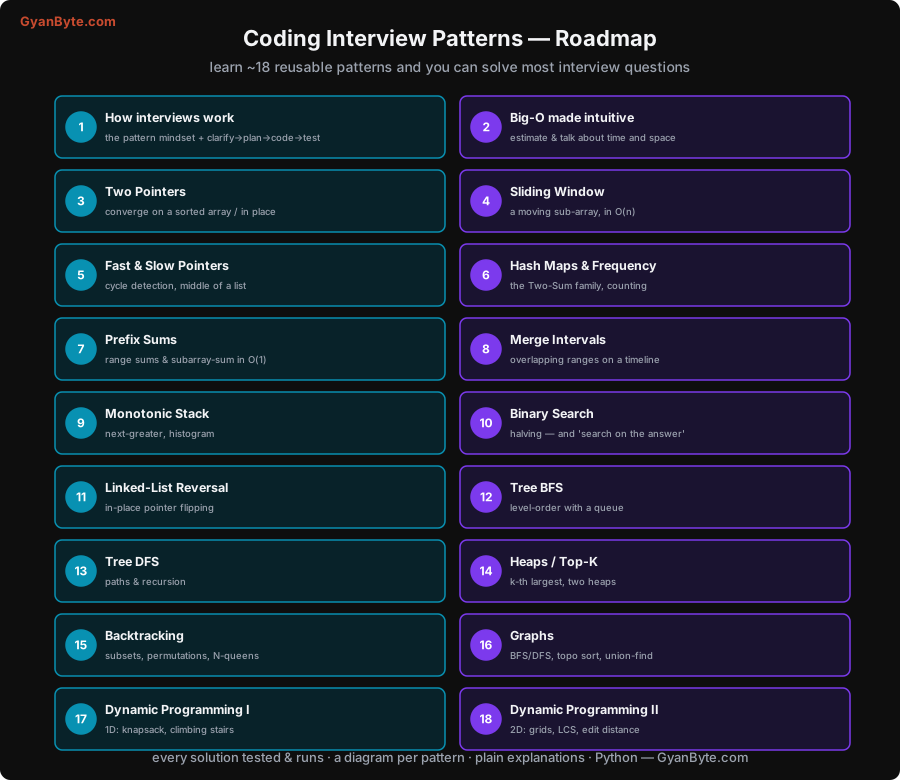
There are thousands of coding-interview questions but only about eighteen underlying patterns. The strong candidate is not the one who has memorised a thousand problems — it is the one who looks at a new question and thinks “ah, this is a sliding-window problem” and reaches for the template. That recognition is the real skill a coding round tests, and it is completely learnable. This course teaches those patterns, one per lesson, the easy way: a plain explanation, a diagram of the mechanism, a Python code template, and a few representative questions solved in full. A Part II then rounds out the toolbox — a data-structures reference and the extra and advanced topics (tries, bit manipulation, greedy, weighted-graph algorithms, advanced DP, string matching) that the harder senior/staff interviews reach for.
How to use this course. Read it in order the first time — the patterns build on each other. Then use it as a reference: when you see a new problem, scan your mental list of patterns and ask which one fits. For each pattern, learn the template by heart (not individual problems), practise 5–10 questions on it, and always say the pattern name out loud in the interview before you code. Every code sample here was actually run and tested, so you can trust the solutions.
Why patterns, not problems
Grinding hundreds of random problems is slow and brittle — you learn that problem, not how to solve the next one. Patterns are the opposite: each one is a reusable technique with a template that fits a whole family of questions. Learn “sliding window” once and you can solve longest-substring, max-sum-subarray, min-window and anagram problems. Learn “backtracking” once and subsets, permutations, combinations and N-queens all fall out of the same shape. Eighteen patterns, a handful of templates, and the judgement to recognise which applies — that is the whole game, and it is a far better use of your time than problem #347.
What this course covers
| # | Lesson | The pattern |
|---|---|---|
| 1 | How Interviews Work | The pattern mindset + the clarify→plan→code→test method |
| 2 | Big-O Made Intuitive | Estimating complexity, and reading it off the constraints |
| 3 | Two Pointers | Converge from both ends on a sorted array |
| 4 | Sliding Window | A moving contiguous sub-array in O(n) |
| 5 | Fast & Slow Pointers | Cycle detection, middle of a list |
| 6 | Hash Maps & Frequency | O(1) lookups — the Two-Sum family |
| 7 | Prefix Sums | Range and subarray sums in O(1) |
| 8 | Merge Intervals | Overlapping ranges — sort then sweep |
| 9 | Monotonic Stack | Next greater / smaller, histograms |
| 10 | Binary Search | Halving — and “search on the answer” |
| 11 | Linked-List Reversal | In-place pointer flipping |
| 12 | Tree BFS | Level-order traversal with a queue |
| 13 | Tree DFS | Recurse, combine, return |
| 14 | Heaps / Top-K | Priority queues, two heaps |
| 15 | Backtracking | Try, recurse, undo |
| 16 | Graphs | BFS, DFS, topological sort, union-find |
| 17 | Dynamic Programming I | 1-D tables and recurrences |
| 18 | Dynamic Programming II | 2-D tables (two sequences / grids) |
| Part II — Extended & Advanced | ||
| 19 | Data Structures: Your Toolbox | Core structures + trie, union-find, segment tree |
| 20 | Tries | Prefix trees for word & prefix queries |
| 21 | Bit Manipulation | XOR tricks, masks, bitmask enumeration |
| 22 | Greedy | Local-optimal choices that prove globally optimal |
| 23 | Advanced Graphs | Dijkstra, Bellman-Ford, Floyd-Warshall, MST |
| 24 | Advanced DP | Bitmask, interval and tree DP |
| 25 | String Algorithms | KMP and Rabin-Karp matching |
| 26 | Math & Geometry | In-place matrix tricks + number problems |
| 27 | Design a Data Structure | LRU/LFU — compose a map with a list/heap |
| 28 | Study Plan | Blind 75 / NeetCode 150 map + 8-week schedule |
Written in plain Indian English for a working engineer, with easy explanations, a clear diagram per pattern, Python code you can run, and representative questions solved in full. Pair it with the Cracking the System Design Interview course for the design rounds, and the AI FAANG interview coach article if you want to see how interviews are being automated.
Every pattern lesson has a companion Practice Problems page — over 260 real MAANG interview questions (LeetCode) in total, grouped easy → medium → hard, each with a worked approach and Python you can run. Every single solution was executed and tested. The course covers every NeetCode 150 category, and a closing study-plan lesson maps the patterns to the Blind 75 / NeetCode 150 lists with an 8-week schedule. Learn the pattern in the lesson, then drill it on the practice page: recognise the pattern, then do the reps. That combination is what actually gets you through the coding round — reading alone will not.
Start with Lesson 1: How Interviews Work.