Graphs look intimidating, but interview graph problems reduce to four tools on top of one structure (an adjacency list). Learn when to use each and most graph questions become routine — including grid problems, which are graphs in disguise.
The idea
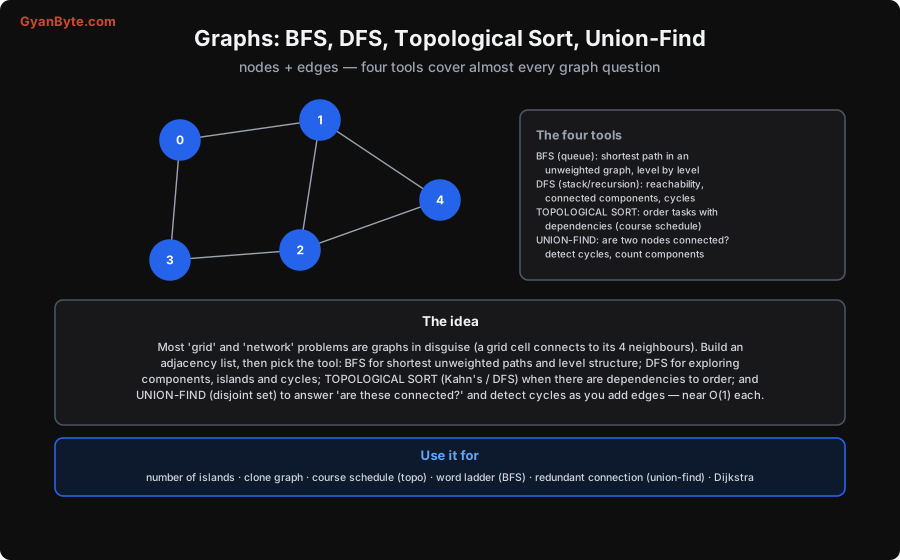
Represent the graph as an adjacency list ({node: [neighbours]}). Then choose:
- BFS (queue) — shortest path in an unweighted graph, level structure.
- DFS (recursion/stack) — reachability, connected components, islands, cycle detection.
- Topological sort — ordering tasks with dependencies (and detecting cycles).
- Union-Find (disjoint set) — ”are these connected?”, counting components, detecting cycles as edges are added.
A huge class of problems are grids — treat each cell as a node connected to its up-to-4 neighbours.
DFS: number of islands (grid as graph)
Flood-fill each unvisited land cell, marking it visited; count how many flood-fills you start:
def num_islands(grid):
    if not grid: return 0
    R, C = len(grid), len(grid[0]); count = 0
    def dfs(r, c):
        if r < 0 or c < 0 or r >= R or c >= C or grid[r][c] != '1':
            return
        grid[r][c] = '0'                       # mark visited
        dfs(r+1,c); dfs(r-1,c); dfs(r,c+1); dfs(r,c-1)
    for r in range(R):
        for c in range(C):
            if grid[r][c] == '1':
                count += 1; dfs(r, c)
    return count
Topological sort: course schedule
Can you finish all courses given prerequisites? Compute each node’s in-degree, start from the zero-in-degree nodes, and repeatedly remove them (Kahn’s algorithm). If you process all nodes, there’s no cycle:
from collections import defaultdict, deque
def can_finish(n, prereqs):
    adj = defaultdict(list); indeg = [0]*n
    for a, b in prereqs:            # b -> a (b is a prerequisite of a)
        adj[b].append(a); indeg[a] += 1
    q = deque([i for i in range(n) if indeg[i] == 0])
    seen = 0
    while q:
        u = q.popleft(); seen += 1
        for v in adj[u]:
            indeg[v] -= 1
            if indeg[v] == 0: q.append(v)
    return seen == n               # all processed → no cycle
# can_finish(2, [[1,0]]) -> True ;  can_finish(2, [[1,0],[0,1]]) -> False
Union-Find: detect a redundant connection
Union-Find answers connectivity and detects the edge that creates a cycle, near O(1) per operation with path compression:
def find_redundant(edges):
    parent = list(range(len(edges) + 1))
    def find(x):
        while parent[x] != x:
            parent[x] = parent[parent[x]]      # path compression
            x = parent[x]
        return x
    for a, b in edges:
        ra, rb = find(a), find(b)
        if ra == rb:                           # already connected → this edge makes a cycle
            return [a, b]
        parent[ra] = rb                        # union
    return []
# find_redundant([[1,2],[1,3],[2,3]]) -> [2,3]
Step-by-step walkthrough
Trace Course Schedule II (topological sort, Kahn’s algorithm) with 4 courses and prerequisites 0→1, 0→2, 1→3, 2→3. Start with every course that has no prerequisites; taking a course lowers its dependents’ in-degree, and any that hit zero become available.
| take | in-degrees after | newly free | queue | order so far |
|---|---|---|---|---|
| 0 | [0, 0, 0, 2] | [1, 2] | [1, 2] | [0] |
| 1 | [0, 0, 0, 1] | — | [2] | [0, 1] |
| 2 | [0, 0, 0, 0] | [3] | [3] | [0, 1, 2] |
| 3 | [0, 0, 0, 0] | — | [] | [0, 1, 2, 3] |
Order: [0, 1, 2, 3]. All 4 courses were processed, so there is no cycle. If a cycle existed, some in-degree would never reach zero and the order would come up short — that’s the cycle check.
When to reach for which
- “Shortest path / fewest steps” (unweighted) → BFS (word ladder, shortest path in a grid).
- “Explore / count regions / detect a cycle” → DFS (islands, clone graph, flood fill).
- “Order tasks with dependencies” / “is it possible given prerequisites” → topological sort (course schedule, alien dictionary).
- “Are these connected? / number of groups / redundant edge” → union-find.
- “Shortest path with weights” → Dijkstra (a heap-based BFS, Lesson 14’s heap + graph).
Pitfalls
- Not marking visited. Infinite loops come from re-visiting nodes. Mark on enqueue/visit, not on dequeue, for BFS to avoid duplicates.
- DFS recursion depth on big grids. A huge grid can blow the stack; mention an explicit stack or BFS if asked.
- Topo sort on a cyclic graph. If not all nodes are processed, there’s a cycle — that is often the answer (can’t finish).
Recap
Build an adjacency list, then pick the tool: BFS for shortest unweighted paths, DFS for components/cycles/islands, topological sort (in-degrees, Kahn’s) for dependency ordering, union-find for connectivity. Grids are graphs (cells = nodes). For weighted shortest paths, Dijkstra (heap + BFS). Signal words: connected, shortest, schedule/order, islands, redundant edge.
Practice: 12 solved problems on graphs → — cover each one, solve it yourself, then check the tested code.