Before any algorithms, let us get the right model of what a coding interview is — because getting this wrong is why smart people underperform in interviews they could easily pass.
What is actually being tested
A coding interview is not a memory test. The interviewer is not checking whether you’ve seen this exact problem; they are watching how you think — how you break down an unfamiliar problem, communicate, handle edge cases, and write clean, correct code. That is the thing they are trying to hire: a problem-solver they can work with.
This is good news, because it means you do not need to memorise a thousand problems. You need to learn the patterns and the method.
Patterns beat problems
Here is the single most useful fact about coding interviews: there are thousands of questions but only about eighteen underlying patterns. Two Sum, 3Sum, container-with-most-water and valid-palindrome are all the same pattern (two pointers). Longest-substring, max-sum-subarray and min-window are all one pattern (sliding window). Once you recognise the pattern, you already know the template — you are just filling in the details.
So the goal of this course is not “solve 500 problems”; it is “learn 18 patterns deeply, and the judgement to recognise which one fits.” That is a far better use of your time, and it transfers to problems you have never seen.
The method: clarify → examples → plan → code → test
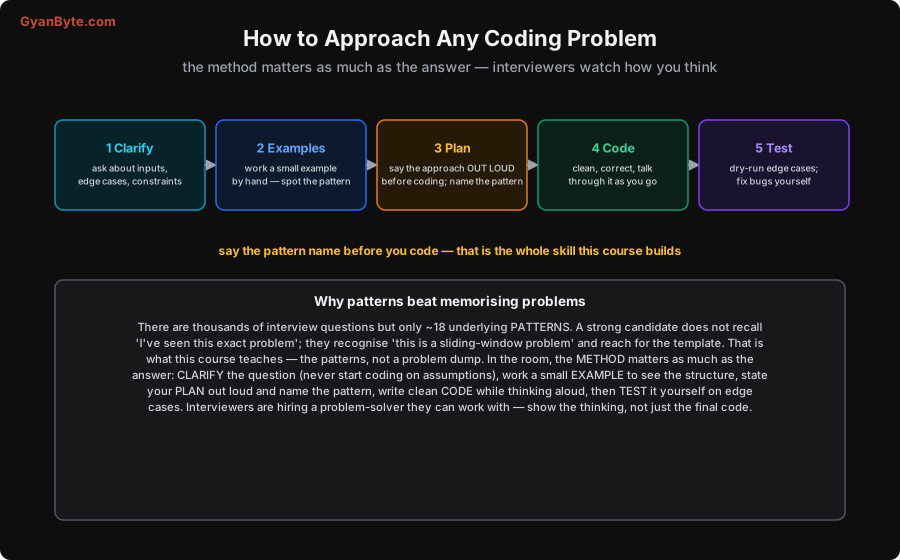
Have a routine you run for every question, so you never freeze:
- Clarify. Never start coding on assumptions. Ask: what are the input types and ranges? Can the array be empty, have duplicates, be unsorted? What should I return on no answer? These questions also buy you thinking time and show maturity.
- Examples. Work a small example by hand. Writing out
[2,7,11,15], target 9and finding9 = 2+7often reveals the structure (and the pattern) faster than staring at the abstract problem. - Plan. State your approach out loud before coding, and name the pattern: “I’ll use two pointers because the array is sorted.” This is the most important habit in the whole interview — it lets the interviewer course-correct you before you waste time, and it is exactly the signal they are looking for.
- Code. Write clean, correct code, narrating as you go (“now I’ll loop and keep a running max…”). Silence is bad; a running commentary is good.
- Test. Dry-run your code on your example and on edge cases (empty, one element, duplicates, the boundary). Find your own bugs before the interviewer does — that is a huge positive signal.
Read the constraints — they are a hint
One pro move: the constraints in the problem statement tell you the intended complexity, and often the pattern. n ≤ 20 hints at exponential/backtracking. n = 10⁵ means you need O(n log n) or better, so brute force is out. n = 10⁹ means O(log n) or O(1). Always read the constraints first — they are not decoration, they are a clue (Lesson 2).
Communicate, always
The hardest thing for many strong coders: talk. Think out loud. Explain your plan. Ask questions. Admit when you’re stuck and reason through it. The interviewer cannot read your mind, and a brilliant silent solution scores worse than a good, clearly-communicated one. You are auditioning as a teammate, not just a coder.
Pitfalls
- Coding before clarifying. You solve the wrong problem, or miss an edge case the interviewer specifically wanted. Always clarify first.
- Going silent. The interviewer is evaluating your thinking; if you don’t share it, there’s nothing to evaluate. Narrate.
- Memorising problems instead of patterns. You freeze on anything slightly different. Learn the pattern and the template.
Recap
A coding interview tests how you solve problems, not whether you’ve memorised them — and there are only ~18 underlying patterns to learn. Run a method on every question: clarify, work an example, state the plan (name the pattern), code cleanly, test yourself. Read the constraints for the intended complexity, and communicate throughout. That mindset, plus the patterns in this course, is what cracks the coding round.
Next: Lesson 2 — Big-O Made Intuitive, so you can state and choose complexity with confidence.