AI Agent Development — From First Loop to Production
A practical, no-hype course on building AI agents that survive real users. Write the agent loop from scratch, design tools, manage memory, control cost, debug with traces, evaluate trajectories, lock down security, and scale to thousands of concurrent runs, with every pitfall I have hit along the way.


Every second LinkedIn post today is about AI agents. Most of them show a demo that books a flight or writes a blog post, and the comments are full of fire emojis. What nobody posts is the Slack thread three weeks later: the agent went into a loop over the weekend and burnt ₹1.8 lakh in tokens, or it read a malicious email and forwarded the customer list to a stranger, or it “worked perfectly” in testing and then answered 30% of production tickets with confident nonsense.
I have been on the wrong side of each of those threads. This course is what I wish someone had handed me before I shipped my first agent.
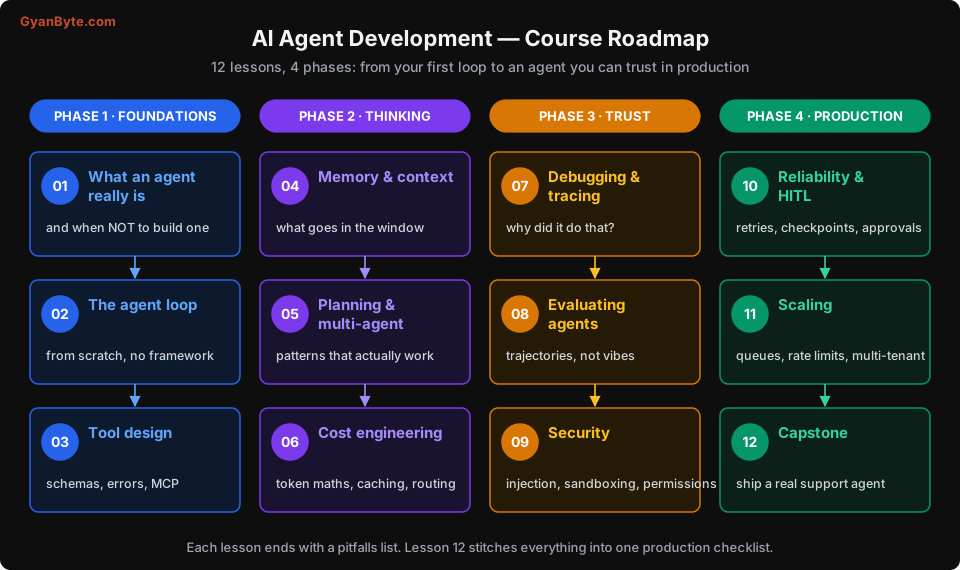
What This Course Covers
Twelve lessons. We start with a plain Python loop and end with a production support agent that has budgets, traces, evals, approvals, and a security model you can defend in a review meeting.
| # | Lesson | What you walk away with |
|---|---|---|
| 1 | What an Agent Really Is (and When Not to Build One) | A decision framework that will save you from building agents you don’t need |
| 2 | The Agent Loop from Scratch | A ~120 line agent with no framework, and a clear idea of what frameworks hide from you |
| 3 | Designing Tools Agents Can Actually Use | Tool schemas, error messages that teach the model, idempotency, and MCP |
| 4 | Memory and Context Management | Context budgets, summarisation, scratchpads, and long-term memory without the hype |
| 5 | Planning and Multi-Agent Patterns | Orchestrator-worker, evaluator loops, and an honest look at when multi-agent hurts |
| 6 | Cost Engineering for Agents | Why agent cost grows quadratically, and the six levers that bring it back under control |
| 7 | Debugging and Observability | Traces, replays, and a catalogue of the failure modes you will definitely see |
| 8 | Evaluating Agents | Outcome evals, trajectory evals, LLM judges, and a regression suite that runs in CI |
| 9 | Securing AI Agents | Prompt injection through tools, the lethal trifecta, sandboxing, and least-privilege design |
| 10 | Reliability and Human-in-the-Loop | Retries, idempotency, durable execution, checkpoints, and approval flows |
| 11 | Scaling Agents in Production | Queues, workers, rate limits, multi-tenancy, and the architecture that holds at 10k runs/day |
| 12 | Capstone: Ship a Production Support Agent | Everything stitched together, plus a printable pre-launch checklist |
Who Is This For?
- Backend and full-stack engineers who have called an LLM API and now need to build something that takes actions
- Tech leads who have been asked “can we put an agent on this?” and want to answer with numbers, not vibes
- Engineers who built an agent prototype in a hackathon and are now scared to put it in front of customers (good instinct)
Prerequisites
- Comfortable with Python (async helps but isn’t required)
- You have used at least one LLM API and know what a token is
- Basic understanding of REST APIs, queues, and databases
- An Anthropic API key. Code uses the official
anthropicPython SDK, but the ideas apply to any provider
If you have never called an LLM API before, do the LLM Engineering in Production course first, at least lessons 1 to 3. I will not re-explain tokens and prompts here.
A Note on Frameworks
You will notice I don’t use LangChain, CrewAI, or any agent framework in the core lessons. That is deliberate. Frameworks are fine, and I use some of them at work, but they hide the exact parts of the system that break in production: the message history, the token count, the retry logic, the tool error handling. Once you understand those parts by writing them yourself, pick whatever framework you like. You will debug it ten times faster.
How to Follow Along
Each lesson has runnable code, at least two diagrams, and a “Pitfalls” section at the end. If you are short on time, read the diagrams and the pitfalls sections first. They hold most of the hard-won stuff.
Chalo, let’s start.