An outright long or short future is a big, leveraged, directional bet. Spreads are the thinking trader’s alternative: trade the relationship between two contracts, which is usually far calmer and — because the legs hedge each other — gets reduced margin from the exchange. This is where a quant’s relative-value edge really shows.
The three kinds
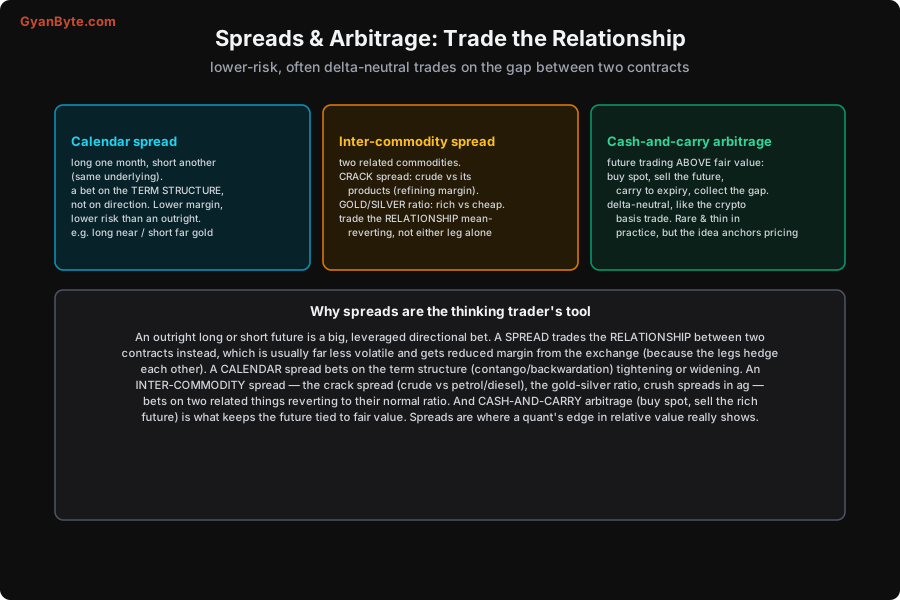
Calendar spread (bet on the term structure)
Go long one month and short another of the same underlying — for example, long the near-month gold future and short the far-month. You are no longer betting on gold’s direction (the two legs cancel most of that); you are betting on the term structure — whether the contango/backwardation widens or narrows. Because the legs hedge, the position is far less volatile than an outright, and the exchange charges lower margin. Calendar spreads are a direct, lower-risk way to trade the roll-yield dynamics from Lesson 6.
Inter-commodity spread (bet on a ratio)
Trade two related commodities against each other, betting their ratio reverts to normal:
- Crack spread — crude oil vs its refined products (petrol, diesel). This is the refining margin; it widens and narrows with refinery economics.
- Gold/silver ratio — how many ounces of silver equal one of gold. When the ratio is historically stretched, traders bet on reversion (long the “cheap” metal, short the “rich” one).
- Crush spread — in agriculture, the raw crop vs its processed outputs.
These trade a relationship, which is usually more stable and more mean-reverting than either leg alone — a natural fit for a systematic, statistical approach (the same thinking as pairs trading; see the mean-reversion / pairs article).
Cash-and-carry arbitrage
When a future trades above its fair value (Lesson 3), there is an arbitrage: buy the spot asset, sell the rich future, carry the spot to expiry (collecting the carry), and pocket the gap as the future converges to spot. It is delta-neutral — exactly the same idea as the crypto basis trade. In practice, true arbitrage is rare, thin and competed away quickly by professionals, but the existence of this trade is what keeps futures tied to fair value — and understanding it anchors everything about pricing.
def calendar_spread_pnl(near_entry, far_entry, near_exit, far_exit):
    # long near, short far: profit if the near-far gap moves in your favour
    long_leg  = near_exit - near_entry      # long near-month
    short_leg = far_entry - far_exit        # short far-month
    return long_leg + short_leg             # direction mostly cancels; you trade the SPREAD
Why spreads suit a programmer
Spreads are a quant’s natural territory: the relationship is more predictable and mean-reverting than raw direction, the risk and margin are lower, and the edge is statistical — exactly the kind of thing you can measure, backtest and automate. The catch is that they are two-legged: you pay two sets of fees and must manage both legs together (a half-filled spread is suddenly a naked directional bet). But for disciplined, relative-value systematic trading, spreads are often a far better risk-adjusted use of capital than outright futures.
Pitfalls
- Legging risk. Entering/exiting the two legs separately can leave you briefly naked and directional. Use the exchange’s spread order type where available, or enter carefully.
- Assuming a stretched ratio must revert now. Ratios can stay stretched or trend (a structural shift). Use stops; mean reversion is a tendency, not a law.
- Ignoring double fees. Two legs = two sets of costs on entry and exit. Thin spreads can be eaten by fees — model them.
Recap
Spreads trade the relationship between two contracts, with lower volatility and reduced margin. Calendar spreads bet on the term structure; inter-commodity spreads (crack, gold/silver ratio, crush) bet on a ratio reverting; cash-and-carry arbitrage (buy spot, sell the rich future) keeps futures tied to fair value and is delta-neutral. Spreads are where a quant’s relative-value edge shows — lower risk, statistical, automatable — but mind legging risk and double fees.
Next: Lesson 9 — Hedging, what futures were actually invented for.