If you skip everything else, do not skip this. In futures, leverage is the whole story of risk: the same ~8× that lets a small account trade a big notional is exactly what wipes out the careless. This lesson is the one that keeps you solvent.
The specific dangers
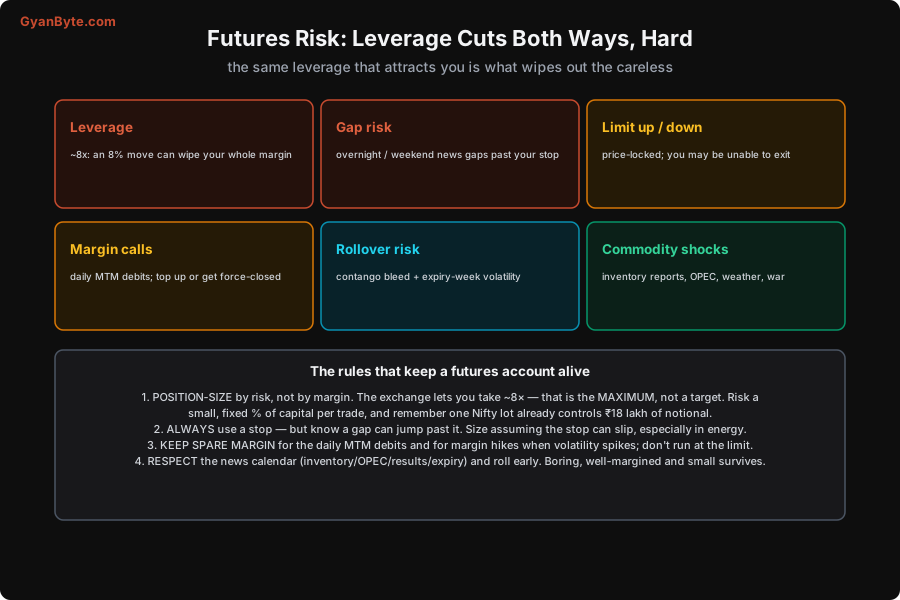
- Leverage. ~8× on an index future means an 8% move wipes your entire margin. It magnifies losses exactly as much as gains. Most futures blow-ups are simply too big a position.
- Gap risk. Markets can gap overnight or over a weekend — opening far from the previous close on news — jumping straight past your stop-loss. Your stop does not protect you against a gap; you can lose far more than planned. Energy (crude, natural gas) gaps especially violently.
- Limit up / limit down. Exchanges can lock a contract at a daily price limit during extreme moves. If you are on the wrong side, you may be unable to exit at all until it unlocks — a terrifying, account-threatening situation.
- Margin calls. Daily MTM debits (Lesson 5) can push you below maintenance margin, forcing a top-up or a force-close at the worst time.
- Rollover risk. The contango bleed (Lesson 6) plus expiry-week volatility erodes held positions and can give bad fills if you roll late.
- Commodity shocks. Inventory reports, OPEC decisions, weather, geopolitics — scheduled and unscheduled events that move commodities 5–10% in a session.
The rules that keep an account alive
-
Position-size by RISK, not by margin. This is rule zero. The exchange lets you take ~8× — that is the maximum the system allows, not a target. Risk a small, fixed % of capital per trade (say 1–2%), based on your stop distance, not on how many lots your margin permits. Remember: one Nifty lot already controls ₹18 lakh of notional.
def position_size(capital, risk_pct, entry, stop, point_value): risk_rupees = capital * risk_pct # e.g. 2% of capital risk_per_lot = abs(entry - stop) * point_value # loss per lot if stop hits return int(risk_rupees // risk_per_lot) # lots to trade (floor) position_size(1_000_000, 0.02, entry=24000, stop=23850, point_value=75) # risk ₹20,000 / (150 pts × 75 = ₹11,250 per lot) -> 1 lot -
Always use a stop — but size assuming it can slip. A stop limits normal losses, but a gap can jump past it. So size the position so that even a worse-than-stop fill is survivable, especially in gap-prone commodities.
-
Keep spare margin. Never run at the margin limit. Daily MTM debits and volatility-driven margin hikes will hit; a buffer prevents a forced liquidation at the low.
-
Respect the news calendar and roll early. Know when inventory reports, OPEC meetings, results and expiries fall; reduce size or stand aside around them, and roll a few days before expiry (Lesson 6).
-
Account for all costs. Brokerage, STT/CTT (securities/commodities transaction tax), exchange fees and slippage — model them, because leverage magnifies the drag of costs too.
The mindset
Leverage is seductive precisely because it makes small moves feel big. The traders who survive treat it with suspicion: they size as if they were trading without leverage and simply use futures for capital efficiency and the ability to short. They assume the gap, keep the buffer, and never let one trade threaten the account. Boring, well-margined and small survives; clever, over-leveraged and big gets a margin call.
Pitfalls
- Sizing by margin (“I can afford 5 lots”). Margin is the minimum to enter, not a safe size. Size by the rupee risk if your stop is hit.
- Trusting a stop against a gap. Stops don’t fill at your price through a gap. Size for a worse fill, especially in energy and over weekends.
- Running at the margin limit. One volatility spike hikes margin and triggers a force-close. Always keep spare margin.
Recap
Futures risk is dominated by leverage (~8×, an 8% move wipes your margin, cuts both ways), plus gap risk, limit up/down, margin calls, rollover risk and commodity shocks. The rules that keep you alive: size by risk not margin (small fixed %, based on stop distance), use a stop but assume it can slip, keep spare margin, respect the news calendar and roll early, and count all costs. Boring, well-margined and small survives.
Next: Lesson 11 — Data & Tooling Stack, where the programmer’s edge — and the continuous-contract trap — come in.