This lesson is the vocabulary and mechanics you must own. Futures are simpler than options, but the details of the contract — and the symmetric, uncapped payoff — matter a lot.
Long and short, and the linear payoff
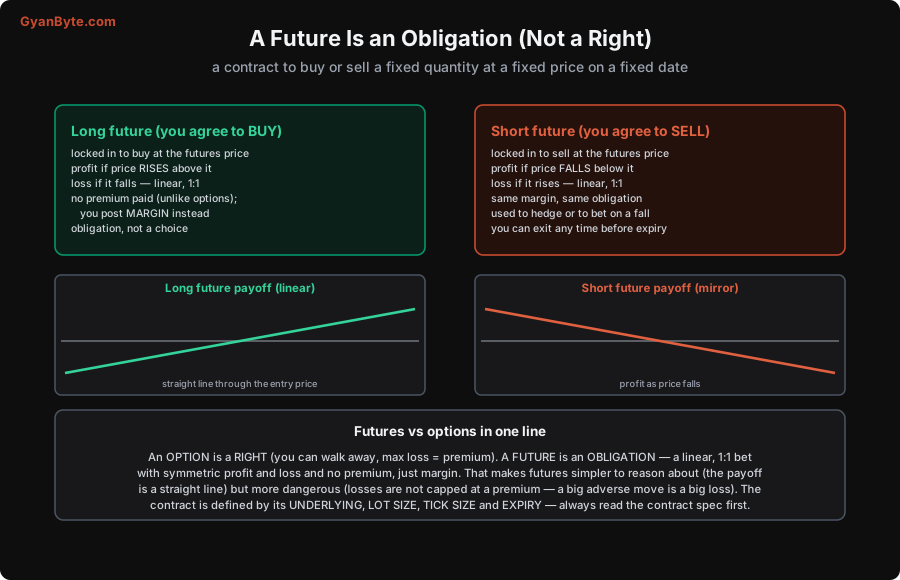
- Long a future — you have agreed to buy the underlying at the futures price. You profit if the price rises, lose if it falls, in a straight 1:1 line. You might go long to bet on a rise, or to hedge a future purchase.
- Short a future — you have agreed to sell at the futures price. You profit if the price falls. Crucially, going short is as easy as going long — no borrowing, no restrictions. You might short to bet on a fall, or (commonly) to hedge something you own.
The payoff is a straight line through your entry price, symmetric in profit and loss. This is the big contrast with options: an option’s payoff is a hockey stick (capped loss at the premium); a future’s is a diagonal line (uncapped both ways). Simpler to reason about, but with no premium to cap the downside.
def future_pnl(entry, exit, lot_size, side="long"):
    move = exit - entry
    return (move if side == "long" else -move) * lot_size

future_pnl(24000, 24200, lot_size=75, side="long")   # +15000  (200 pts up)
future_pnl(24000, 23700, lot_size=75, side="long")   # -22500  (300 pts down)
future_pnl(24000, 23700, lot_size=75, side="short")  # +22500  (short profits on the fall)
Notice there is no premium term. Your entire P&L is (exit − entry) × lot size, with the sign flipped for a short. That is the whole model.
The contract specification (read it first)
A future is fully described by its contract spec, and you must read it before trading anything:
- Underlying — what the contract is on (Nifty 50, Bank Nifty, a stock, gold, crude oil…).
- Lot size — the quantity per contract. This varies hugely: Nifty is 75, MCX Gold is 100g (mini) or 1kg (big), Crude Oil is 100 barrels, Silver is 30 kg, Natural Gas is 1250 mmBtu. The lot size sets how much capital and risk one contract represents, so it is the first thing to check.
- Tick size — the minimum price increment (e.g. ₹0.05 for Nifty, ₹1 for gold per 10g). Each tick’s rupee value = tick size × lot size.
- Expiry — when the contract settles. NSE index futures expire monthly (with some weekly); MCX commodities have their own monthly cycles.
- Settlement — cash-settled (you receive/pay the cash difference; index futures) or physically deliverable (you take/give delivery of the actual commodity; many MCX contracts near expiry). This matters enormously — holding a deliverable commodity future into expiry can mean you are obligated to take delivery of actual gold or crude, which retail traders almost never want. Always exit or roll deliverable contracts before the delivery period.
Nifty future:  underlying Nifty 50 · lot 75 · tick ₹0.05 · monthly expiry · CASH-settled
MCX Gold:      underlying gold · lot 100g/1kg · tick ₹1/10g · monthly · DELIVERABLE near expiry
Pitfalls
- Ignoring the lot multiplier. A 200-point move is ₹15,000 per Nifty lot, not ₹200. Always think in rupees = points × lot size.
- Holding a deliverable commodity future into the delivery window. You can end up obligated to take/give physical delivery. Exit or roll well before then.
- Forgetting the loss is uncapped. No premium caps a future’s loss. A big adverse move is a big loss — size accordingly (Lesson 10).
Recap
Long a future = agree to buy (profit if price rises); short = agree to sell (profit if price falls); both are linear, 1:1, symmetric, with no premium — you post margin. The payoff is a straight line, the P&L is (exit − entry) × lot size. Every contract has a spec — underlying, lot size, tick size, expiry, cash-vs-physical settlement — that you must read first, especially the settlement type on commodities.
Next: Lesson 3 — Pricing & Basis, where we learn why a future is priced a little above or below spot.