Options have premiums; futures have margin and daily mark-to-market. These two mechanics are what make futures powerful (leverage) and dangerous (daily cash bleed, margin calls). Understand them cold before trading a single lot.
Leverage and margin
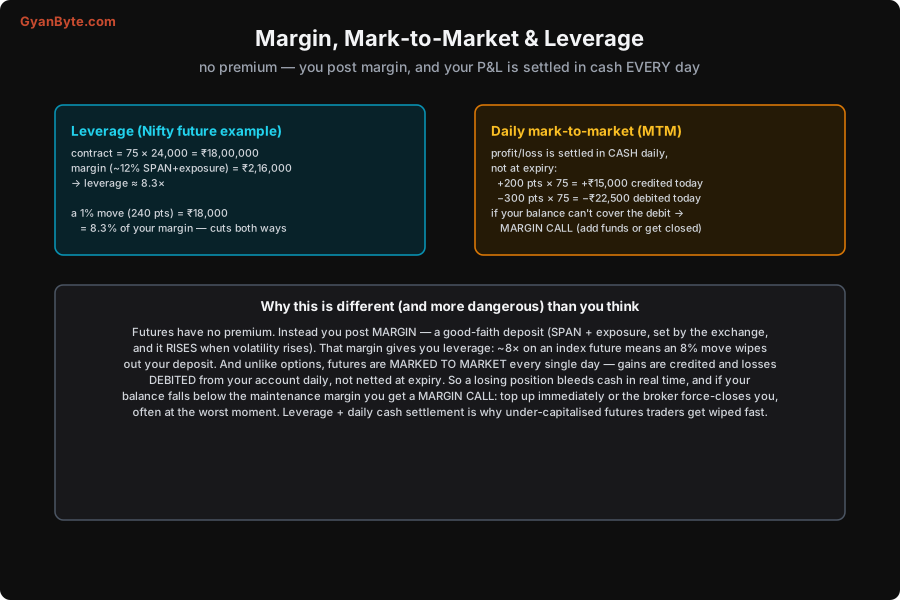
You do not pay for a future; you post margin — a good-faith deposit the exchange requires. In India this is the SPAN + exposure margin, roughly the worst-case one-day loss the exchange models for the position. It is a fraction of the contract value, and that fraction is your leverage:
Nifty future:  contract = 75 × 24,000 = ₹18,00,000
               margin (~12% SPAN+exposure) ≈ ₹2,16,000
               leverage = 18,00,000 / 2,16,000 ≈ 8.3×

a 1% move (240 pts) = 240 × 75 = ₹18,000 = 8.3% of your margin
So ~₹2.16 lakh controls ₹18 lakh — about 8.3× leverage. That means an 8% move in the underlying wipes out your entire margin. Leverage cuts both ways: it is why a small account can trade a big notional, and why a small adverse move is a large percentage loss. And note — margin rises when volatility rises, so in a turbulent market the exchange can demand more, squeezing you exactly when it hurts.
Daily mark-to-market (the part people underestimate)
Here is the mechanic that surprises people coming from stocks or options. Futures are marked to market every single day. Your profit or loss is settled in cash daily, not netted at expiry:
Long 1 Nifty lot, entry 24,000:
  day it rises to 24,200  →  +200 × 75 = +₹15,000 CREDITED to your account that day
  day it falls to 23,700  →  −300 × 75 = −₹22,500 DEBITED from your account that day
So a losing position bleeds cash in real time. You do not get to wait for expiry and hope it recovers — the loss is taken from your balance today. If your balance drops below the maintenance margin, you get a margin call: add funds immediately, or the broker force-closes your position — often at the worst possible moment, locking in the loss.
def daily_mtm(prev_close, today_close, lot_size, side="long"):
    move = today_close - prev_close
    return (move if side == "long" else -move) * lot_size

daily_mtm(24000, 24200, 75)          # +15000 credited today
daily_mtm(24200, 23700, 75)          # -37500 debited today (from 24200)
Why this combination is deadly for the under-capitalised
Put the two together: ~8× leverage means moves are magnified, and daily cash settlement means losses hit your account immediately and can trigger a margin call. An under-capitalised trader — one running near the margin limit with no buffer — gets caught in a vicious cycle: a bad day debits cash, the balance drops below maintenance, a margin call forces a sale at the low, and the position is gone. This is the single most common way futures accounts die, and it has nothing to do with being wrong about the long-term direction — just about sizing and spare margin.
The defence is simple and non-negotiable:
- Keep a healthy buffer of spare margin — never run at the limit. Assume daily MTM debits and volatility-driven margin hikes.
- Size by risk, not by margin. The ~8× the exchange allows is the maximum; a sane position risks a small % of capital, far below the margin limit.
- Have the cash ready for a margin call before you are in the trade, not scrambling during it.
Pitfalls
- Running at the margin limit. One bad day and a volatility-driven margin hike trigger a forced close. Always keep a buffer.
- Thinking of margin as the cost. Margin is the minimum to enter, not a safe position size. Size by risk.
- Forgetting MTM is daily and in cash. You can be “right eventually” and still be force-closed by the daily debits before expiry.
Recap
Futures have no premium — you post SPAN + exposure margin, which gives ~8× leverage (an 8% move wipes your deposit) and rises with volatility. Futures are marked to market daily: gains credited, losses debited in cash every day, with a margin call (top up or get force-closed) if you fall below maintenance. Leverage + daily cash settlement is why the under-capitalised get wiped — so keep spare margin, size by risk, and never run at the limit.
Next: Lesson 6 — Rollover & Term Structure, the quiet cost of holding futures past expiry.