Before there were speculators and algos, there were farmers and millers who just wanted to know what price they would get at harvest. Hedging is the original purpose of futures, and understanding it makes you a far better trader — even if you never hedge a thing yourself — because it explains why the market behaves as it does.
The classic hedgers
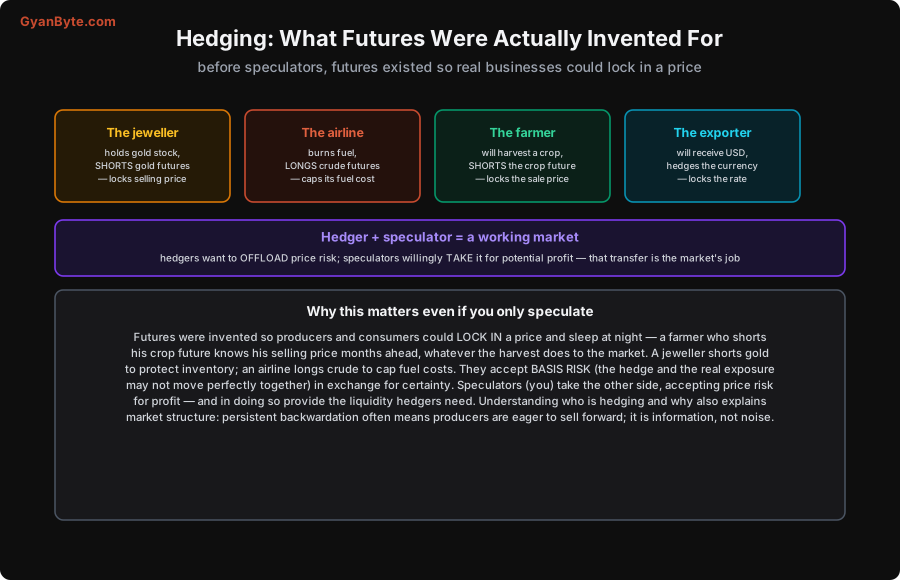
A hedge is simply taking an opposite futures position to something you are already exposed to, so the two cancel and your price is locked:
- The jeweller holds physical gold inventory (long gold, in effect). If gold falls, their stock loses value. So they short gold futures — now a fall in gold is offset by a gain on the short, locking their effective selling price.
- The airline will need to buy jet fuel (short fuel, in effect — they owe it). If crude rises, their costs balloon. So they long crude futures — a rise in crude is offset by a gain on the long, capping their fuel cost.
- The farmer will harvest a crop in a few months (long the crop). If prices fall by harvest, they suffer. So they short the crop future now, locking in today’s price for a future sale.
- The exporter will receive US dollars later (long USD). If the rupee strengthens, they get less. So they hedge the currency to lock the rate.
In each case the business accepts certainty in exchange for giving up the upside — a jeweller who shorts gold is protected if gold falls but gains nothing if it rises. That is the whole point: hedging is about removing uncertainty, not making money.
Basis risk
Hedges are rarely perfect. The futures contract you use may not move exactly with your real exposure — a different grade of crude, a slightly different location, a timing mismatch between the hedge’s expiry and your actual cash flow. The residual gap is basis risk: the risk that (your exposure − your hedge) still moves a little. A good hedger minimises basis risk by choosing the closest-matching contract and expiry, but some always remains. Understanding basis risk is why hedging is a craft, not a switch.
Hedger meets speculator (why the market works)
Here is the beautiful part. Hedgers want to offload price risk — they will pay to be rid of it. Speculators (you) are willing to take that risk, hoping to profit from price moves. The futures market is the mechanism that transfers risk from those who don’t want it to those who do. Hedgers get their certainty; speculators get the liquidity and the opportunity; the market does its job.
This matters even if you only ever speculate, for two reasons:
- It explains market structure. Persistent backwardation in a commodity (Lesson 3) often means producers are eager to sell forward (hedge their output), pushing far futures down. The term structure is partly a map of who is hedging what. Reading it gives you information, not just noise.
- It explains who is on the other side of your trade. When you go long crude, you may be taking risk off an airline’s books. Knowing the hedging flows (commercials vs speculators — visible in data like Commitment-of-Traders reports in some markets) can be a genuine signal.
Pitfalls
- Thinking a hedge should make money. A hedge that “loses” because the price moved favourably did its job — it removed uncertainty. Judge a hedge by certainty gained, not P&L.
- Ignoring basis risk. A mismatched contract/expiry can leave real exposure unhedged. Match the contract and timing as closely as possible.
- Over-hedging or under-hedging. Hedge the actual exposure, in the right quantity (the “hedge ratio”). Too much turns a hedge into a speculative bet.
Recap
Futures were invented for hedging — letting real businesses (jeweller, airline, farmer, exporter) lock in a price and remove uncertainty, by taking an opposite futures position. They accept basis risk (imperfect match) for certainty. Hedgers offload price risk; speculators take it for profit — that transfer is the market’s job. Even as a pure speculator, understanding hedging explains term structure and who is on the other side of your trade.
Next: Lesson 10 — Risk & Position Sizing, the lesson that keeps your account alive.