Now the menu. Indian futures come in two big families — financial futures on NSE and commodity futures on MCX — and within those, each instrument has a distinct personality you should respect.
The universe
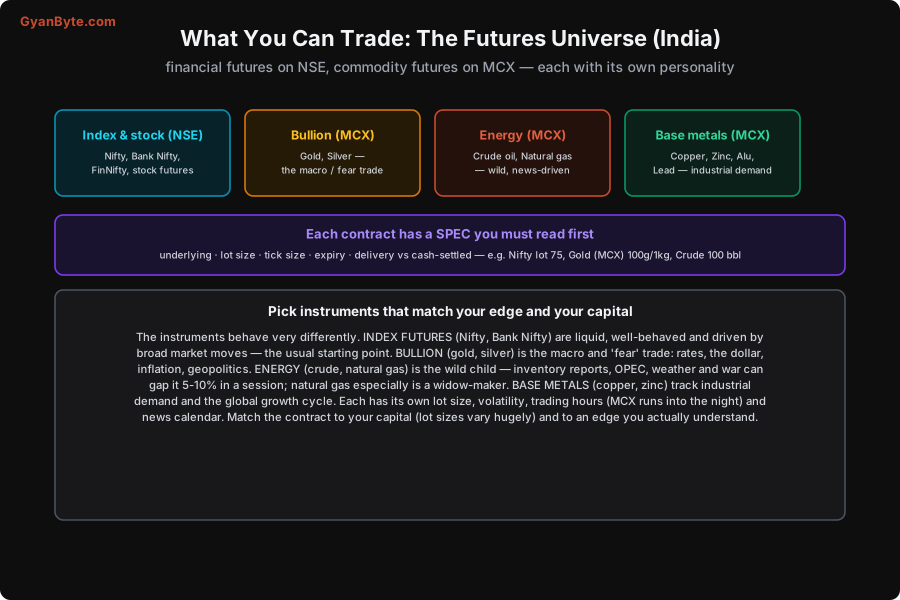
Financial futures (NSE)
- Index futures — Nifty 50, Bank Nifty, FinNifty. Highly liquid, well-behaved, and driven by broad market moves. These are the usual starting point: deep liquidity, familiar drivers, cash-settled, tight spreads.
- Single-stock futures — futures on individual stocks (Reliance, HDFC Bank, etc.). More idiosyncratic (company news matters), and physically settled in India, so mind delivery near expiry.
Commodity futures (MCX)
- Bullion — gold, silver. The macro and “fear” trade. Prices move on interest rates, the US dollar, inflation, and geopolitics. Gold is a safe-haven; silver is more volatile and has an industrial side. Popular, liquid, and a good diversifier from equities.
- Energy — crude oil, natural gas. The wild child of the complex. Inventory reports (weekly US data), OPEC decisions, weather, and geopolitics can gap these 5–10% in a single session. Natural gas is famous as a “widow-maker” — extraordinarily volatile. High reward, high danger; respect it.
- Base metals — copper, zinc, aluminium, lead. Track industrial demand and the global growth cycle (copper is nicknamed “Dr. Copper” for its read on the economy). Driven by China, construction, and manufacturing data.
Read the spec, match it to your capital
Each contract has its own spec (Lesson 2), and the differences are large. Lot sizes range from a Nifty lot (₹18 lakh notional) to a Gold Mini (100g, a few lakh) to a full Crude lot (100 barrels). Volatility ranges from well-mannered index futures to the gap-happy natural gas. Trading hours differ too — MCX runs into the night (into the evening session, tracking global markets), so commodities keep moving after the equity market closes. And each has its own news calendar that drives the big moves.
The practical takeaways:
- Start with liquid, well-behaved instruments (index futures, gold) while learning. Save natural gas for much later, if ever.
- Match the contract to your capital. Lot sizes vary enormously; pick ones where one lot is a sane fraction of your account.
- Know each instrument’s drivers and news calendar. You cannot trade crude without knowing the inventory-report schedule, or bullion without watching rates and the dollar.
- Trade an edge you actually understand. Spreading yourself across unfamiliar commodities is a fast way to lose; depth beats breadth.
Pitfalls
- Jumping into natural gas or crude for the volatility. The same moves that attract you can gap through your stop. These are advanced instruments; earn your way to them.
- Ignoring MCX’s evening session. Commodities move after equity hours on global news — your position is live and your risk is real while you might be offline.
- Over-sizing because a mini contract “looks small”. Still leveraged; still size by risk, not by how cheap the lot looks.
Recap
The Indian futures universe: financial (NSE — Nifty/Bank Nifty index and stock futures; liquid, broad-market-driven) and commodity (MCX — bullion the macro/fear trade, energy the wild news-driven one, base metals the industrial-cycle read). Each has its own spec, volatility, hours and news calendar. Start liquid and well-behaved, match the contract to your capital, and trade an edge you understand.
Next: Lesson 5 — Margin, MTM & Leverage, the mechanics that make futures powerful and dangerous.