

Why Redis for Node.js
Redis is an in-memory data store that serves as a cache, message broker, session store, and more. Its sub-millisecond latency makes it the go-to choice for performance-critical Node.js applications.
Setting Up ioredis
const Redis = require('ioredis');

const redis = new Redis({
  host: process.env.REDIS_HOST || 'localhost',
  port: 6379,
  password: process.env.REDIS_PASSWORD,
  maxRetriesPerRequest: 3,
  retryStrategy(times) {
    const delay = Math.min(times * 50, 2000);
    return delay;
  },
});

redis.on('connect', () => console.log('Redis connected'));
redis.on('error', (err) => console.error('Redis error:', err));
Redis Data Structures
// Strings — simple key-value
await redis.set('user:1:name', 'Alice');
await redis.get('user:1:name'); // 'Alice'
await redis.set('api:token', 'abc123', 'EX', 3600); // Expires in 1 hour

// Hashes — object-like storage
await redis.hset('user:1', { name: 'Alice', email: '[email protected]', role: 'admin' });
await redis.hget('user:1', 'name');    // 'Alice'
await redis.hgetall('user:1');          // { name: 'Alice', email: '...', role: 'admin' }

// Lists — ordered collection (queue/stack)
await redis.lpush('queue:emails', JSON.stringify({ to: '[email protected]', subject: 'Welcome' }));
await redis.rpop('queue:emails'); // FIFO processing

// Sets — unique values
await redis.sadd('user:1:roles', 'admin', 'editor');
await redis.sismember('user:1:roles', 'admin'); // 1 (true)
await redis.smembers('user:1:roles'); // ['admin', 'editor']

// Sorted Sets — ranked data
await redis.zadd('leaderboard', 1500, 'player:1', 2200, 'player:2', 1800, 'player:3');
await redis.zrevrange('leaderboard', 0, 9, 'WITHSCORES'); // Top 10
Caching Strategies
Cache-Aside (Lazy Loading)
The most common caching pattern. Check cache first, fall back to database, then populate cache.
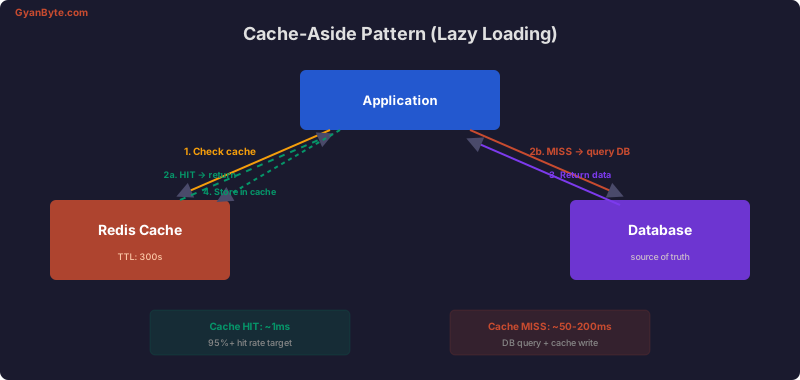
class CacheService {
  constructor(redis, defaultTTL = 300) {
    this.redis = redis;
    this.defaultTTL = defaultTTL;
  }

  async get(key) {
    const cached = await this.redis.get(key);
    return cached ? JSON.parse(cached) : null;
  }

  async set(key, value, ttl = this.defaultTTL) {
    await this.redis.set(key, JSON.stringify(value), 'EX', ttl);
  }

  async invalidate(key) {
    await this.redis.del(key);
  }

  async invalidatePattern(pattern) {
    const keys = await this.redis.keys(pattern);
    if (keys.length > 0) {
      await this.redis.del(...keys);
    }
  }
}

// Usage in a service
async function getUser(id) {
  const cacheKey = `user:${id}`;

  // 1. Check cache
  const cached = await cache.get(cacheKey);
  if (cached) return cached;

  // 2. Cache miss — query database
  const user = await db.users.findById(id);
  if (!user) return null;

  // 3. Store in cache
  await cache.set(cacheKey, user, 600); // 10 min TTL

  return user;
}

// Invalidate on update
async function updateUser(id, data) {
  const user = await db.users.update(id, data);
  await cache.invalidate(`user:${id}`);
  return user;
}
Write-Through Cache
async function createOrder(orderData) {
  // Write to DB first
  const order = await db.orders.create(orderData);

  // Write to cache simultaneously
  await cache.set(`order:${order.id}`, order, 3600);

  return order;
}
Session Storage with connect-redis
const session = require('express-session');
const RedisStore = require('connect-redis').default;

app.use(session({
  store: new RedisStore({
    client: redis,
    prefix: 'sess:',
    ttl: 86400, // 24 hours
  }),
  secret: process.env.SESSION_SECRET,
  resave: false,
  saveUninitialized: false,
  cookie: {
    secure: process.env.NODE_ENV === 'production',
    httpOnly: true,
    maxAge: 24 * 60 * 60 * 1000,
    sameSite: 'strict',
  },
}));
Pub/Sub Implementation
Redis Pub/Sub enables real-time messaging between services.
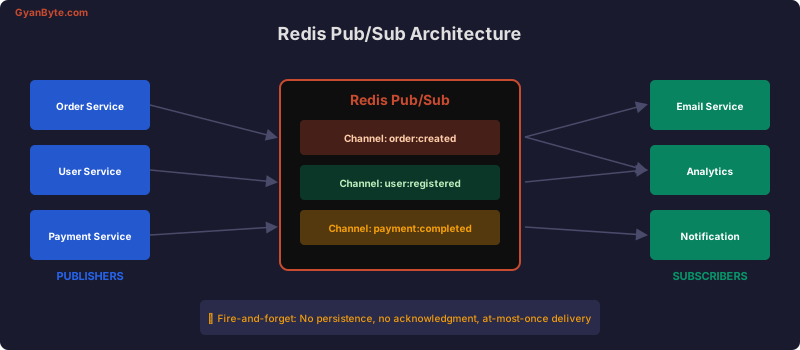
// Publisher (uses main redis connection)
async function publishEvent(channel, data) {
  await redis.publish(channel, JSON.stringify({
    ...data,
    timestamp: Date.now(),
  }));
}

// On order creation
await publishEvent('order:created', {
  orderId: order.id,
  userId: order.userId,
  total: order.total,
});

// Subscriber (needs a DEDICATED connection)
const subscriber = new Redis(/* same config */);

subscriber.subscribe('order:created', 'user:registered', 'payment:completed');

subscriber.on('message', (channel, message) => {
  const data = JSON.parse(message);

  switch (channel) {
    case 'order:created':
      emailService.sendOrderConfirmation(data);
      analyticsService.trackOrder(data);
      break;
    case 'user:registered':
      emailService.sendWelcome(data);
      break;
    case 'payment:completed':
      fulfillmentService.processOrder(data);
      break;
  }
});

// Pattern-based subscription
subscriber.psubscribe('order:*');
subscriber.on('pmessage', (pattern, channel, message) => {
  console.log(`${channel}: ${message}`);
});
Rate Limiting with Redis
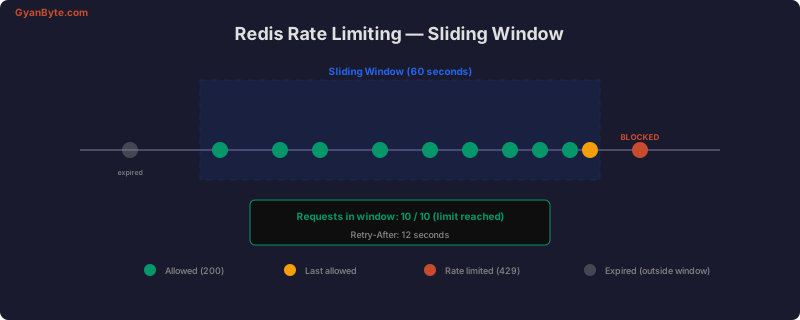
// Sliding window rate limiter using sorted sets
async function rateLimit(key, limit, windowSeconds) {
  const now = Date.now();
  const windowStart = now - windowSeconds * 1000;

  const pipeline = redis.pipeline();

  // Remove expired entries
  pipeline.zremrangebyscore(key, 0, windowStart);
  // Add current request
  pipeline.zadd(key, now, `${now}:${Math.random()}`);
  // Count requests in window
  pipeline.zcard(key);
  // Set TTL on the key
  pipeline.expire(key, windowSeconds);

  const results = await pipeline.exec();
  const requestCount = results[2][1];

  return {
    allowed: requestCount <= limit,
    remaining: Math.max(0, limit - requestCount),
    resetAt: new Date(now + windowSeconds * 1000),
  };
}

// Express middleware
function rateLimitMiddleware(limit = 100, windowSeconds = 60) {
  return async (req, res, next) => {
    const key = `ratelimit:${req.ip}`;
    const result = await rateLimit(key, limit, windowSeconds);

    res.set({
      'X-RateLimit-Limit': limit,
      'X-RateLimit-Remaining': result.remaining,
      'X-RateLimit-Reset': result.resetAt.toISOString(),
    });

    if (!result.allowed) {
      return res.status(429).json({
        error: 'Too many requests',
        retryAfter: windowSeconds,
      });
    }

    next();
  };
}

app.use('/api/', rateLimitMiddleware(100, 60));
Distributed Locks with Redlock
const Redlock = require('redlock');

const redlock = new Redlock([redis], {
  retryCount: 3,
  retryDelay: 200,
  retryJitter: 200,
});

// Acquire lock before critical section
async function processPayment(orderId) {
  const lockKey = `lock:payment:${orderId}`;

  const lock = await redlock.acquire([lockKey], 10000); // 10s lock

  try {
    // Critical section — only one process can execute this
    const order = await db.orders.findById(orderId);

    if (order.status !== 'pending') {
      throw new Error('Order already processed');
    }

    await paymentGateway.charge(order);
    await db.orders.update(orderId, { status: 'paid' });
  } finally {
    await lock.release();
  }
}
Performance Tips
// Use pipelines for batch operations (reduces round trips)
const pipeline = redis.pipeline();
for (const id of userIds) {
  pipeline.hgetall(`user:${id}`);
}
const results = await pipeline.exec();
const users = results.map(([err, data]) => data);

// Use Lua scripts for atomic operations
const luaScript = `
  local current = redis.call('GET', KEYS[1])
  if current and tonumber(current) >= tonumber(ARGV[1]) then
    return redis.call('DECRBY', KEYS[1], ARGV[1])
  end
  return nil
`;

// Atomic "decrement if sufficient balance"
const newBalance = await redis.eval(luaScript, 1, 'balance:user:1', 50);
Key Takeaways
- Cache-aside is the safest pattern — cache on miss, invalidate on write
- Pub/Sub is fire-and-forget — no persistence, use streams for durability
- Rate limiting with sorted sets gives precise sliding windows
- Use pipelines for batch operations and Lua scripts for atomicity
- Always set TTL on cached keys to prevent stale data
- Use dedicated connections for pub/sub subscribers


