Finally, the part that is ours. Everything so far — the maths, the strategies, the risk — applies to every options trader. This lesson is about the edge only a programmer has: turning all of it into software.
The stack
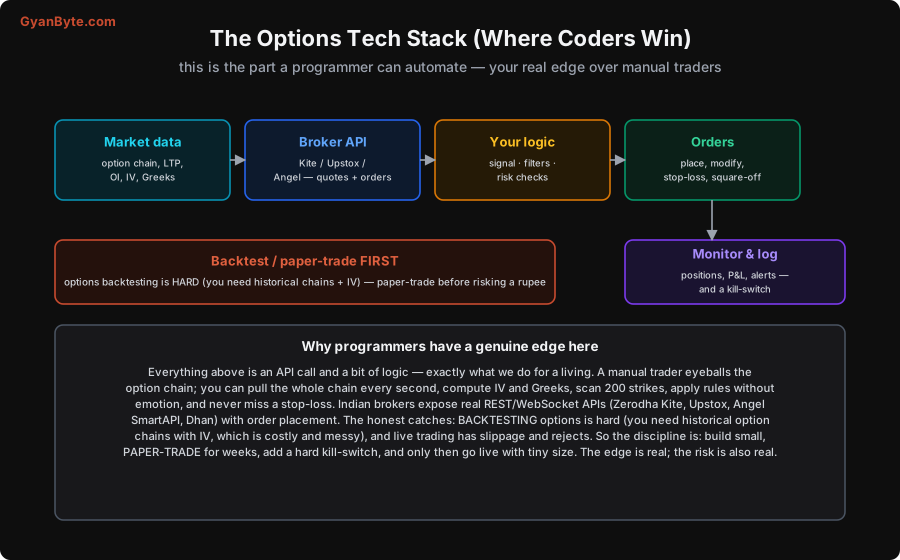
A complete options trading system is just a few components you already know how to build:
- Market data — the live option chain: every strike’s last price, bid/ask, open interest (OI), volume, and often IV and Greeks. Your broker’s API gives this; NSE also publishes chain snapshots.
- Broker API — for quotes and for placing/modifying/cancelling orders. In India the main ones are Zerodha Kite Connect, Upstox API, Angel One SmartAPI, and Dhan — all expose REST + WebSocket endpoints with order placement.
- Your logic — the signal (when to act), filters, and risk checks. This is the part that is actually you.
- Orders — place, modify, attach a stop-loss, square off.
- Monitor & log — track positions, P&L and alerts, with a kill-switch that can flatten everything instantly.
Pulling and enriching the chain
Here is the shape of a chain fetcher that adds IV and Greeks to every strike (using the pricer from Lessons 4–5):
# pseudo-code around a real broker SDK
chain = broker.option_chain("NIFTY", expiry="2026-11-06")   # list of strikes
spot  = broker.ltp("NIFTY")

for row in chain:
    row["iv"]    = implied_vol(row["ltp"], spot, row["strike"],
                               T=days_to_expiry/365, r=0.07,
                               call=(row["type"] == "CE"))
    row["greeks"] = greeks(spot, row["strike"], days_to_expiry/365,
                           0.07, row["iv"], call=(row["type"] == "CE"))

# now you can scan: "show me OTM puts with IV rank > 70 and delta < 0.2"
atm_straddle = next(r for r in chain if r["strike"] == atm_strike)
This is the edge in one snippet. A manual trader reads the chain with their eyes, a few strikes at a time. You compute IV and Greeks for every strike every second, rank them, filter them, and act on a rule — without emotion and without missing anything. That is not a small advantage.
The honest catches
I will be straight with you, because the tutorials never are:
- Backtesting options is genuinely hard. For stocks you just need historical prices. For options you need historical option chains — every strike’s price and IV at every point in time — which is expensive, messy, and often incomplete. On top of that, modelling realistic fills and slippage for multi-leg strategies is difficult. So be very sceptical of beautiful options backtests; they are easy to fool yourself with.
- Live trading is messier than the demo. Orders get rejected, partially filled, or filled at a worse price (slippage). Connections drop. Margins change intraday. Your code must handle all of this gracefully, not assume the happy path.
- Rate limits and data costs. Broker APIs have rate limits; good historical data costs money. Plan around both.
The discipline
Because of those catches, the right way to build is boring and careful:
- Build small — a chain fetcher and IV/Greeks first, then a simple signal.
- Paper-trade for weeks — run the full logic against live data placing simulated orders, and watch it behave in real conditions before any real money.
- Add a hard kill-switch that flattens every position and stops trading on any error or unexpected state.
- Only then go live, with tiny size (one lot), and scale up extremely slowly if and only if it genuinely works after costs.
The programmer’s edge is real, but it is an edge in execution and discipline, not a magic money printer. The code is the easy part; the discipline is the whole thing.
Pitfalls
- Trusting a pretty options backtest. Survivorship, missing IV history, and unrealistic fills make most options backtests far too optimistic. Paper-trade forward instead.
- No kill-switch. A bug in a live options algo can lose money fast. A tested, one-button flatten-everything is non-negotiable.
- Scaling size too fast. A few good weeks is not proof. Scale slowly, and only after costs are accounted for.
Recap
The options stack is market data → broker API → your logic → orders → monitoring, all of it APIs and code you can write. The edge is scanning and acting across the whole chain without emotion. The catches are real: options backtesting is hard and live trading is messy. So build small, paper-trade for weeks, add a kill-switch, and go live tiny.
Next: Lesson 12 — Build a Simple Algo, where we put the whole course together into one end-to-end strategy loop.