Single options have problems: a bought option bleeds theta and often expires worthless; a sold option has scary open-ended risk. Spreads fix both by combining two options. They are the sensible next step and, honestly, where a lot of disciplined traders live permanently.
The idea: buy one, sell one
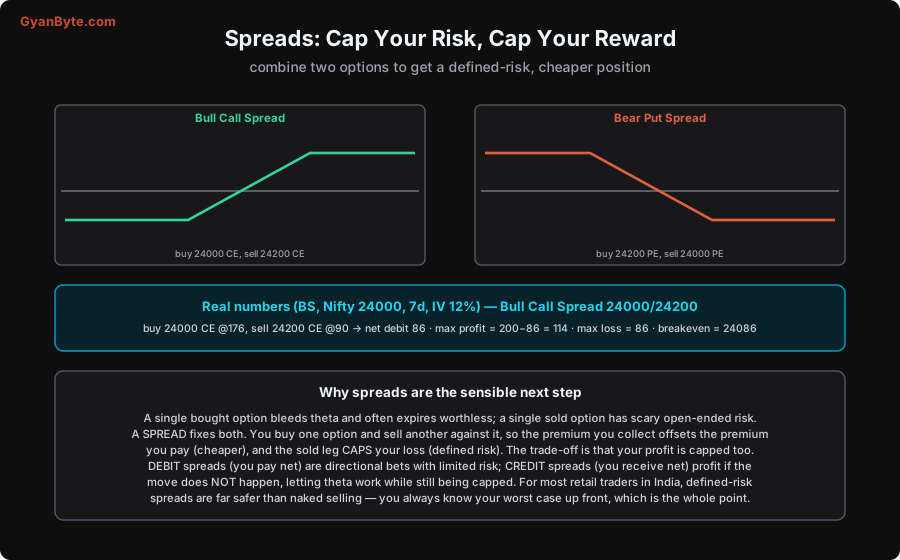
A spread is two options of the same type (both calls, or both puts) at different strikes — you buy one and sell the other. The sold option does two jobs: its premium reduces your cost, and it caps your loss. In return, your profit is capped too. You give up the home-run for a known, limited risk — a trade most experienced people happily make.
Bull call spread (a bounded bullish bet)
You expect the underlying to rise, but not infinitely. So you buy a call and sell a higher-strike call against it. With real Black-Scholes numbers (Nifty 24,000, 7 days, IV 12%):
Buy  24000 CE @ 176     (you pay)
Sell 24200 CE @  90     (you receive)
-----------------------------------
Net debit   = 176 − 90  =  86 points      ← this is your MAX LOSS
Strikes gap = 24200 − 24000 = 200
Max profit  = 200 − 86  = 114 points
Breakeven   = 24000 + 86 = 24086
So for 86 points of risk you can make 114 — a clean, defined-risk bullish trade. Compare it to simply buying the 24000 call for 176: the spread costs less than half, and your breakeven is lower (24086 vs 24176). The price you pay is that your profit stops at 114 no matter how high Nifty goes.
import numpy as np

def bull_call_spread(spot, k_long, k_short, debit):
    long_leg  = np.maximum(spot - k_long, 0)
    short_leg = np.maximum(spot - k_short, 0)
    return (long_leg - short_leg) - debit     # payoff in points at expiry

spot = np.linspace(23600, 24600, 400)
pnl  = bull_call_spread(spot, 24000, 24200, debit=86)
# max profit = 114 above 24200, max loss = -86 below 24000, breakeven at 24086
Bear put spread (the mirror)
Bearish but not expecting a crash? Buy a put and sell a lower-strike put. Same logic, flipped: defined risk, capped profit, cheaper than a single put. It profits as the underlying falls, up to the lower strike.
Debit vs credit spreads — a key distinction
- Debit spread — you pay a net premium (the bought leg costs more than the sold leg). It is a directional bet with limited risk: you need the move to happen. Bull call spread and bear put spread are debit spreads.
- Credit spread — you receive a net premium (the sold leg is worth more). It profits if the move does NOT happen — you keep the credit as long as the underlying stays on the right side, letting theta work for you. A bull put spread (sell a higher put, buy a lower put) is a credit spread that profits if the market stays up or rises.
The beauty of both is the same: defined risk. Because you always own the further-out “wing”, your maximum loss is capped and known the moment you enter. For retail traders in India this matters enormously — naked option selling can lose far more than you expect, but a credit spread has a hard, known worst case. That single property makes spreads the responsible way to sell premium.
Pitfalls
- Spreads on illiquid strikes. Two legs means two bid-ask spreads to cross. Trade liquid strikes or the costs eat your edge.
- Forgetting both legs settle. On expiry, both options settle — don’t let the sold leg surprise you. Square off or let both settle cleanly.
- Treating a credit spread as “free money”. It is capped-risk, not no-risk. The max loss is (strike gap − credit); size for that, not for the credit.
Recap
A spread buys one option and sells another, making the position cheaper and — crucially — defined-risk. Bull call / bear put spreads are directional debit bets; credit spreads profit if the move doesn’t happen, with theta on your side. Profit is capped, loss is capped and known. For most people, spreads are the sane way to trade options.
Next: Lesson 9 — Advanced Strategies, where we combine more legs for volatility bets: straddles, strangles, iron condors and butterflies.