Two ideas in this lesson — moneyness and payoffs — and once they are in your bones, reading an option chain becomes second nature.
Moneyness: where the strike sits
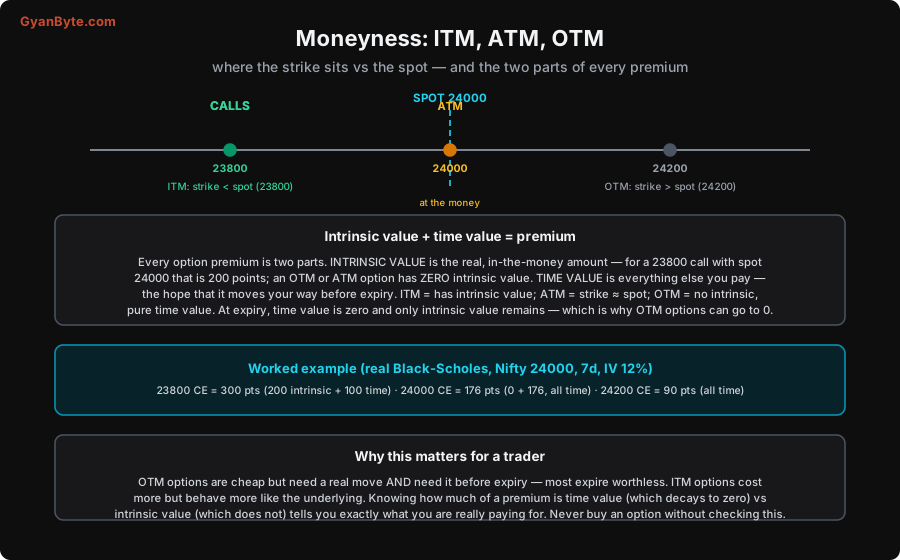
Moneyness just describes where the strike is relative to the current spot price:
- ITM (In The Money) — the option already has real value if exercised now. A call is ITM when strike < spot; a put is ITM when strike > spot.
- ATM (At The Money) — strike ≈ spot. The most actively traded, and the most sensitive to time and volatility.
- OTM (Out of The Money) — no value if exercised now. A call is OTM when strike > spot; a put is OTM when strike < spot. These are cheap, and most of them expire worthless.
The two parts of every premium
This is the single most useful mental model for a premium:
premium = intrinsic value + time value- Intrinsic value is the real, in-the-money amount —
max(spot − strike, 0)for a call. It cannot go negative. An ATM or OTM option has zero intrinsic value. - Time value is everything else — the market’s price for the hope that the option moves your way before expiry. It is highest for ATM options and it decays to zero by expiry (this is theta, Lesson 4).
With real Black-Scholes numbers (Nifty spot 24,000, 7 days to expiry, IV 12%):
23,800 CE = 300 pts  = 200 intrinsic + 100 time value   (ITM)
24,000 CE = 176 pts  =   0 intrinsic + 176 time value    (ATM — ALL time value)
24,200 CE =  90 pts  =   0 intrinsic +  90 time value    (OTM — ALL time value)
Notice: when you buy that ATM or OTM call, you are paying for pure hope — time value that will melt to zero if the market does not move. That is why “cheap” OTM options are not actually cheap in any useful sense; they are usually a bet that is very likely to lose.
The four payoff shapes
Now the shapes. A payoff diagram plots your profit/loss (y-axis) against the underlying’s price at expiry (x-axis). Four shapes cover the basic building blocks — learn them cold.
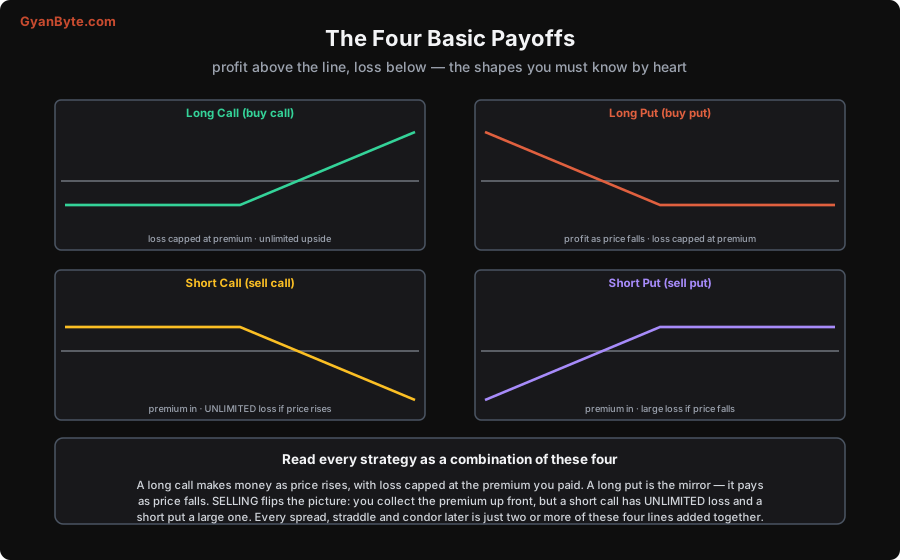
- Long call (you buy a call): flat loss (the premium) until the strike, then profit rising with the price. Loss capped, upside large.
- Long put (you buy a put): the mirror — profit as the price falls, loss capped at the premium.
- Short call (you sell a call): flat profit (the premium) until the strike, then loss that keeps growing — unlimited to the upside.
- Short put (you sell a put): flat profit (the premium) on the upside, large loss as the price falls.
A little Python to draw any of these:
import numpy as np
import matplotlib.pyplot as plt

def long_call(spot, strike, premium):
    return np.maximum(spot - strike, 0) - premium

spot = np.linspace(23000, 25000, 400)
pnl  = long_call(spot, strike=24000, premium=176)   # in points

plt.axhline(0, color="grey", lw=1)
plt.plot(spot, pnl)
plt.title("Long 24000 Call payoff at expiry")
plt.xlabel("Nifty at expiry"); plt.ylabel("P&L (points)")
plt.show()
# breakeven = strike + premium = 24176
Every strategy later in this course — spreads, straddles, condors — is literally two or more of these four lines added together. Once you can picture the shapes, you can picture any strategy’s risk instantly.
Pitfalls
- Buying OTM lottery tickets. They are cheap because they are unlikely to pay. Most expire worthless — you are paying pure time value that decays.
- Confusing premium with intrinsic value. An ATM option is all time value; you are paying entirely for hope that melts.
- Reading the payoff at today’s price instead of expiry. Payoff diagrams are at expiry; before that, time value and IV also move the price (Lessons 4–5).
Recap
Moneyness tells you where the strike sits (ITM/ATM/OTM). Every premium splits into intrinsic value (real, in-the-money) plus time value (hope, decays to zero). The four payoff shapes — long/short call, long/short put — are the alphabet of options; every strategy is built from them.
Next: Lesson 4 — The Greeks, where we measure exactly how an option’s price moves — and meet theta, the melting ice cube.