Now the famous four-letter-word strategies. The key mental shift here: these are not direction bets. They are bets on volatility — on how much the market moves, regardless of which way. This is a whole second axis of trading, and it is where options get genuinely interesting.
The shapes
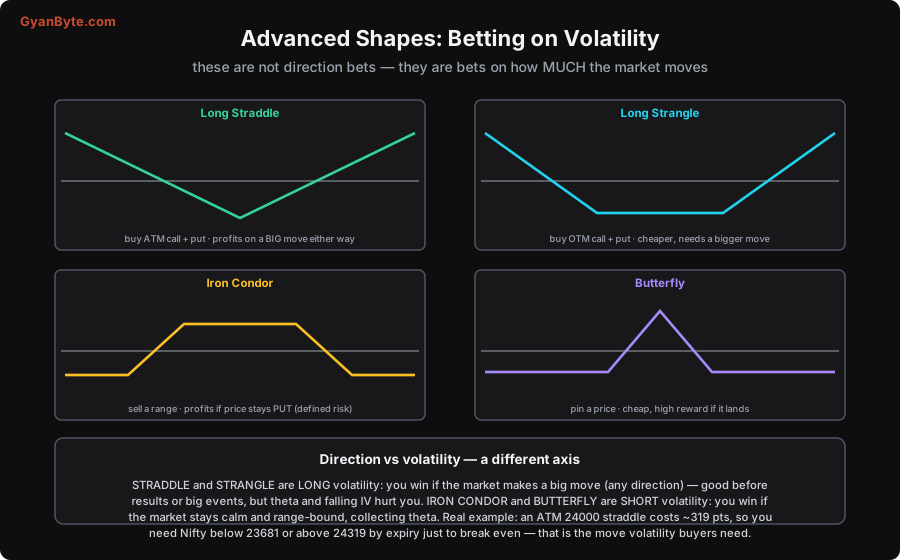
Long straddle and strangle (betting on a big move)
- Long straddle — buy an ATM call and put at the same strike. You profit if the underlying makes a big move in either direction. With real numbers, an ATM Nifty 24,000 straddle costs
176 + 143 = 319 points— so your breakevens are24000 ± 319 = 23,681 and 24,319. Nifty must move more than 319 points by expiry just for you to break even. That is the cost of betting on movement without picking a side. - Long strangle — buy an OTM call and an OTM put. Cheaper than a straddle (both legs are OTM), but you need an even bigger move to profit, because you start further from the money.
Both are long volatility: you want a big move and you benefit if IV rises. They shine before uncertain events (results, big announcements) — but beware: IV is usually already high before known events, and theta and IV crush work against you. Many a trader has bought a straddle before results, been right that the stock moved, and still lost because IV collapsed afterwards.
Iron condor and butterfly (betting on calm)
- Iron condor — sell an OTM call spread and an OTM put spread at the same time. You collect premium and profit if the underlying stays within a range until expiry. Because you buy the outer wings, it is defined-risk. This is the classic “the market will do nothing” income trade — short volatility, collecting theta, popular in calm, high-IV-rank conditions.
- Butterfly — buy one, sell two, buy one (e.g. a 23,900 / 24,000 / 24,100 call butterfly). Cheap, with a sharp peak profit if the underlying pins near the middle strike at expiry. A low-cost, high-reward-if-it-lands bet on a specific price.
Both are short volatility: you want the market to be boring, and you benefit if IV falls.
Direction vs volatility: the second axis
This is the lesson to internalise. Every option position sits on two axes:
- Direction — up, down, or neutral.
- Volatility — do you want a big move (long vol: straddle, strangle) or calm (short vol: condor, butterfly, most premium selling)?
So before choosing a structure, answer two questions: which way (if any) do I lean, and is IV high or low right now (IV rank, Lesson 6)? Sell premium (condors, spreads) when IV rank is high and you expect calm; buy premium (straddles) when IV is low and you expect a storm. Matching the structure to your volatility view — not just your price view — is what separates thoughtful options trading from gambling.
Pitfalls
- Buying straddles into known events. IV is already pumped up; even a correct move can lose to IV crush. Long vol pays best when IV is low and a surprise comes.
- Naked (undefined) condors/strangles. Selling without the protective wings is open-ended risk. Keep them defined-risk, especially starting out (Lesson 10).
- Four-leg strategies on illiquid options. Four legs = four bid-ask spreads. Only trade liquid underlyings (Nifty, Bank Nifty) or costs destroy the edge.
Recap
Straddles and strangles are long volatility — bet on a big move either way, but fight theta and IV crush. Iron condors and butterflies are short volatility — bet on calm, collect theta, keep them defined-risk. The big idea: direction and volatility are separate axes; choose your structure for both, guided by IV rank.
Next: Lesson 10 — Risk & Position Sizing, the most important lesson in the course — how to not blow up.