This lesson is the vocabulary you must own before anything else makes sense. Spend time here — every later lesson is just these pieces combined.
Call and put: the two building blocks
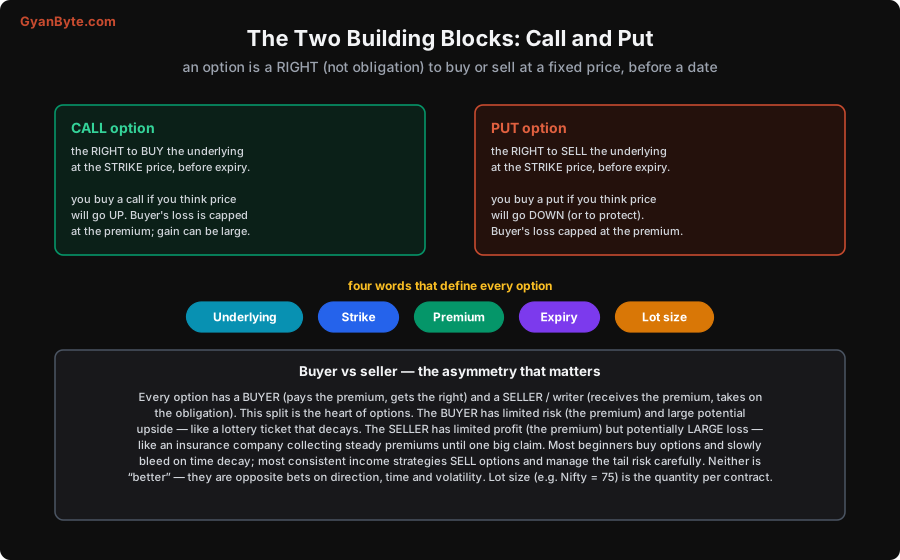
There are exactly two kinds of option, and everything is built from them:
- A call is the right to buy the underlying at the strike price. You buy a call when you expect the price to go up. If Nifty is at 24,000 and you buy a 24,200 call, you have locked in the right to “buy Nifty at 24,200” — which becomes valuable if Nifty climbs well past 24,200.
- A put is the right to sell the underlying at the strike price. You buy a put when you expect the price to go down, or to protect something you own (like insurance). A 23,800 put lets you “sell Nifty at 23,800” — valuable if Nifty falls below that.
The five words that define any option
Every option contract is fully described by five things:
- Underlying — what the option is on. For us, usually an index (Nifty 50, Bank Nifty) or a stock.
- Strike — the fixed price at which you can buy (call) or sell (put). Strikes come in fixed steps (e.g. every 50 or 100 points for Nifty).
- Premium — the price of the option itself, quoted in points. This is what the buyer pays and the seller receives. It moves constantly with the market.
- Expiry — the deadline. Indian index options have weekly and monthly expiries. After expiry the option is settled and gone.
- Lot size — options trade in fixed quantities called lots. One Nifty lot is currently 75 units (SEBI revises these periodically, so always check the current value). So one Nifty option at a premium of 176 points costs
176 × 75 = ₹13,200.
In India, both index and single-stock options are European-style (exercised only at expiry, though you can buy or sell them any time before). The difference is settlement: index options are cash-settled (you receive/pay the cash difference, no delivery of the index), while stock options are physically settled — if they expire in-the-money you actually take or give delivery of the shares, which catches people out every expiry. (This is different from the US, where stock options are American-style; don’t carry that assumption over.)
The buyer–seller asymmetry (this is the big one)
Here is the idea that trips up most beginners, so let us be very clear. Every single option has two sides:
- The buyer pays the premium and gets the right. Their maximum loss is the premium — known, limited, small. Their upside can be large. They are like someone holding a lottery ticket that slowly loses value.
- The seller (or “writer”) receives the premium and takes on the obligation. Their maximum profit is the premium — limited. But their loss can be large: for a sold (naked) call, theoretically unlimited, because the price can keep rising. They are like an insurance company: steady small premiums coming in, with the risk of a rare big payout.
Buy a 24,000 call for 176 points (1 lot = 75):
  cost today        = 176 × 75 = ₹13,200   ← this is your MAX loss
  if Nifty → 24,500 = (500 − 176) × 75 = ₹24,300 profit
  if Nifty → 23,500 = option expires worthless, you lose ₹13,200

Sell that same call (you are the writer):
  you RECEIVE ₹13,200 today (your max profit)
  if Nifty → 24,500 you LOSE ₹24,300
  if Nifty keeps rising, your loss keeps growing — unlimited
This asymmetry explains almost everything about how options are traded. Beginners usually buy options (limited risk, lottery-ticket feel) and slowly bleed as time decay eats the premium. Consistent income strategies usually sell options (collect premium, win most of the time) and spend all their energy managing that rare-but-large loss. Neither side is “right” — they are opposite bets on direction, time and volatility. Knowing which side you are on, and what your real risk is, is the foundation of not blowing up.
Pitfalls
- Forgetting the lot multiplier. A premium of 176 “points” is ₹13,200 per lot, not ₹176. Always multiply by lot size to see real rupees.
- Buying cheap OTM options because they’re “only ₹20”. Cheap usually means far out-of-the-money and very likely to expire worthless (Lesson 3).
- Selling naked options without understanding the unlimited risk. This is how accounts blow up. We handle selling safely in Lesson 10.
Recap
A call is the right to buy, a put the right to sell, both at a strike before expiry, for a premium, trading in lots. The buyer has limited risk (premium) and big upside; the seller has limited profit (premium) and big risk. Master this asymmetry — the rest of the course is just combinations of these two blocks.
Next: Lesson 3 — Moneyness & Payoffs, where we learn ITM/ATM/OTM, the two parts of every premium, and the four payoff shapes you must know by heart.