If you skip every other lesson, do not skip this one. Strategies are interesting; risk management is what decides whether you are still trading in a year. The uncomfortable truth from Lesson 1 bears repeating: most retail F&O traders in India lose money, and almost always the cause is not a bad strategy — it is poor risk management and over-sizing.
The two risk profiles
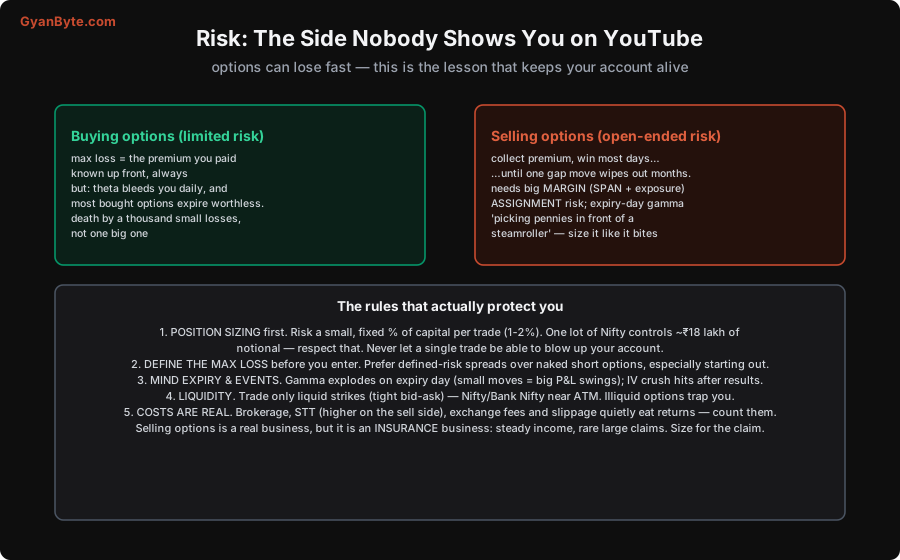
- Buying options — limited risk. Your max loss is the premium, known up front. The danger is subtle: theta bleeds you daily, and most bought options expire worthless. You do not blow up in one trade; you die by a thousand small losses. The fix is discipline: don’t over-trade, respect that time is against you, and take profits.
- Selling options — open-ended risk. You collect premium and win on most days — which is exactly the trap. It feels like free money right up until one gap-down or gap-up wipes out months of gains in a single morning. “Picking up pennies in front of a steamroller” is the famous phrase, and it is accurate. Selling needs large margin and demands real respect for the tail.
The rules that actually protect you
- Position sizing comes first — before strategy, before direction. Risk a small, fixed percentage of your capital per trade (say 1–2%). Remember the scale: one Nifty lot (75) at 24,000 controls
75 × 24000 = ₹18 lakhof notional. That is enormous leverage on a small margin. Never let a single trade be able to seriously dent your account. Most blow-ups are simply too big a position. - Define your maximum loss before you enter. Know the exact worst case in rupees. Strongly prefer defined-risk spreads (Lesson 8) over naked short options, especially while learning — a spread has a hard, known max loss; a naked short call does not.
- Mind expiry and events. On expiry day, ATM gamma explodes — tiny moves cause big P&L swings, and a calm position can turn ugly in minutes. After results, IV crush can hurt option buyers even when they called the direction right. Know the calendar.
- Trade only liquid strikes. Stick to liquid underlyings (Nifty, Bank Nifty) and near-ATM strikes with tight bid-ask spreads. Illiquid options trap you — you can get in but not out at a fair price.
- Count the costs — they are real. Brokerage, exchange fees, and especially STT (Securities Transaction Tax, notably higher on the sell side of options) plus slippage quietly eat returns. A strategy that looks profitable before costs often loses after them. Always model costs in.
Margin, SPAN and assignment
When you sell options in India, you post margin calculated by the SPAN + exposure system — roughly the worst-case loss the exchange thinks the position could suffer in a day. It is large, and it can increase if the market gets volatile, forcing you to add funds or exit at a bad time. Budget for margin expansion, don’t run at the limit.
Assignment is the other seller’s risk: if your sold option is in-the-money near/at expiry, you are obligated to settle. For cash-settled index options this is just a cash difference; for physically-settled stock options it can mean taking/giving delivery, which surprises people every expiry. Know how your contracts settle.
The mindset: it’s an insurance business
Selling options, done well, is a real and sensible business — but it is an insurance business. You collect steady premiums and occasionally pay a large claim. The whole game is sizing for the claim, not for the income. If one bad event can wipe out a year of premiums, you are mis-sized, full stop. The traders who survive think about the rare disaster first and the steady income second. Make that your default too.
Pitfalls
- Sizing by “what I can afford in margin” instead of “what I can afford to lose”. Margin tells you the minimum to enter, not a safe size. Size by risk.
- Naked selling for the thrill of high win-rate. A 95% win rate with a catastrophic 5% is a losing game. Defined-risk, always, until you deeply understand the tail.
- Ignoring costs and taxes. STT and slippage turn many “profitable” strategies into losers. Model every cost.
Recap
Buying options risks only the premium but bleeds on theta; selling has open-ended risk and needs real respect. The rules that keep you alive: size small (1–2% risk), define max loss, prefer defined-risk spreads, mind expiry/events, trade liquid strikes, and count costs. Treat option selling as an insurance business and size for the rare big claim. This lesson, not any strategy, is what keeps you in the game.
Next: Lesson 11 — Data & Tooling Stack, where the programmer’s edge finally comes out to play.