Go for Backend Engineers — Concurrency, Simplicity and Real Numbers
A practical, measurement-grounded course on Go for people who build backend services: why Go's boring-on-purpose design pays off, Go fundamentals fast (explicit errors, no exceptions), implicit interfaces and composition over inheritance, goroutines and the M:N scheduler, channels and CSP, concurrency patterns (worker pools, fan-in/out, context cancellation), sync vs atomic and the race detector, building an HTTP service with net/http, testing and tooling, databases with database/sql and the connection pool, taking a service to production (graceful shutdown, config, structured logs, one static binary), and performance and memory (escape analysis, GC, allocations). Grounded in real Go 1.24 measurements — 1,000,000 goroutines in 586 ms, 12.3M channel messages/sec, mutex vs atomic, stack vs heap allocation.


Most backend languages give you more features every year. Go went the other way: it deliberately left things out — no inheritance, no exceptions, no clever metaprogramming — and bet that a small, boring language would let a team build and run services for years without drowning in cleverness. For backend work, that bet has paid off handsomely. Go compiles to one static binary you can copy and run, starts in milliseconds, sips memory, and has concurrency built into the language rather than bolted on. This course teaches Go the way you will actually use it on the backend — and backs the big claims with numbers I measured, not adjectives.
We start with why Go, then move fast through the fundamentals that trip up newcomers — errors are values you check in plain sight, not exceptions that jump three layers up — and the two ideas that shape every Go codebase: implicit interfaces (a type satisfies an interface just by having the methods) and composition over inheritance (you embed small pieces, you do not build class towers). Then the heart of the language: goroutines and the scheduler (how a million goroutines run on a handful of OS threads), channels and CSP (“share memory by communicating”), concurrency patterns (worker pools, fan-in/out, pipelines, and context cancellation), and protecting shared state (channel vs mutex vs atomic, and the race detector that keeps you honest).
From there it is production backend engineering: building an HTTP service with the standard library, testing and tooling (table tests, benchmarks, pprof), databases with database/sql and the connection pool that bites everyone once, taking a service to production (graceful shutdown, config, structured logging with slog, one tiny container), and finally performance and memory — escape analysis, the garbage collector, and driving down allocations on the hot path.
It is written in plain Indian English with a working engineer in mind, and it is grounded in real measurements I ran on Go 1.24: a million goroutines launched and finished in 586 ms, a buffered channel pushing 12.3 million messages a second, an atomic counter 2.7× faster than a mutex under contention, near-linear scaling across processors, and a stack allocation 56× faster than a heap one with zero garbage. Every lesson ends with pitfalls and a quick recap.
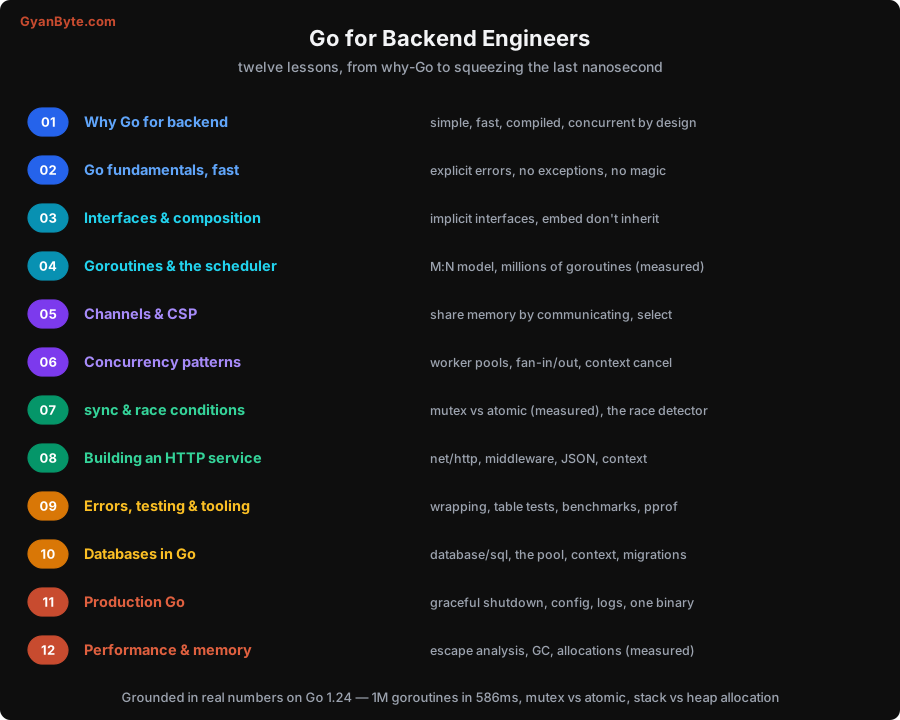
What This Course Covers
| # | Lesson | What you will learn |
|---|---|---|
| 1 | Why Go for Backend | The boring-on-purpose design: simple, fast, one static binary, concurrent |
| 2 | Go Fundamentals, Fast | Errors as values, no exceptions, wrapping with %w, the idioms |
| 3 | Interfaces & Composition | Implicit interfaces, accept interfaces/return structs, embed don’t inherit |
| 4 | Goroutines & the Scheduler | Goroutines vs threads (measured), the G-M-P model, GOMAXPROCS |
| 5 | Channels & CSP | Unbuffered vs buffered, select, close/range, share by communicating |
| 6 | Concurrency Patterns | Worker pools, fan-in/fan-out, pipelines, context cancellation |
| 7 | sync & Race Conditions | Channel vs mutex vs atomic (measured), the race detector |
| 8 | Building an HTTP Service | net/http, routing, middleware, JSON, timeouts, context |
| 9 | Errors, Testing & Tooling | Table tests, benchmarks, pprof, the built-in toolchain |
| 10 | Databases in Go | database/sql, the connection pool, context, rows.Close, migrations |
| 11 | Production Go | Graceful shutdown, 12-factor config, slog, one small static container |
| 12 | Performance & Memory | Escape analysis, stack vs heap (measured), the GC, cutting allocations |
Who Is This For?
- Backend engineers coming from Java, Python, Node.js, or C++ who are picking up Go
- People who can write a bit of Go but want to understand goroutines, channels and the scheduler properly
- Engineers building or operating Go services who want the production and performance details that tutorials skip
- Anyone who wants concurrency explained with real measurements instead of hand-waving
This course pairs naturally with the other backend courses on the site — Node.js Backend Engineering (a great contrast in concurrency models), Database Internals for Backend Engineers (what the pool in Lesson 10 is talking to), Kubernetes for Backend Engineers (where your tiny Go binary ends up running), and Observability & Production Debugging (the p99 tails that Lesson 12’s allocations feed).
How to Use It
Read it in order the first time — it builds from the language up through concurrency to production and performance. After that, keep it as a reference: when you hit a concurrency bug (Lessons 4–7), stand up a service (Lesson 8), wire up a database (Lesson 10), harden for production (Lesson 11), or chase a latency spike to its allocations (Lesson 12), come back to that lesson. The measured numbers are there so you can reason about Go with real figures, and the pitfalls sections are where the hard-won lessons live.
Let’s start with the question that decides whether Go is the right tool at all: why reach for it on the backend.