

You’ve learned the theory. Now let’s build something real.
This capstone project ties together everything from the course: IAM analysis, network security, encryption verification, logging checks, and automated reporting. By the end, you’ll have a working Python CLI that scans an AWS account for the most common security misconfigurations and generates a scored report.
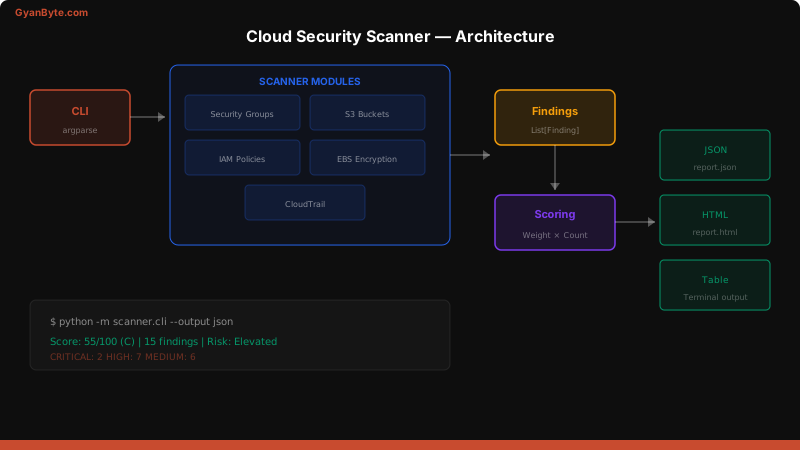
Project Overview
We’re building cloud-sec-scan — a command-line tool that:
- Scans five security domains (Security Groups, S3, IAM, EBS, CloudTrail)
- Scores each finding by severity (Critical, High, Medium, Low)
- Calculates an overall account security score
- Generates an HTML report
Architecture
The scanner follows a modular design:
cloud-sec-scan/
├── scanner/
│   ├── __init__.py
│   ├── cli.py           # CLI entry point
│   ├── base.py          # Base scanner class
│   ├── security_groups.py
│   ├── s3_buckets.py
│   ├── iam_policies.py
│   ├── ebs_encryption.py
│   └── cloudtrail.py
├── scoring/
│   ├── __init__.py
│   └── engine.py        # Severity scoring
├── reporting/
│   ├── __init__.py
│   └── html_report.py   # HTML report generator
├── requirements.txt
└── README.md
Setting Up the Project
mkdir cloud-sec-scan && cd cloud-sec-scan
python -m venv venv
source venv/bin/activate

pip install boto3 jinja2
# requirements.txt
boto3>=1.28.0
jinja2>=3.1.0Base Scanner Class
Every scanner module inherits from a common base:
# scanner/base.py
from dataclasses import dataclass, field
from enum import Enum
from datetime import datetime
from typing import List

class Severity(Enum):
    CRITICAL = 4
    HIGH = 3
    MEDIUM = 2
    LOW = 1
    INFO = 0

@dataclass
class Finding:
    title: str
    description: str
    severity: Severity
    resource_id: str
    resource_type: str
    recommendation: str
    region: str = "global"
    timestamp: str = field(default_factory=lambda: datetime.utcnow().isoformat())

class BaseScanner:
    """Base class for all security scanners"""

    def __init__(self, session=None):
        self.session = session or __import__('boto3').Session()
        self.findings: List[Finding] = []

    def scan(self) -> List[Finding]:
        raise NotImplementedError

    def add_finding(self, **kwargs):
        finding = Finding(**kwargs)
        self.findings.append(finding)
        return finding
Scanner Module 1: Security Groups
Detects security groups with overly permissive ingress rules.
# scanner/security_groups.py
import boto3
from .base import BaseScanner, Severity

DANGEROUS_PORTS = {
    22: "SSH",
    3389: "RDP",
    3306: "MySQL",
    5432: "PostgreSQL",
    27017: "MongoDB",
    6379: "Redis",
    9200: "Elasticsearch",
}

class SecurityGroupScanner(BaseScanner):

    def scan(self):
        ec2 = self.session.client('ec2')
        paginator = ec2.get_paginator('describe_security_groups')

        for page in paginator.paginate():
            for sg in page['SecurityGroups']:
                self._check_ingress_rules(sg)

        return self.findings

    def _check_ingress_rules(self, sg):
        sg_id = sg['GroupId']
        sg_name = sg.get('GroupName', 'unknown')

        for rule in sg.get('IpPermissions', []):
            from_port = rule.get('FromPort', 0)
            to_port = rule.get('ToPort', 65535)

            for ip_range in rule.get('IpRanges', []):
                cidr = ip_range.get('CidrIp', '')
                if cidr == '0.0.0.0/0':
                    self._report_open_rule(sg_id, sg_name, from_port, to_port, cidr)

            for ip_range in rule.get('Ipv6Ranges', []):
                cidr = ip_range.get('CidrIpv6', '')
                if cidr == '::/0':
                    self._report_open_rule(sg_id, sg_name, from_port, to_port, cidr)

    def _report_open_rule(self, sg_id, sg_name, from_port, to_port, cidr):
        # Check if it's a dangerous port
        for port, service in DANGEROUS_PORTS.items():
            if from_port <= port <= to_port:
                self.add_finding(
                    title=f"Security group allows {service} ({port}) from internet",
                    description=f"Security group {sg_id} ({sg_name}) allows inbound traffic on port {port} ({service}) from {cidr}",
                    severity=Severity.CRITICAL,
                    resource_id=sg_id,
                    resource_type="AWS::EC2::SecurityGroup",
                    recommendation=f"Restrict port {port} to specific IP ranges or remove the rule"
                )
                return

        # Generic open port
        if from_port == 0 and to_port == 65535:
            self.add_finding(
                title=f"Security group allows ALL ports from internet",
                description=f"Security group {sg_id} ({sg_name}) allows all inbound traffic from {cidr}",
                severity=Severity.CRITICAL,
                resource_id=sg_id,
                resource_type="AWS::EC2::SecurityGroup",
                recommendation="Remove the 0.0.0.0/0 rule or restrict to specific ports"
            )
        else:
            self.add_finding(
                title=f"Security group allows port {from_port}-{to_port} from internet",
                description=f"Security group {sg_id} ({sg_name}) allows inbound traffic on ports {from_port}-{to_port} from {cidr}",
                severity=Severity.HIGH,
                resource_id=sg_id,
                resource_type="AWS::EC2::SecurityGroup",
                recommendation="Restrict to specific IP ranges"
            )
Scanner Module 2: S3 Buckets
# scanner/s3_buckets.py
from .base import BaseScanner, Severity

class S3BucketScanner(BaseScanner):

    def scan(self):
        s3 = self.session.client('s3')
        s3control = self.session.client('s3control')
        account_id = self.session.client('sts').get_caller_identity()['Account']

        # Check account-level public access block
        try:
            account_block = s3control.get_public_access_block(AccountId=account_id)
            config = account_block['PublicAccessBlockConfiguration']
            if not all([config.get('BlockPublicAcls'), config.get('BlockPublicPolicy'),
                       config.get('IgnorePublicAcls'), config.get('RestrictPublicBuckets')]):
                self.add_finding(
                    title="Account-level S3 Block Public Access is not fully enabled",
                    description="One or more Block Public Access settings are disabled at the account level",
                    severity=Severity.HIGH,
                    resource_id=account_id,
                    resource_type="AWS::S3::AccountPublicAccessBlock",
                    recommendation="Enable all four Block Public Access settings at the account level"
                )
        except Exception:
            self.add_finding(
                title="Account-level S3 Block Public Access is not configured",
                severity=Severity.HIGH,
                description="No account-level public access block found",
                resource_id=account_id,
                resource_type="AWS::S3::AccountPublicAccessBlock",
                recommendation="Enable Block Public Access at the account level"
            )

        # Check individual buckets
        buckets = s3.list_buckets().get('Buckets', [])
        for bucket in buckets:
            name = bucket['Name']
            self._check_encryption(s3, name)
            self._check_versioning(s3, name)
            self._check_logging(s3, name)

        return self.findings

    def _check_encryption(self, s3, bucket_name):
        try:
            s3.get_bucket_encryption(Bucket=bucket_name)
        except s3.exceptions.ClientError:
            self.add_finding(
                title=f"S3 bucket '{bucket_name}' has no default encryption",
                description=f"Bucket {bucket_name} does not have server-side encryption enabled",
                severity=Severity.HIGH,
                resource_id=bucket_name,
                resource_type="AWS::S3::Bucket",
                recommendation="Enable default encryption with KMS or AES-256"
            )

    def _check_versioning(self, s3, bucket_name):
        response = s3.get_bucket_versioning(Bucket=bucket_name)
        if response.get('Status') != 'Enabled':
            self.add_finding(
                title=f"S3 bucket '{bucket_name}' versioning is not enabled",
                description=f"Bucket {bucket_name} does not have versioning enabled",
                severity=Severity.MEDIUM,
                resource_id=bucket_name,
                resource_type="AWS::S3::Bucket",
                recommendation="Enable versioning for data protection and recovery"
            )

    def _check_logging(self, s3, bucket_name):
        response = s3.get_bucket_logging(Bucket=bucket_name)
        if 'LoggingEnabled' not in response:
            self.add_finding(
                title=f"S3 bucket '{bucket_name}' access logging is not enabled",
                description=f"Bucket {bucket_name} does not have access logging enabled",
                severity=Severity.MEDIUM,
                resource_id=bucket_name,
                resource_type="AWS::S3::Bucket",
                recommendation="Enable access logging for audit trail"
            )
Scanner Module 3: IAM Policies
# scanner/iam_policies.py
from .base import BaseScanner, Severity
import json

class IAMScanner(BaseScanner):

    def scan(self):
        iam = self.session.client('iam')

        self._check_root_access_keys(iam)
        self._check_mfa(iam)
        self._check_admin_policies(iam)
        self._check_old_access_keys(iam)

        return self.findings

    def _check_root_access_keys(self, iam):
        summary = iam.get_account_summary()['SummaryMap']
        if summary.get('AccountAccessKeysPresent', 0) > 0:
            self.add_finding(
                title="Root account has access keys",
                description="The root account has active access keys, which is a critical security risk",
                severity=Severity.CRITICAL,
                resource_id="root",
                resource_type="AWS::IAM::User",
                recommendation="Delete root access keys and use IAM roles instead"
            )

    def _check_mfa(self, iam):
        users = iam.list_users()['Users']
        for user in users:
            mfa_devices = iam.list_mfa_devices(UserName=user['UserName'])['MFADevices']
            login_profile_exists = True
            try:
                iam.get_login_profile(UserName=user['UserName'])
            except iam.exceptions.NoSuchEntityException:
                login_profile_exists = False

            if login_profile_exists and not mfa_devices:
                self.add_finding(
                    title=f"IAM user '{user['UserName']}' has console access without MFA",
                    description=f"User {user['UserName']} can log into the console but has no MFA device configured",
                    severity=Severity.HIGH,
                    resource_id=user['UserName'],
                    resource_type="AWS::IAM::User",
                    recommendation="Enable MFA for all console users"
                )

    def _check_admin_policies(self, iam):
        roles = iam.list_roles()['Roles']
        for role in roles:
            policies = iam.list_attached_role_policies(RoleName=role['RoleName'])['AttachedPolicies']
            for policy in policies:
                if policy['PolicyArn'] == 'arn:aws:iam::aws:policy/AdministratorAccess':
                    self.add_finding(
                        title=f"Role '{role['RoleName']}' has AdministratorAccess",
                        description=f"IAM role {role['RoleName']} has the AdministratorAccess managed policy attached",
                        severity=Severity.HIGH,
                        resource_id=role['RoleName'],
                        resource_type="AWS::IAM::Role",
                        recommendation="Replace with least-privilege policy using IAM Access Analyzer"
                    )

    def _check_old_access_keys(self, iam):
        from datetime import datetime, timezone, timedelta
        users = iam.list_users()['Users']
        threshold = datetime.now(timezone.utc) - timedelta(days=90)

        for user in users:
            keys = iam.list_access_keys(UserName=user['UserName'])['AccessKeyMetadata']
            for key in keys:
                if key['Status'] == 'Active' and key['CreateDate'] < threshold:
                    age_days = (datetime.now(timezone.utc) - key['CreateDate']).days
                    self.add_finding(
                        title=f"Access key for '{user['UserName']}' is {age_days} days old",
                        description=f"Access key {key['AccessKeyId']} for user {user['UserName']} was created {age_days} days ago",
                        severity=Severity.MEDIUM,
                        resource_id=key['AccessKeyId'],
                        resource_type="AWS::IAM::AccessKey",
                        recommendation="Rotate access keys every 90 days"
                    )
Scanner Module 4: EBS Encryption
# scanner/ebs_encryption.py
from .base import BaseScanner, Severity

class EBSScanner(BaseScanner):

    def scan(self):
        ec2 = self.session.client('ec2')

        # Check default encryption
        try:
            default_enc = ec2.get_ebs_encryption_by_default()
            if not default_enc.get('EbsEncryptionByDefault'):
                self.add_finding(
                    title="EBS default encryption is not enabled",
                    description="New EBS volumes will not be encrypted by default",
                    severity=Severity.HIGH,
                    resource_id="ebs-default-encryption",
                    resource_type="AWS::EC2::Volume",
                    recommendation="Enable EBS encryption by default for the region"
                )
        except Exception:
            pass

        # Check existing volumes
        paginator = ec2.get_paginator('describe_volumes')
        for page in paginator.paginate():
            for volume in page['Volumes']:
                if not volume.get('Encrypted', False):
                    self.add_finding(
                        title=f"EBS volume {volume['VolumeId']} is not encrypted",
                        description=f"Volume {volume['VolumeId']} (state: {volume['State']}, size: {volume['Size']}GB) is not encrypted",
                        severity=Severity.HIGH,
                        resource_id=volume['VolumeId'],
                        resource_type="AWS::EC2::Volume",
                        recommendation="Create an encrypted snapshot and replace the volume"
                    )

        return self.findings
Scanner Module 5: CloudTrail Status
# scanner/cloudtrail.py
from .base import BaseScanner, Severity

class CloudTrailScanner(BaseScanner):

    def scan(self):
        ct = self.session.client('cloudtrail')
        trails = ct.describe_trails()['trailList']

        if not trails:
            self.add_finding(
                title="No CloudTrail trails configured",
                description="This account has no CloudTrail trails. API calls are not being logged.",
                severity=Severity.CRITICAL,
                resource_id="cloudtrail",
                resource_type="AWS::CloudTrail::Trail",
                recommendation="Create a multi-region trail with log file validation"
            )
            return self.findings

        for trail in trails:
            name = trail['Name']
            status = ct.get_trail_status(Name=name)

            if not status.get('IsLogging'):
                self.add_finding(
                    title=f"CloudTrail '{name}' is not logging",
                    description=f"Trail {name} exists but logging is stopped",
                    severity=Severity.CRITICAL,
                    resource_id=name,
                    resource_type="AWS::CloudTrail::Trail",
                    recommendation="Start logging immediately — this may indicate tampering"
                )

            if not trail.get('IsMultiRegionTrail'):
                self.add_finding(
                    title=f"CloudTrail '{name}' is not multi-region",
                    description=f"Trail {name} only covers one region. Activity in other regions is not logged.",
                    severity=Severity.HIGH,
                    resource_id=name,
                    resource_type="AWS::CloudTrail::Trail",
                    recommendation="Enable multi-region logging"
                )

            if not trail.get('LogFileValidationEnabled'):
                self.add_finding(
                    title=f"CloudTrail '{name}' log file validation is disabled",
                    description=f"Without log validation, tampered logs cannot be detected",
                    severity=Severity.MEDIUM,
                    resource_id=name,
                    resource_type="AWS::CloudTrail::Trail",
                    recommendation="Enable log file validation"
                )

        return self.findings
Scoring Engine
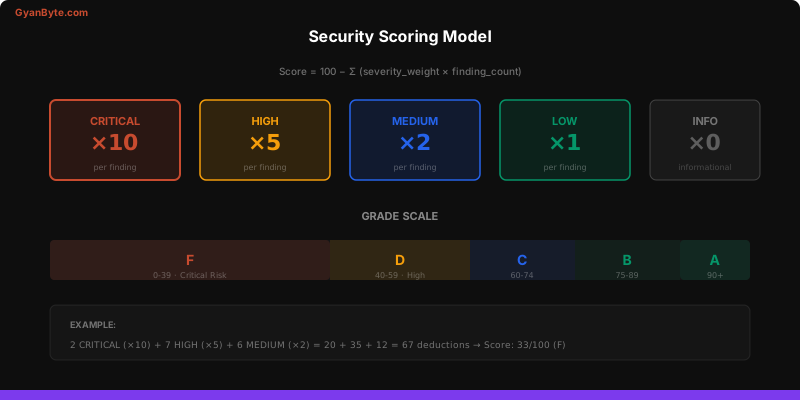
# scoring/engine.py
from scanner.base import Severity, Finding
from typing import List

SEVERITY_WEIGHTS = {
    Severity.CRITICAL: 10,
    Severity.HIGH: 5,
    Severity.MEDIUM: 2,
    Severity.LOW: 1,
    Severity.INFO: 0,
}

def calculate_score(findings: List[Finding]) -> dict:
    if not findings:
        return {"score": 100, "grade": "A+", "risk_level": "Low"}

    total_deductions = sum(SEVERITY_WEIGHTS[f.severity] for f in findings)
    max_score = 100
    score = max(0, max_score - total_deductions)

    counts = {}
    for severity in Severity:
        counts[severity.name] = len([f for f in findings if f.severity == severity])

    if score >= 90:
        grade, risk = "A", "Low"
    elif score >= 75:
        grade, risk = "B", "Moderate"
    elif score >= 60:
        grade, risk = "C", "Elevated"
    elif score >= 40:
        grade, risk = "D", "High"
    else:
        grade, risk = "F", "Critical"

    return {
        "score": score,
        "grade": grade,
        "risk_level": risk,
        "total_findings": len(findings),
        "counts": counts,
    }
CLI Entry Point
# scanner/cli.py
import argparse
import json
from datetime import datetime

from scanner.security_groups import SecurityGroupScanner
from scanner.s3_buckets import S3BucketScanner
from scanner.iam_policies import IAMScanner
from scanner.ebs_encryption import EBSScanner
from scanner.cloudtrail import CloudTrailScanner
from scoring.engine import calculate_score

SCANNERS = {
    "security-groups": SecurityGroupScanner,
    "s3": S3BucketScanner,
    "iam": IAMScanner,
    "ebs": EBSScanner,
    "cloudtrail": CloudTrailScanner,
}

def main():
    parser = argparse.ArgumentParser(description="Cloud Security Scanner")
    parser.add_argument("--modules", nargs="+", choices=list(SCANNERS.keys()) + ["all"],
                       default=["all"], help="Modules to run")
    parser.add_argument("--output", choices=["json", "html", "table"],
                       default="table", help="Output format")
    parser.add_argument("--output-file", type=str, help="Output file path")
    args = parser.parse_args()

    modules = list(SCANNERS.keys()) if "all" in args.modules else args.modules
    all_findings = []

    print(f"\n{'='*60}")
    print(f"  Cloud Security Scanner — {datetime.utcnow().strftime('%Y-%m-%d %H:%M UTC')}")
    print(f"{'='*60}\n")

    for module_name in modules:
        scanner_class = SCANNERS[module_name]
        print(f"  Scanning: {module_name}...", end=" ", flush=True)
        scanner = scanner_class()
        findings = scanner.scan()
        all_findings.extend(findings)
        print(f"found {len(findings)} findings")

    # Score
    result = calculate_score(all_findings)

    print(f"\n{'='*60}")
    print(f"  Score: {result['score']}/100 (Grade: {result['grade']})")
    print(f"  Risk Level: {result['risk_level']}")
    print(f"  Total Findings: {result['total_findings']}")
    for severity, count in result['counts'].items():
        if count > 0:
            print(f"    {severity}: {count}")
    print(f"{'='*60}\n")

    if args.output == "json":
        output = {
            "scan_time": datetime.utcnow().isoformat(),
            "score": result,
            "findings": [
                {
                    "title": f.title,
                    "severity": f.severity.name,
                    "resource_id": f.resource_id,
                    "resource_type": f.resource_type,
                    "description": f.description,
                    "recommendation": f.recommendation,
                }
                for f in all_findings
            ]
        }
        if args.output_file:
            with open(args.output_file, 'w') as f:
                json.dump(output, f, indent=2)
            print(f"Report saved to {args.output_file}")
        else:
            print(json.dumps(output, indent=2))

    elif args.output == "table":
        for f in sorted(all_findings, key=lambda x: x.severity.value, reverse=True):
            icon = {"CRITICAL": "🔴", "HIGH": "🟠", "MEDIUM": "🟡", "LOW": "🟢"}.get(f.severity.name, "⚪")
            print(f"  {icon} [{f.severity.name}] {f.title}")
            print(f"     Resource: {f.resource_id}")
            print(f"     Fix: {f.recommendation}\n")

if __name__ == "__main__":
    main()
Running the Scanner
# Scan everything
python -m scanner.cli

# Scan specific modules
python -m scanner.cli --modules security-groups s3

# JSON output
python -m scanner.cli --output json --output-file report.json

# Example output:
# ============================================================
#   Cloud Security Scanner — 2026-04-04 14:30 UTC
# ============================================================
#
#   Scanning: security-groups... found 3 findings
#   Scanning: s3... found 5 findings
#   Scanning: iam... found 4 findings
#   Scanning: ebs... found 2 findings
#   Scanning: cloudtrail... found 1 findings
#
# ============================================================
#   Score: 55/100 (Grade: C)
#   Risk Level: Elevated
#   Total Findings: 15
#     CRITICAL: 2
#     HIGH: 7
#     MEDIUM: 6
# ============================================================
Extending the Scanner
The modular design makes it easy to add new scanners:
# scanner/rds_security.py — add RDS checks
class RDSScanner(BaseScanner):
    def scan(self):
        rds = self.session.client('rds')
        instances = rds.describe_db_instances()['DBInstances']
        for db in instances:
            if db.get('PubliclyAccessible'):
                self.add_finding(
                    title=f"RDS instance '{db['DBInstanceIdentifier']}' is publicly accessible",
                    severity=Severity.CRITICAL,
                    # ...
                )
        return self.findings
Ideas for extension:
- RDS security — public access, encryption, backup retention
- Lambda security — runtime versions, VPC config, environment variables
- VPC security — flow logs, default VPC usage, peering
- GuardDuty — check if enabled, unresolved findings
- Secrets Manager — rotation status, age of secrets
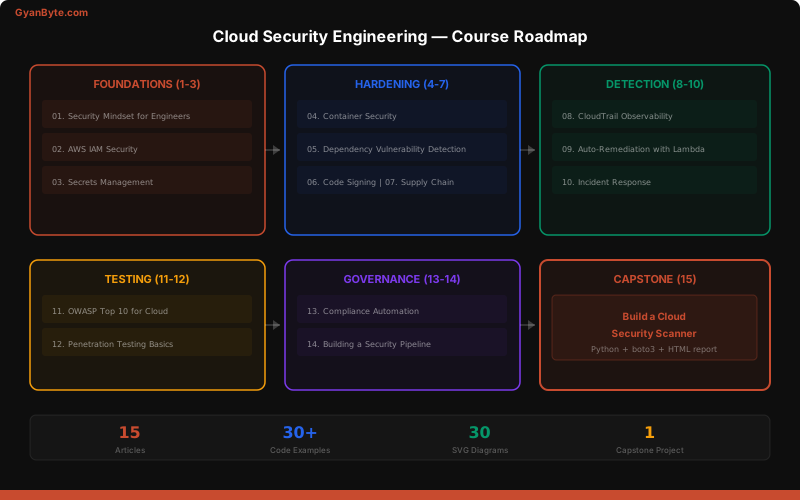
Course Roadmap
Key Takeaways
- Modular design — each scanner is independent and testable
- Severity scoring — not all findings are equal, weight them appropriately
- Actionable output — every finding includes a specific recommendation
- Easy to extend — add new scanners by implementing
BaseScanner.scan() - Run regularly — integrate into CI/CD or run as a scheduled Lambda
Course Wrap-Up
Over 15 articles, we’ve covered the full spectrum of cloud security engineering:
- Foundations (1-3): Security mindset, IAM mastery, secrets management
- Hardening (4-7): Container security, dependency scanning, code signing, supply chain
- Detection (8-10): CloudTrail observability, auto-remediation, incident response
- Testing (11-12): OWASP for cloud, penetration testing basics
- Governance (13-14): Compliance automation, security pipelines
- Capstone (15): Building a real security scanner
Security engineering isn’t a destination — it’s a practice. The tools and techniques in this course give you the foundation to build, operate, and defend cloud systems with confidence. Now go build something secure.


