
Schema Design Philosophy
MongoDB schema design is fundamentally different from relational databases. Instead of normalizing data, you design schemas around your query patterns.
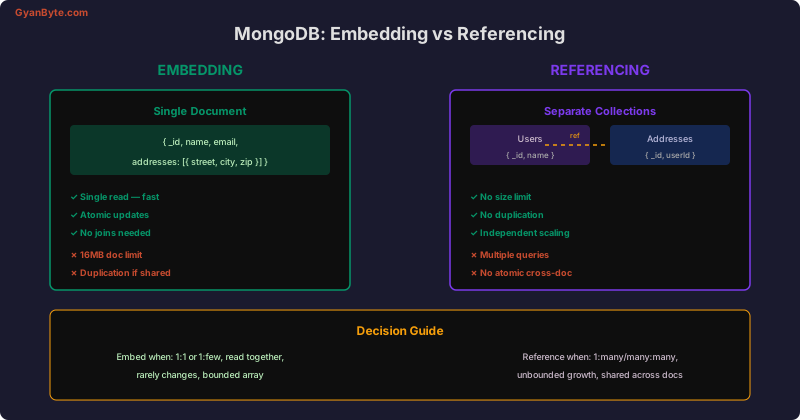
Mongoose Schema Definition
const mongoose = require('mongoose');
const { Schema } = mongoose;

// Address schema (embedded subdocument)
const addressSchema = new Schema({
  street: { type: String, required: true },
  city: { type: String, required: true },
  state: { type: String, required: true },
  zip: { type: String, required: true, match: /^\d{5}(-\d{4})?$/ },
  isPrimary: { type: Boolean, default: false },
});

// User schema
const userSchema = new Schema({
  name: {
    type: String,
    required: [true, 'Name is required'],
    trim: true,
    minlength: 2,
    maxlength: 100,
  },
  email: {
    type: String,
    required: true,
    unique: true,
    lowercase: true,
    match: [/^\S+@\S+\.\S+$/, 'Invalid email format'],
  },
  passwordHash: { type: String, required: true, select: false },
  role: { type: String, enum: ['user', 'admin', 'moderator'], default: 'user' },
  addresses: [addressSchema],  // Embedded
  orders: [{ type: Schema.Types.ObjectId, ref: 'Order' }],  // Referenced
  lastLoginAt: Date,
}, {
  timestamps: true,  // Adds createdAt and updatedAt
  toJSON: { virtuals: true },
  toObject: { virtuals: true },
});

// Virtual field (computed, not stored)
userSchema.virtual('displayName').get(function() {
  return `${this.name} (${this.role})`;
});

// Compound index
userSchema.index({ email: 1 }, { unique: true });
userSchema.index({ role: 1, createdAt: -1 });

const User = mongoose.model('User', userSchema);
Middleware (Pre/Post Hooks)
const bcrypt = require('bcrypt');

// Pre-save hook — hash password before saving
userSchema.pre('save', async function(next) {
  if (!this.isModified('passwordHash')) return next();
  this.passwordHash = await bcrypt.hash(this.passwordHash, 12);
  next();
});

// Pre-find hook — exclude deleted users by default
userSchema.pre(/^find/, function(next) {
  this.find({ deletedAt: { $exists: false } });
  next();
});

// Post-save hook — log new user creation
userSchema.post('save', function(doc) {
  if (doc.wasNew) {
    console.log(`New user created: ${doc.email}`);
  }
});

// Instance method
userSchema.methods.comparePassword = async function(candidatePassword) {
  return bcrypt.compare(candidatePassword, this.passwordHash);
};

// Static method
userSchema.statics.findByEmail = function(email) {
  return this.findOne({ email: email.toLowerCase() });
};
Population (Joins)
// Order schema with references
const orderSchema = new Schema({
  user: { type: Schema.Types.ObjectId, ref: 'User', required: true },
  items: [{
    product: { type: Schema.Types.ObjectId, ref: 'Product' },
    quantity: { type: Number, min: 1 },
    price: Number,
  }],
  total: Number,
  status: { type: String, enum: ['pending', 'shipped', 'delivered'], default: 'pending' },
}, { timestamps: true });

// Populate user and product references
const order = await Order.findById(orderId)
  .populate('user', 'name email')        // Only select name and email
  .populate('items.product', 'name price image');

// Virtual populate (reverse reference without storing IDs)
userSchema.virtual('recentOrders', {
  ref: 'Order',
  localField: '_id',
  foreignField: 'user',
  options: { sort: { createdAt: -1 }, limit: 5 },
});

const user = await User.findById(userId).populate('recentOrders');
Aggregation Pipeline
For complex data transformations, use the aggregation pipeline.
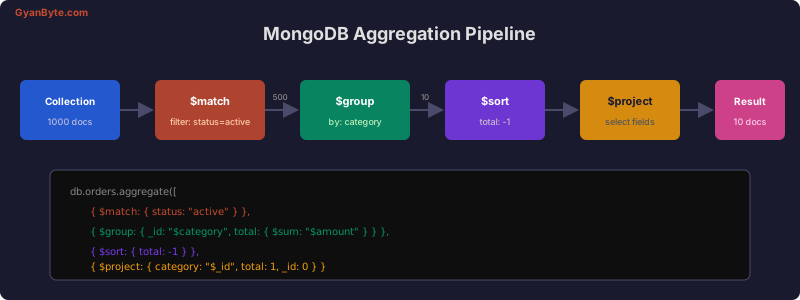
// Revenue by category for the last 30 days
const revenue = await Order.aggregate([
  // Stage 1: Filter recent delivered orders
  {
    $match: {
      status: 'delivered',
      createdAt: { $gte: new Date(Date.now() - 30 * 24 * 60 * 60 * 1000) },
    },
  },
  // Stage 2: Unwind items array (one doc per item)
  { $unwind: '$items' },
  // Stage 3: Lookup product details
  {
    $lookup: {
      from: 'products',
      localField: 'items.product',
      foreignField: '_id',
      as: 'productInfo',
    },
  },
  { $unwind: '$productInfo' },
  // Stage 4: Group by category
  {
    $group: {
      _id: '$productInfo.category',
      totalRevenue: { $sum: { $multiply: ['$items.price', '$items.quantity'] } },
      orderCount: { $sum: 1 },
      avgOrderValue: { $avg: { $multiply: ['$items.price', '$items.quantity'] } },
    },
  },
  // Stage 5: Sort by revenue
  { $sort: { totalRevenue: -1 } },
  // Stage 6: Reshape output
  {
    $project: {
      _id: 0,
      category: '$_id',
      totalRevenue: { $round: ['$totalRevenue', 2] },
      orderCount: 1,
      avgOrderValue: { $round: ['$avgOrderValue', 2] },
    },
  },
]);
Indexing Strategies
// Single field index
userSchema.index({ email: 1 });

// Compound index (order matters!)
// Supports queries on: { role }, { role, createdAt }, but NOT { createdAt } alone
orderSchema.index({ status: 1, createdAt: -1 });

// Text index for full-text search
productSchema.index({ name: 'text', description: 'text' });
const results = await Product.find({ $text: { $search: 'wireless headphones' } });

// TTL index (auto-delete expired documents)
sessionSchema.index({ expiresAt: 1 }, { expireAfterSeconds: 0 });

// Partial index (index only matching documents)
userSchema.index(
  { email: 1 },
  { partialFilterExpression: { role: 'admin' } }
);
Common Pitfalls and Fixes
1. Unbounded Arrays
// BAD: Array grows forever — hits 16MB limit
const chatSchema = new Schema({
  participants: [ObjectId],
  messages: [{           // Can grow to millions!
    sender: ObjectId,
    text: String,
    sentAt: Date,
  }],
});

// GOOD: Separate collection for messages
const messageSchema = new Schema({
  chatId: { type: ObjectId, ref: 'Chat', index: true },
  sender: { type: ObjectId, ref: 'User' },
  text: String,
  sentAt: { type: Date, default: Date.now },
});
messageSchema.index({ chatId: 1, sentAt: -1 });
2. Missing lean() for Read-Only Queries
// Without lean(): Returns full Mongoose documents (change tracking, virtuals, methods)
// ~3x slower, ~3x more memory
const users = await User.find({ role: 'user' });

// With lean(): Returns plain JavaScript objects
// Much faster for read-only operations
const users = await User.find({ role: 'user' }).lean();
3. N+1 Query Problem
// BAD: One query per order for user data
const orders = await Order.find();
for (const order of orders) {
  order.userName = (await User.findById(order.user)).name; // N queries!
}

// GOOD: Use populate
const orders = await Order.find().populate('user', 'name');

// BETTER for complex joins: Use aggregation $lookup
const orders = await Order.aggregate([
  { $lookup: { from: 'users', localField: 'user', foreignField: '_id', as: 'userInfo' } },
  { $unwind: '$userInfo' },
  { $project: { total: 1, status: 1, userName: '$userInfo.name' } },
]);
4. Not Handling Connection Errors
const mongoose = require('mongoose');

async function connectDB() {
  try {
    await mongoose.connect(process.env.MONGODB_URI, {
      maxPoolSize: 10,
      serverSelectionTimeoutMS: 5000,
      socketTimeoutMS: 45000,
    });
    console.log('MongoDB connected');
  } catch (err) {
    console.error('MongoDB connection error:', err);
    process.exit(1);
  }
}

mongoose.connection.on('disconnected', () => {
  console.warn('MongoDB disconnected. Attempting reconnect...');
});

mongoose.connection.on('error', (err) => {
  console.error('MongoDB error:', err);
});

// Graceful shutdown
process.on('SIGTERM', async () => {
  await mongoose.connection.close();
  process.exit(0);
});
Performance Tips
- Use
select()to return only needed fields — reduces network transfer and memory - Use
lean()for read-only queries — skips hydration overhead - Create compound indexes matching your query patterns — check with
explain() - Avoid
$whereand JavaScript execution in queries — can’t use indexes - Use
bulkWrite()for batch operations — reduces round trips - Set
maxPoolSizebased on your workload — default 5 is often too low
// Bulk operations
await User.bulkWrite([
  { updateOne: { filter: { _id: id1 }, update: { $set: { role: 'admin' } } } },
  { updateOne: { filter: { _id: id2 }, update: { $inc: { loginCount: 1 } } } },
  { deleteOne: { filter: { _id: id3 } } },
]);
MongoDB with Mongoose is powerful when you design schemas around access patterns. The key mistakes to avoid: unbounded arrays, missing indexes, and over-populating when aggregation would be more efficient.

