

In the previous article I argued that AI is not killing software engineering — it is pushing our value up the stack, from typing towards judgment, verification and ownership. Fine. But “build judgment” is useless advice if I don’t tell you how. So this one is fully practical. No philosophy, just the playbook I would give my own junior self today.
A quick honest note first: I am not writing this from some mountain-top. I am figuring a lot of this out myself, in real time, like all of us. So take it as notes from a fellow traveller, not a guru.
Become T-shaped (this is the whole strategy in one picture)
If you remember only one thing from this article, remember this shape.
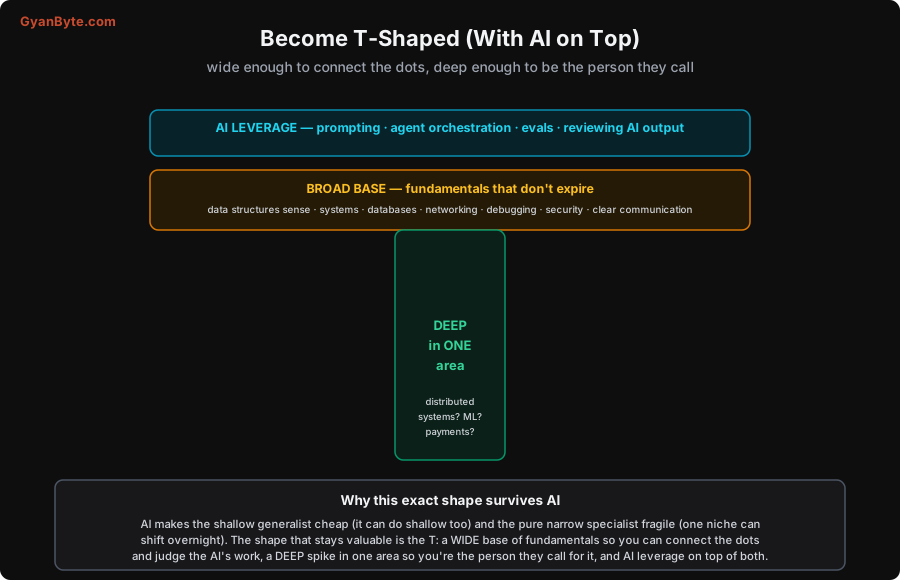
- The wide base — fundamentals that do not expire. Data-structure sense, how systems and databases and networks actually work, debugging, security basics, and clear communication. Frameworks come and go; these do not. AI makes a shallow generalist cheap (it can do shallow too), so a thin base is not enough — but a strong base is what lets you judge whether the AI’s code is any good.
- The deep spike — be the person they call for ONE thing. Pick an area and go genuinely deep: distributed systems, ML, payments, frontend performance, databases, security — whatever pulls you. A pure narrow specialist is fragile (a niche can shift), but combined with the wide base it makes you the person a team cannot replace with a prompt.
- AI leverage on top. Prompting well, orchestrating agents, writing evals, reviewing AI output critically. This is a real skill now, and it multiplies everything below it.
Generalist-only is cheap. Specialist-only is fragile. T-shaped is safe.
The one habit that beats everything: learn WITH AI, not INSTEAD of learning
This is the most imporant section, so read it twice. AI is the best learning tool our field has ever had — a patient tutor that will explain anything, at exactly your level, instantly. Used well, it makes you grow maybe three times faster. Used lazily, the same tool quietly rots the exact muscles that make you valuable. Same tool, opposite outcomes.
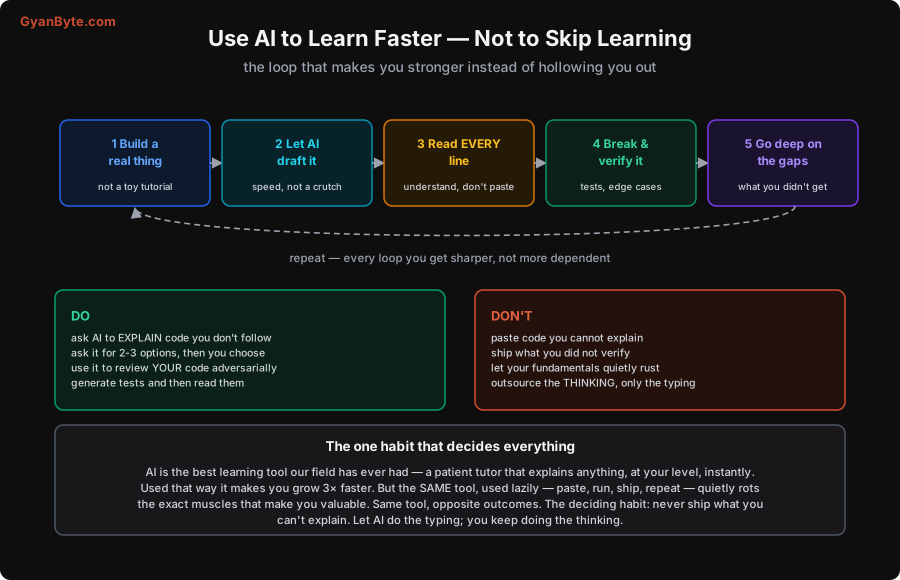
The loop that keeps you growing:
- Build a real thing — not a toy tutorial you copy step by step. A real project with real messy requirements.
- Let AI draft it — use the speed, no guilt. This is the whole point of the tool.
- Read every single line — and here is the rule that decides your whole career: understand what you accept. If you cannot explain why a line is there, you do not get to ship it yet.
- Break it and verify it — write tests, try the edge cases, feed it bad input. This is where real understanding forms.
- Go deep on the gaps — whatever the AI did that you did not fully follow, that is your study list for the week. Go and actually learn it.
The one-line version: never ship code you cannot explain. Let AI do the typing; you keep doing the thinking. Do this and every project makes you sharper. Skip it and every project makes you more dependent and more replaceable.
The concrete skills to grow (in rough priority)
If you want a checklist to actually work on, here it is, roughly most-important first:
- Judgment and taste — knowing what to build, which trade-off is right, when “good enough” is actually good enough. This is the top skill now, and you build it by making real decisions and living with the consequences.
- Verifying AI output — reading code critically, spotting the subtle bug, knowing what to test. You are becoming the senior reviewer of a very fast junior.
- System design — how pieces fit at scale. AI writes a function; it does not design your system. Our System Design Masterclass and the system design patterns are a good path here.
- Debugging — the one thing AI is still genuinely weak at, because real bugs need understanding of the whole running system, not one file. Become the person who can debug anything.
- Specs and communication — turning a vague human need into a crisp, clear problem statement. Half of “prompting well” is just being good at this.
- Domain depth — understand the business, the users, the money. A dev who understands why beats ten who only know how.
- AI-leverage skills — prompting, agents, evals. Learn to build with models, not just use a chat window. The AI Agent Development and LLM Engineering courses are built for this.
If you are junior
Your situation is different, so let me be direct. The “easy” starter tasks you used to learn from are exactly what AI now does. So you have to be deliberate about learning, or you will plateau. Do this: fight with the AI’s code. Don’t just accept it — ask why it did that, change it, break it, ask it to explain, re-implement a piece yourself without help. Treat AI as a tutor you are arguing with, not a vending machine. The juniors who do this will become strong seniors faster than any generation before them, honestly, because they have a tutor on tap. The ones who paste and ship will stay stuck at junior forever, no matter how many years pass.
If you are senior
Raise your altitude. Your value was never really in typing — it was in design, judgment, mentoring and ownership, and all of those just became more important. Use AI to clear the grunt work off your plate so you have more time for the hard architectural and people problems. Review AI-generated code with the same rigour you would review a junior’s. And please mentor the juniors on how to think, not just what to type — that is how the whole field stays healthy, and it is on us.
Takeaways
- Be T-shaped: a wide base of non-expiring fundamentals, one deep spike where you’re essential, and AI leverage on top. Generalist-only is cheap, specialist-only is fragile.
- Learn WITH AI, not instead of learning: build real things, let AI draft, read and understand every line, break and verify, go deep on the gaps. Never ship what you can’t explain.
- Grow the skills AI can’t replace: judgment, verifying output, system design, debugging, communication, domain depth — plus real AI-leverage skills.
- Juniors: fight the AI’s code, don’t accept it blindly. Seniors: raise your altitude to design, review, ownership, and mentor on thinking.
Start with the big-picture article if you missed it. Then go build the fundamentals: the System Design Masterclass, the Staff Engineer track for the judgment-and-ownership side, and AI Agent Development to get real AI-leverage skills. Now stop reading and go build somthing you can’t fully do yet — that is where all the growth is.


