A voicebot that works in a demo and a voicebot that works in production are different things. The demo has you, speaking clearly, asking expected questions, on good audio. Production has tired callers, background noise, strong accents, half-sentences, silence, abuse, and your providers occasionally failing — all at once, at scale. This final-stretch lesson is about surviving that: testing before launch, monitoring in flight, handling failure gracefully, and scaling. It’s the least glamorous lesson and the one that decides whether your voicebot is trusted or abandoned.
Test, Monitor, Handle Failure
Three disciplines run in parallel in production.
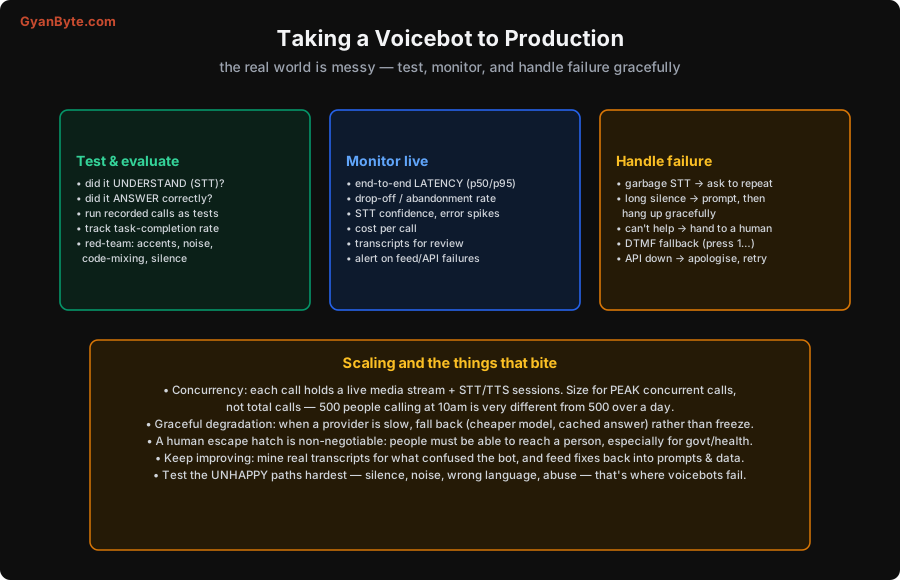
Test & evaluate. Before and after every change, ask two questions: did the bot understand (STT got the words right) and did it answer correctly (the right response/action)? Make this systematic:
- Run recorded calls as regression tests. Keep a suite of real (anonymised) and synthetic call audio, run them through the pipeline, and check the outcomes. This catches regressions when you swap a model or edit a prompt.
- Track task-completion rate — did the caller actually get what they came for (the answer, the booking, the gatepass)? This is the metric that matters, more than any component accuracy.
- Red-team the hard cases — strong accents, background noise, code-mixing, silence, people going off-script, abuse. Production is the hard cases; test them deliberately.
Monitor live. You can’t fix what you can’t see:
- End-to-end latency (p50 and p95) — not just the average; the p95 (the slow tail) is what frustrates users. Alert if it creeps up (Lesson 8).
- Drop-off / abandonment rate — where do callers hang up? A spike at one step means that step is broken or confusing.
- STT confidence and error spikes — a drop in confidence often means a noisy line, an accent the model struggles with, or an upstream issue.
- Cost per call (Lesson 11) — watch it so a change doesn’t quietly blow the budget.
- Transcripts for review — keep (privacy-respecting, Lesson 13) transcripts so you can see what actually happened.
- Alert on feed/API failures — STT/TTS/LLM provider outages, telephony issues, a dead media stream.
Handle failure gracefully. Things will go wrong on a call; the bot must degrade like a competent human, not freeze:
- Garbage STT (noise, mumbling) → “Sorry, I didn’t catch that — could you say it again?” rather than acting on nonsense (Lesson 6).
- Long silence → prompt once (“Are you still there?”), then hang up gracefully (and stop billing, Lesson 11).
- Can’t help → hand off to a human (below) rather than loop.
- DTMF fallback — when speech keeps failing, offer the keypad (“press 1 for English, 2 for Hindi”). Reliable when audio is hard (Lesson 2).
- API down → apologise, retry, or fall back (a cheaper model, a cached answer) — never dead silence or a crash.
Scaling and the Things That Bite
A few production realities that catch teams out:
- Scale for peak concurrent calls, not total calls. Each live call holds a media stream plus active STT and TTS sessions — real, sustained resources. 500 people calling at 10am (a scheme deadline, a sale) is a completely different load from 500 calls spread over a day. Size and autoscale for the concurrency peak, and load-test it.
- Degrade gracefully under provider slowness. When a provider gets slow or flaky, fall back (a cheaper/faster model, a cached answer) rather than letting calls freeze. A slightly worse answer now beats a timeout.
- A human escape hatch is non-negotiable. People must be able to reach a person — especially for government, health, or anything high-stakes. A bot with no path to a human traps frustrated callers and does real harm. Build the handoff (to a queue, a callback, a number) and make it easy to trigger.
- Keep improving from real calls. Mine your transcripts (Lesson 13 on privacy) for where the bot got confused, misheard, or failed to complete the task, and feed fixes back into prompts, data and endpointing. A voicebot is never “done”; it improves with the real calls it sees.
- Test the unhappy paths hardest. Voicebots rarely fail on the clean, expected conversation — they fail on silence, noise, the wrong language, interruptions, abuse, and provider hiccups. That’s where your testing and failure-handling effort should concentrate, because that’s where production lives.
Put simply: a production voicebot is judged not on its best call but on its worst call that a real person experiences. Engineering for the messy edges — and watching them in monitoring — is what turns an impressive demo into a service people actually rely on.
Pitfalls to Avoid
- Shipping a demo. The happy path working once isn’t production. Test the hard cases, monitor live, and handle failure before you launch.
- No regression tests. Swapping a model or editing a prompt silently breaks things. Run recorded calls as tests on every change.
- Watching averages, not p95. The slow tail frustrates users. Monitor p95 latency and drop-off, not just means.
- Freezing on failure. Garbage STT, silence, or an API outage must degrade gracefully (re-ask, DTMF fallback, cached answer, apologise) — never dead air or a crash.
- Sizing for total, not peak concurrent, calls. Each call holds live resources; peak concurrency is what you must handle. Load-test it.
- No human escape hatch. Non-negotiable, especially for govt/health. A trapped, frustrated caller is worse than no bot.
- Never mining transcripts. The real calls tell you exactly what to fix. Review them (privately, Lesson 13) and keep improving.
Quick Recap
- Test & evaluate: did it understand (STT) and answer correctly? Run recorded calls as regression tests, track task-completion rate, and red-team accents/noise/code-mixing/silence.
- Monitor live: p50/p95 latency, drop-off, STT confidence, cost per call, transcripts, and alert on provider failures.
- Handle failure gracefully: re-ask on garbage STT, prompt-then-hang-up on silence, DTMF fallback, apologise/retry on API down, and hand off to a human.
- Scale for peak concurrency, degrade gracefully, keep a human escape hatch (non-negotiable for govt/health), and mine real transcripts to improve. Test the unhappy paths hardest.
Next lesson, the last: the responsibility that comes with a system that records people talking — security, privacy and compliance (consent, DPDP, PII in recordings, TRAI rules, and abuse).