A voicebot can be a wonderful demo and a terrible business if it costs more per call than the call is worth. Because voicebots bill per minute across several services, costs add up fast at scale — a helpline doing 10,000 minutes a day is a very different bill depending on your choices. The good news: the difference between a naive stack and a well-engineered one is enormous (illustratively ~6×), and most of the savings cost the caller nothing in experience. This lesson shows where the money goes and how to cut it. (Every figure here is illustrative — provider pricing shifts constantly, so use this as a model to compute your numbers.)
Where the Money Goes
Your per-minute cost is the sum of the pipeline: STT + LLM + TTS + telephony + infrastructure. Here are two example stacks, same one-minute call, very different bills.
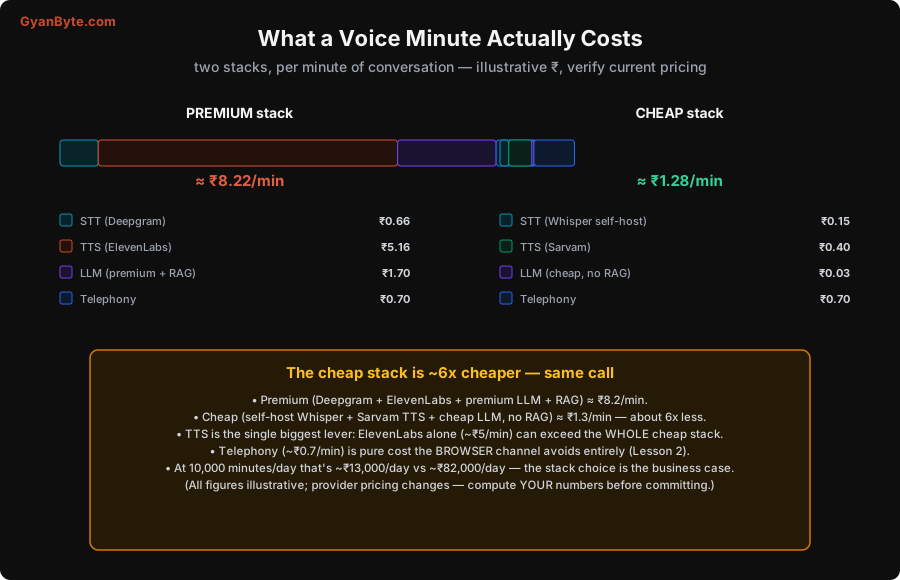
Read the two stacks:
- Premium (Deepgram STT + ElevenLabs TTS + a premium LLM with RAG + telephony) ≈ ₹8.2/min.
- Cheap (self-hosted Whisper STT + Sarvam TTS + a cheap LLM, no RAG + telephony) ≈ ₹1.3/min — about 6× less for the same call.
Two things jump out. First, TTS is the single biggest lever: ElevenLabs alone (~₹5/min in this example) can cost more than the entire cheap stack. Your TTS choice (Lesson 5) dominates the bill. Second, telephony (~₹0.7/min) is a floor the browser channel avoids entirely (Lesson 2) — for browser/app users you simply don’t pay it. At scale the gap is the business case: 10,000 minutes/day is roughly ₹13,000/day vs ₹82,000/day — ~₹25 lakh/year of difference from stack choices alone.
Nine Levers to Make It Cheap
Here are the levers, biggest savings first. Most are invisible to the caller.
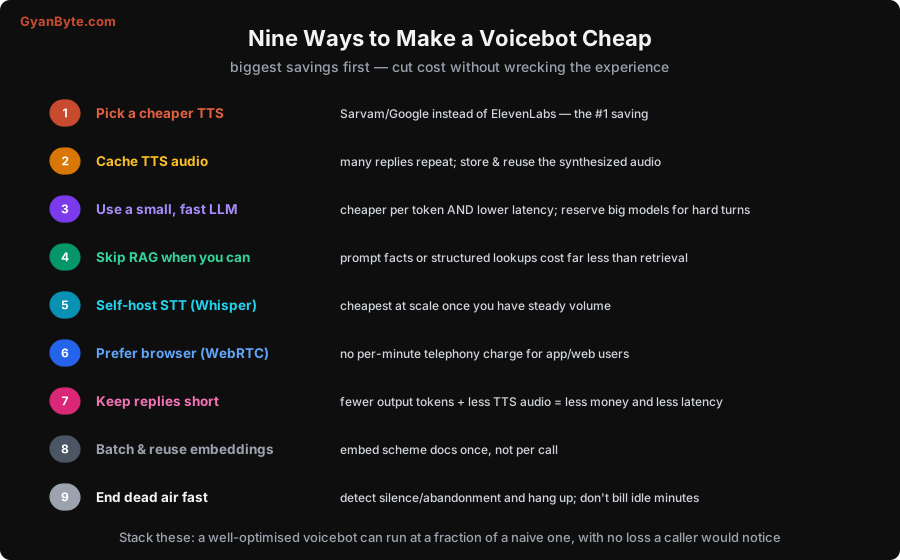
- Pick a cheaper TTS. The #1 saving. Sarvam or Google instead of ElevenLabs often cuts the biggest line item by ~10×, for Indian voices that are perfectly good for most use cases (Lesson 5). Reserve premium voice for where quality is the product.
- Cache TTS audio. Many replies repeat — greetings, “please hold,” common answers (Lesson 9). Synthesize once, store the audio, reuse it. Free and instant thereafter, and it cuts latency too (Lesson 8).
- Use a small, fast LLM. Cheaper per token and lower time-to-first-token (Lessons 6, 8). Route only genuinely hard turns to a bigger model; most turns don’t need it.
- Skip RAG when you can. Prompt facts or structured lookups cost far less than embedding + retrieval per query (Lesson 9). Don’t pay for RAG you don’t need.
- Self-host STT (Whisper). Once you have steady volume, running your own STT on a GPU is cheapest at scale — you trade per-minute API fees for amortised compute (Lesson 4).
- Prefer the browser (WebRTC) where you can. App and web users cost no telephony (Lesson 2). Steer users who can use the browser to it; reserve the phone line for those who need it.
- Keep replies short. Fewer output tokens (LLM cost) and less audio to synthesize (TTS cost) — and it’s more listenable and faster too (Lessons 6, 8). Verbosity pays triple.
- Batch and reuse embeddings. Embed your scheme documents once (Lesson 9), not per call. Precompute, don’t re-embed on every query.
- End dead air fast. Detect silence or an abandoned call and hang up gracefully (Lesson 12) — don’t bill idle minutes where STT/telephony keep running while nobody’s there.
The key insight: these stack. Each is a modest saving; together they take you from the premium ₹8/min toward the cheap ₹1/min — a well-optimised voicebot runs at a fraction of a naive one, and a caller wouldn’t notice the difference (a good Sarvam voice, a fast small model, and a cached greeting feel fine). The savings come from engineering, not from degrading the experience.
How to Think About It
A few framing principles:
- Model your real traffic. Build a little spreadsheet (or script, as this course did) with your expected minutes, turns per call, languages, and the providers you’re considering, and compute ₹/min and ₹/day. The stack decision is a business decision; make it with numbers, not vibes.
- Optimise the biggest line first. TTS, then telephony (via browser), then the LLM — in roughly that order of impact for a typical voicebot. Don’t micro-optimise STT while paying ElevenLabs for everything.
- Match spend to value. A high-value, low-volume concierge bot can justify premium everything; a high-volume citizen helpline must be lean. Spend where the use case warrants it.
- Pricing changes — recompute. Providers change prices and launch cheaper models often. Revisit the math periodically; a quarterly recompute can save a lot.
And the honest caveat one more time: all the numbers in this lesson are illustrative. They show the shape — TTS dominates, browser saves telephony, cheap stacks are ~6× less — which is stable, but the exact rupees are not. Compute your own before committing budget.
Pitfalls to Avoid
- Defaulting to premium TTS. It’s usually your biggest cost (~10× cheaper alternatives exist). Pick a cost-effective Indic TTS unless quality is the product.
- Not caching repeated audio/answers. Callers repeat questions; cache TTS and answers to cut both cost and latency (Lessons 5, 9).
- Using a big LLM for every turn. Most turns need a small fast model; reserve big ones for hard cases. Cheaper and faster (Lessons 6, 8).
- Paying for telephony you could avoid. Browser/app users cost no telephony. Steer them to the browser where possible (Lesson 2).
- RAG everywhere. It adds cost and latency; use prompt/structured data where they suffice (Lesson 9).
- Billing idle minutes. Silence or abandoned calls keep meters running. Detect and hang up gracefully (Lesson 12).
- Guessing instead of modelling. Compute ₹/min on your real traffic; the stack choice is worth lakhs at scale. (And recompute as pricing changes.)
Quick Recap
- Cost is per-minute: STT + LLM + TTS + telephony + infra. Illustratively, premium ≈ ₹8.2/min vs cheap ≈ ₹1.3/min — ~6× difference for the same call.
- TTS is usually the biggest lever (ElevenLabs alone can exceed the whole cheap stack); telephony is a floor the browser avoids.
- Nine stacking levers: cheaper TTS, cache audio, small fast LLM, skip RAG when you can, self-host STT at scale, prefer browser, keep replies short, reuse embeddings, end dead air fast — all largely invisible to the caller.
- Model your real traffic, optimise the biggest line first, match spend to value, and recompute as pricing changes. All figures illustrative.
Next lesson: getting it into production and keeping it there — testing, monitoring, scaling to many concurrent calls, and handling the messy failure paths where voicebots break.