We finish with the part that’s easy to skip and dangerous to get wrong. A voicebot is not just a clever conversation engine — it’s a data-collection system that happens to talk. By its nature it captures people’s voices, transcribes everything they say, and in many use cases collects deeply personal data: Aadhaar numbers, phone numbers, addresses, health details, financial information. That carries real legal and ethical responsibility, especially in India under the DPDP Act, and especially for government and healthcare use. This lesson covers what you must handle; treat it as a floor, not a ceiling.
What You Must Handle
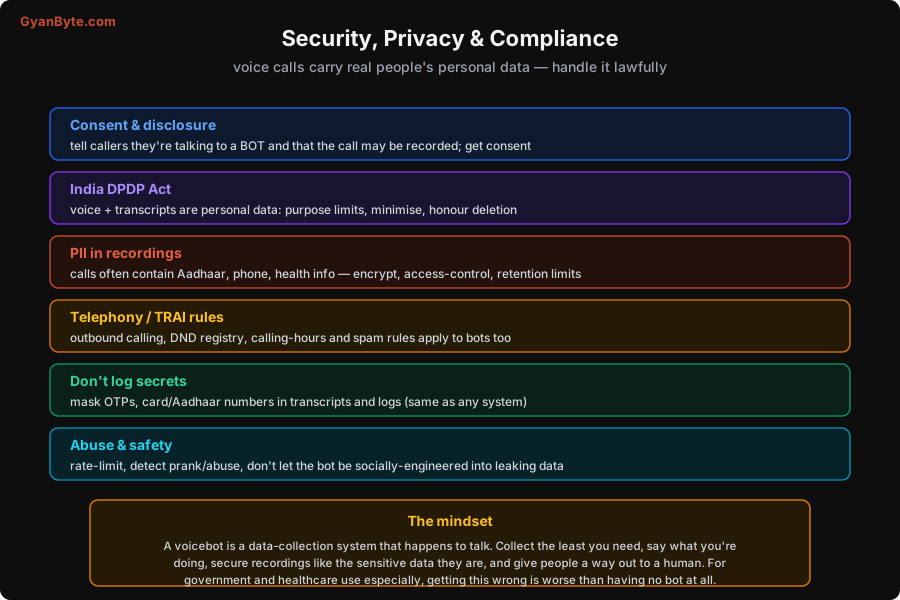
- Consent & disclosure. Tell callers up front that they’re talking to a bot (not a human pretending), and that the call may be recorded — and get consent where required. People have a right to know they’re talking to an AI and that their words are being captured. This is both a legal expectation and basic honesty.
- India’s DPDP Act (2023). Voice recordings and transcripts are personal data under the Digital Personal Data Protection Act. That means: collect for a stated purpose and don’t quietly reuse it, minimise what you collect (every extra field is extra liability), secure it, and honour user rights including deletion. Build these in — “we can’t delete a caller’s data” is both a compliance failure and a design smell.
- PII in recordings. Calls to a government or health or banking bot routinely contain Aadhaar numbers, phone numbers, health information, financial details. Treat recordings and transcripts as the sensitive data they are: encrypt them at rest and in transit, access-control who can listen/read, and set retention limits (don’t keep recordings forever “just in case”).
- Telephony / TRAI rules. Outbound calling (reminders, surveys — Lesson 10) is regulated: respect the DND (Do Not Disturb) registry, calling-hours limits, and anti-spam rules. These apply to bots making calls just as to humans. Getting this wrong risks penalties and blocked numbers.
- Don’t log secrets. The same rule as any system (see the security course): mask OTPs, card numbers, and Aadhaar in transcripts and logs. A transcript is a log, and logs leak — a captured OTP or Aadhaar in plain text is a breach waiting to happen. Redact sensitive fields before they’re stored.
- Abuse & safety. People will prank, abuse, and try to manipulate your bot. Rate-limit to prevent abuse and runaway cost, detect prank/abusive callers, and — importantly — don’t let the bot be socially-engineered into revealing data it shouldn’t (e.g. someone impersonating another user to extract their details). The LLM’s guardrails (Lesson 6) extend to not leaking data under manipulation.
The Mindset
The framing that ties it together, and that should guide every design decision: a voicebot is a data-collection system that happens to talk. Once you see it that way, the obligations are obvious:
- Collect the least you need. Don’t ask for or store data the use case doesn’t require. The data you don’t hold can’t leak and isn’t your liability (DPDP minimisation).
- Say what you’re doing. Disclose the bot, the recording, and the purpose. Honesty is both lawful and trust-building.
- Secure recordings like the sensitive data they are. Encrypt, access-control, retain minimally, and mask secrets. A leaked call archive is a serious breach.
- Give people a way out to a human (Lesson 12). For high-stakes matters — government entitlements, health, money — a human escape hatch isn’t just UX; it’s an ethical requirement. People in difficulty deserve to reach a person.
And the sharpest version of the point, especially for the government-schemes and healthcare use cases this course highlighted: getting this wrong is worse than having no bot at all. A helpline that leaks citizens’ Aadhaar numbers, or gives wrong entitlement information (Lesson 6 grounding), or calls people at 2am violating TRAI rules, does active harm — to the people it was meant to help and to the trust in the service. The compliance and safety work isn’t bureaucratic overhead on top of the “real” engineering; for a system that handles vulnerable people’s personal data by voice, it is the real engineering.
A Practical Checklist
Before you launch, confirm:
- Disclosure: does the bot state it’s an AI and that the call may be recorded, at the start?
- Consent: do you have the consent you need for recording and for the data you collect?
- Minimisation: are you collecting only what the use case requires?
- Encryption & access: are recordings/transcripts encrypted and access-controlled?
- Retention: is there a defined retention period and a deletion path (DPDP rights)?
- Secret masking: are OTPs/Aadhaar/card numbers redacted from transcripts and logs?
- Outbound rules: for outbound, do you respect DND, calling hours and anti-spam rules?
- Abuse controls: rate limits, abuse detection, and guardrails against data-leaking manipulation?
- Human escape hatch: can a caller always reach a person?
Tick those and you’ve handled the responsibilities that come with building a voicebot people can trust.
Pitfalls to Avoid
- Not disclosing the bot or the recording. People have a right to know they’re talking to an AI and being recorded. Disclose it up front and get consent.
- Treating voice/transcripts as not “personal data.” Under DPDP they are. Minimise, state your purpose, secure them, and honour deletion.
- Leaving PII in recordings unprotected. Aadhaar, health, financial data in call archives must be encrypted, access-controlled, and retention-limited.
- Logging secrets in transcripts. OTPs/Aadhaar/card numbers in plain-text transcripts are a breach. Mask them before storage.
- Ignoring TRAI/DND rules for outbound. Bots making calls must respect DND, calling hours and anti-spam rules, or face penalties and blocks.
- No abuse or social-engineering defence. Rate-limit, detect abuse, and ensure the bot won’t be talked into leaking another user’s data (Lesson 6).
- No human escape hatch for high-stakes use. For govt/health/money, trapping people with a bot is harmful. Always offer a human (Lesson 12).
Quick Recap
- A voicebot is a data-collection system that happens to talk — voices, transcripts, and often Aadhaar/health/financial data. Handle it lawfully.
- Disclose the bot and recording and get consent; under DPDP, voice/transcripts are personal data — minimise, state purpose, secure, honour deletion.
- Protect PII in recordings (encrypt, access-control, retention limits), mask secrets (OTP/Aadhaar/card) in transcripts/logs, and follow TRAI/DND rules for outbound.
- Guard against abuse and social engineering, and always offer a human escape hatch. For government and healthcare, getting this wrong is worse than having no bot.
That’s the course. You now understand a voicebot end to end: the STT→LLM→TTS loop, the phone and browser channels and the WebSocket/WebRTC transports beneath them, each pipeline component and how to choose providers for Indian use, orchestration with Pipecat, the latency and barge-in work that makes it feel human, giving it knowledge the right way, real use cases from government schemes to gatepasses, the cost engineering that makes it viable, and the production and compliance discipline that makes it trustworthy. Go build a small one — a single use case, in the browser first, then on a phone number — and grow it from there. Build it honestly, collect the least you need, keep a human in reach, and you’ll have something genuinely useful.