A team spent six weeks fine-tuning a model to answer questions about their product, feeding it their entire documentation. It worked, until the documentation changed the next month, and the model confidently gave the old answers. They had used fine-tuning to teach facts, which is exactly what it’s bad at. The facts should have gone in a retrieval system (RAG); fine-tuning should have been used, if at all, to teach the format and tone of a good answer.
Fine-tuning is powerful and, with LoRA, surprisingly cheap and accessible. But it’s misused more than almost any other LLM technique. This lesson shows what it actually does, with a real training run, and when to reach for it.
What Fine-Tuning Is For (and Not For)
Fine-tuning adjusts a model’s weights on your examples so it behaves more like them. It’s good at teaching behaviour:
- Format: always output this exact JSON schema, this table structure, this template.
- Style and tone: your brand’s voice, a specific level of formality, replies in Hinglish, concise medical summaries.
- A narrow skill: classify into your 30 categories, extract your specific fields, follow your domain’s conventions.
- Implicit rules that are hard to write as a prompt: what counts as a policy violation in your domain, how to triage.
It’s bad at teaching facts, especially facts that change:
- Your current product catalogue, prices, policies, inventory. These change; the model’s weights don’t. Use RAG (put the facts in a retrieval system and feed them in the prompt).
- Knowledge you need to update frequently. Re-fine-tuning for every change is slow and expensive.
The rule I use: fine-tune for how to say it, retrieve for what to say. And before fine-tuning at all, try the cheaper options first: a better prompt, few-shot examples in the prompt, or RAG. Fine-tune only when prompting plateaus and you have enough good examples. Often you won’t need to.
Why LoRA Changed the Economics
Full fine-tuning updates all the model’s weights. For an 8B model that means gradients and optimizer state for 8 billion parameters, which needs many times the model’s size in GPU memory (weights + gradients + two Adam states + an fp32 master copy ≈ 16 bytes/param ≈ 128 GB for 8B). That’s multiple high-end GPUs, for one experiment.
LoRA (Low-Rank Adaptation) sidesteps this. The insight: the change a fine-tune makes to a big weight matrix is usually low-rank, it can be captured by two small matrices multiplied together. So you freeze the original weight W and learn a small update B·A, where A and B are thin (rank r, e.g. 8 or 16).
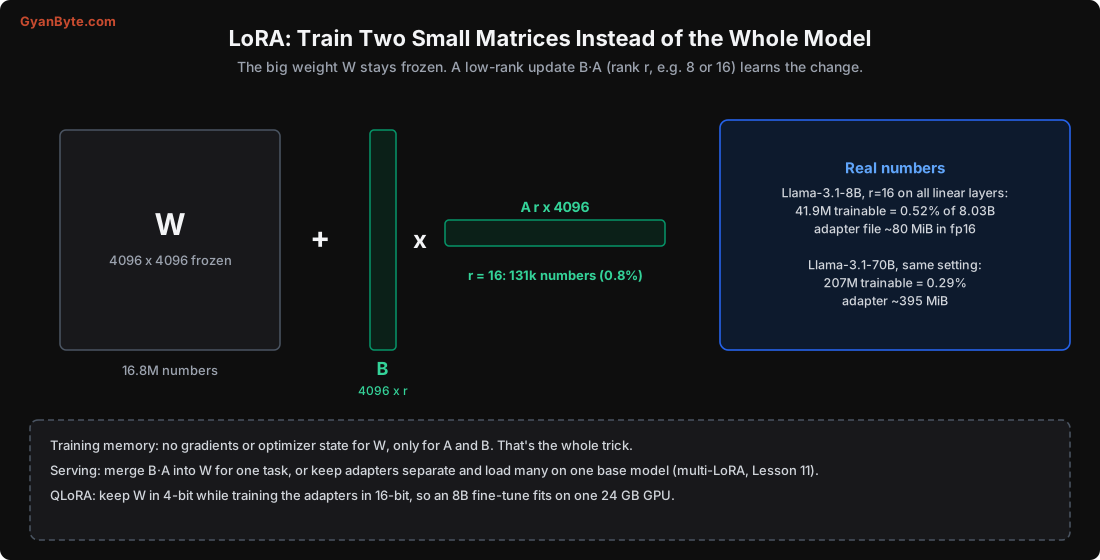
Because W is frozen, you don’t store gradients or optimizer state for it, only for the tiny A and B. That’s the whole trick, and it makes the memory drop dramatically. I computed the trainable fraction for real models (rank 16 on all linear layers):
Llama-3.1-8B:  41.9M trainable = 0.52% of 8.03B,  adapter ~80 MiB (fp16)
Llama-3.1-70B: 207M trainable = 0.29% of 70.55B,  adapter ~395 MiB
You train well under 1% of the parameters, and the result is a small adapter file you can store, version, and swap.
A Real LoRA Training Run
To show the mechanics for real (not just the arithmetic), I ran an actual end-to-end LoRA fine-tune on the CPU. I built a tiny Llama-architecture model (1.05M parameters) and first pretrained it to copy an 8-digit string (output = input). It learned that perfectly: 100% copy accuracy, 0% at reversing.
Then I added a LoRA adapter (rank 8, 94,208 trainable parameters = 8.9% of the model) and trained only the adapter to reverse the digits instead, leaving the base model frozen:
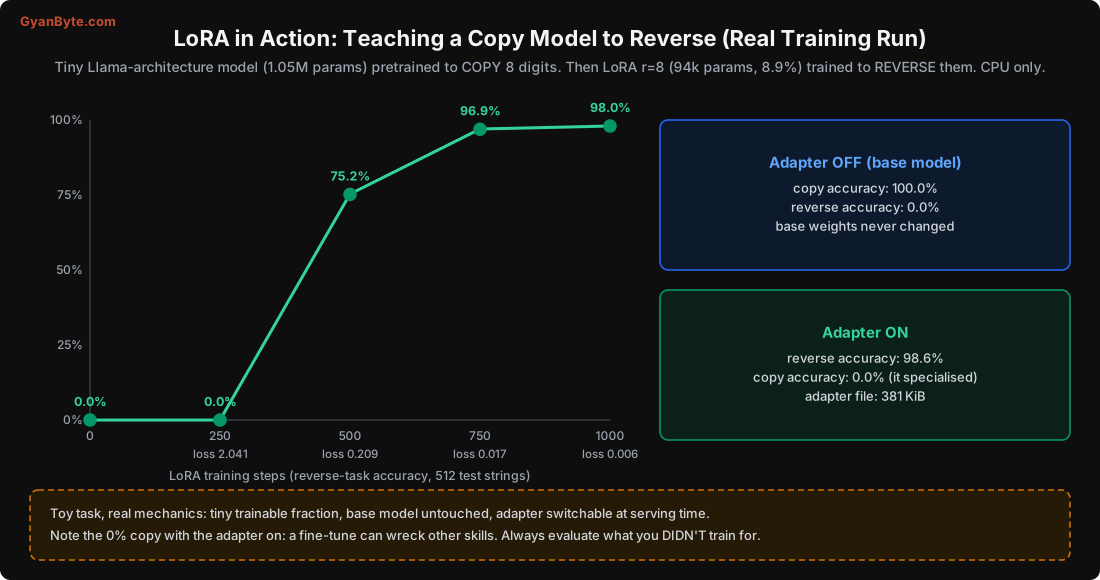
LoRA training (adapter only, base frozen):
  250 steps:  reverse accuracy  0.0%   loss 2.041
  500 steps:  reverse accuracy 75.2%   loss 0.209
  750 steps:  reverse accuracy 96.9%   loss 0.017
 1000 steps:  reverse accuracy 98.0%   loss 0.006

adapter OFF:  copy 100.0%   reverse  0.0%    (the original base model, unchanged)
adapter ON:   copy   0.0%   reverse 98.6%
adapter file size: 381 KiB
Three things to take from this:
- The adapter learned the new skill to 98%+ accuracy, training less than 9% of the parameters.
- The base model is untouched. Switch the adapter off and you get the original copy behaviour back, perfectly. The adapter is a small, separable, switchable file (381 KiB here; 80 MiB for a real 8B).
- The catastrophic-forgetting warning: notice that with the adapter on, the model’s copy accuracy dropped from 100% to 0%. Specialising it for reversing destroyed its original skill. This is real and important: a fine-tune can silently break capabilities you didn’t train for. Always evaluate the skills you care about keeping, not just the one you’re training (Lesson 10).
The code is short, which is part of why LoRA is so widely used (Hugging Face peft):
from peft import LoraConfig, get_peft_model

lora = LoraConfig(r=16, lora_alpha=32, lora_dropout=0.05,
                  target_modules=["q_proj", "k_proj", "v_proj", "o_proj",
                                  "gate_proj", "up_proj", "down_proj"])
model = get_peft_model(base_model, lora)     # base_model stays frozen
model.print_trainable_parameters()           # ~0.5% of params
# ... standard training loop on your examples ...
model.save_pretrained("my-adapter")          # tiny adapter file
QLoRA: Fine-Tune an 8B on One Consumer GPU
QLoRA combines LoRA with quantization (Lesson 4). It keeps the frozen base model in 4-bit (so it takes ~4x less memory) while training the LoRA adapters in 16-bit. The gradients flow through the 4-bit base without updating it. The result: you can fine-tune an 8B model on a single 16-24 GB GPU, and even larger models on one 48-80 GB GPU.
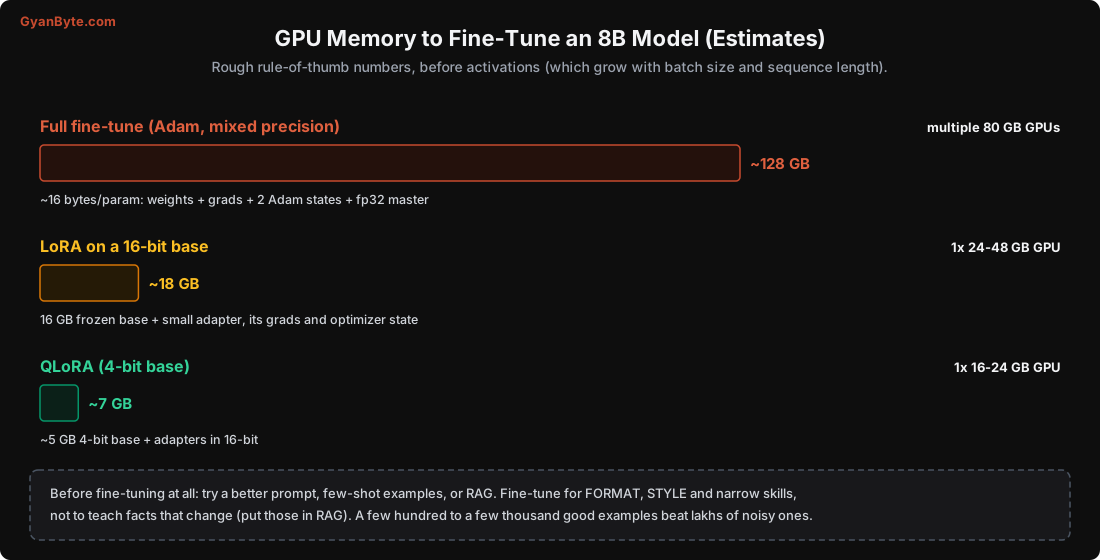
The approximate memory picture (before activations, which depend on batch size and sequence length):
Full fine-tune (8B, Adam, mixed precision):  ~128 GB   -> multiple 80 GB GPUs
LoRA on 16-bit base:                          ~18 GB   -> one 24-48 GB GPU
QLoRA (4-bit base):                            ~7 GB   -> one 16-24 GB GPU
QLoRA is what put fine-tuning within reach of individuals and small teams. For most production fine-tuning of 7-13B models, QLoRA or LoRA is the right default; full fine-tuning is rarely worth its cost unless you’re changing the model deeply.
Serving Fine-Tuned Models
Two options, and the choice matters for Lesson 11:
- Merge the adapter into the base weights (
B·Aadded toW), producing a normal model file. Simplest to serve, slightly faster, but it’s a full-size model per task. - Keep adapters separate and load them on top of a shared base at serving time. This enables multi-LoRA (Lesson 11): one base model in GPU memory, many small adapters, each request choosing its adapter. Four fine-tuned products on one GPU instead of four GPUs. A small latency cost vs merged.
For a single fine-tuned model, merge. For several fine-tunes of the same base, keep them separate and serve multi-LoRA.
Data Quality Beats Data Quantity
A few hard-won rules on the training data, which matters far more than the method:
- A few hundred to a few thousand good examples usually beat lakhs of noisy ones. Quality, consistency and coverage of your real cases matter more than volume.
- Be consistent. If your examples format dates three different ways, the model learns to be inconsistent too.
- Match production. Train on the kind of inputs you’ll actually see, including the messy ones.
- Hold out a test set from the start, and never train on it (Lesson 10).
- Include “hard negatives” and edge cases, not just easy examples.
- Watch for leakage and bias in the data; the model will faithfully learn both.
Pitfalls to Avoid
- Fine-tuning to teach facts. Facts change; weights don’t. Use RAG for knowledge.
- Fine-tuning before trying prompting, few-shot and RAG. Often those are enough.
- Ignoring catastrophic forgetting. The run’s copy skill went 100% to 0%; evaluate skills you didn’t train for.
- Full fine-tuning when LoRA/QLoRA would do. Much more memory and cost for usually no benefit.
- Prioritising data quantity over quality. A few thousand clean examples beat lakhs of noisy ones.
- No held-out test set. You can’t tell if it improved or just memorised.
- Forgetting licensing. Some model licences restrict using outputs to train other models; check (Lesson 1).
Quick Recap
- LoRA freezes the base model and trains tiny low-rank matrices: real run, a 94k-param adapter (8.9%) reached 98% on a new task, base untouched, saved as a 381 KiB switchable file.
- Real adapters are small: ~0.52% of an 8B (80 MiB), ~0.29% of a 70B (395 MiB) at rank 16.
- QLoRA (4-bit base + 16-bit adapters) fits an 8B fine-tune on one 24 GB GPU; full fine-tune needs ~128 GB.
- Fine-tune for format, style and narrow skills; use RAG for facts that change. Try prompting and RAG first.
- Watch catastrophic forgetting (copy skill went 100% to 0%); quality of a few thousand examples beats quantity.
Next lesson: making sure a model change is actually an improvement. Evaluation sets, what silently breaks quality, and rolling out a new model safely with shadow and canary stages.