A log of events is only half the story; the value is in processing it — computing running totals, joining streams, detecting patterns, materialising state. Kafka Streams is the library (Lesson 9) that does this, and stream processing has a few core ideas — state, windows, event time, exactly-once — that apply whether you use Streams, ksqlDB or Flink. This lesson is those ideas, grounded in how Streams implements them.
The pipeline and its state
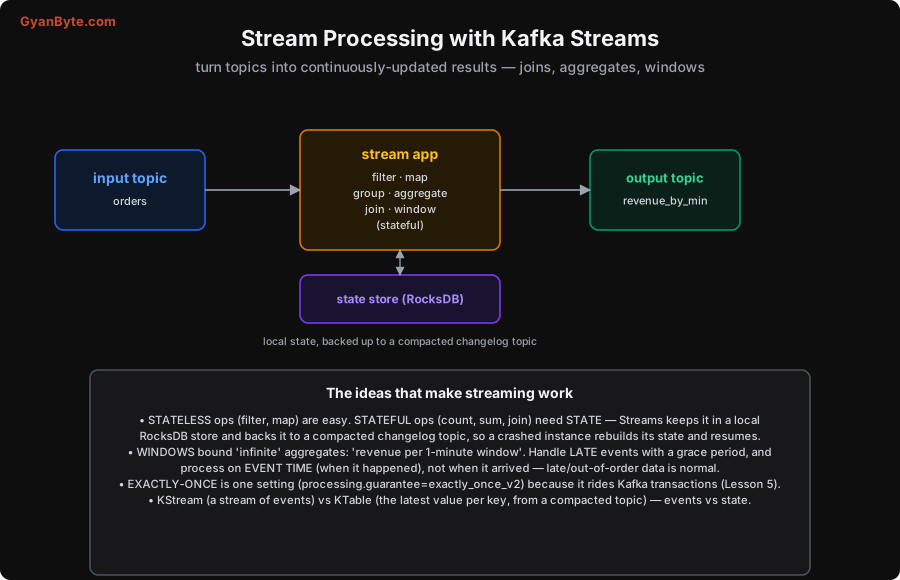
A Streams app reads from input topics, processes, and writes to output topics — a continuous dataflow. The operations split into two kinds, and the difference is everything:
- Stateless operations —
filter,map,flatMap. Each record is transformed independently; no memory of past records needed. Easy, cheap, and trivially parallel. - Stateful operations —
count,sum,aggregate,join. These need to remember something across records: a running total per key, the last value seen, the other side of a join. That memory is state, and managing it correctly under failures is the hard part of stream processing.
Streams handles state elegantly: it keeps it in a local state store (embedded RocksDB, on the instance’s disk) for fast access, and — critically — backs that state up to a compacted changelog topic in Kafka (Lesson 7’s compaction, used here). So if an instance crashes, a new one replays the changelog to rebuild the exact state and resumes where it left off. You get fault-tolerant local state for free — fast local reads, durable Kafka-backed recovery. This is why Streams can do heavy stateful work without an external database.
Windows: bounding the infinite
Aggregating a never-ending stream raises an obvious problem: “total revenue” over an infinite stream never finishes. Windows bound aggregates in time: “revenue per 1-minute window,” “unique users per hour.” The stream is sliced into windows, and each window produces a result.
But windows surface the hard reality of streaming: data arrives late and out of order. A mobile app was offline and uploads an event from 10 minutes ago; a retry reorders events. So two rules matter:
- Process on event time, not arrival time. Each event carries a timestamp of when it actually happened; windows should be assigned by that event time, not when the event reached Kafka. Otherwise your “last minute” window is wrong whenever anything is delayed.
- Allow a grace period for late data. Keep a window open a little past its end to admit stragglers, then finalise. Events later than the grace period are dropped or sent to a side channel. (This is the same late-data discipline as the data engineering course.)
Getting event-time and late-data handling right is most of what separates a correct streaming aggregate from a subtly-wrong one.
Exactly-once, for one setting
Here’s where Kafka’s pieces pay off together. Stream processing is a classic read-process-write loop: consume from input, update state, produce to output. Doing that exactly once — so a crash never double-counts or loses — is exactly what Kafka’s transactions (Lesson 5) provide. And Streams wires it up for you: set processing.guarantee=exactly_once_v2, and the consume, the state update (changelog write), and the produce all happen atomically within Kafka transactions. One setting gives you exactly-once stream processing — something that’s genuinely hard to build by hand. (The caveat from Lesson 5 still holds: it’s exactly-once within Kafka; external sinks still need idempotent writes.)
KStream vs KTable: events vs state
The last core idea is the abstraction Streams gives you, and it maps directly to Lesson 7’s retention-vs-compaction distinction:
- KStream — a stream of events, where every record matters. “User clicked,” “order placed.” Backed by a normal (retention) topic. You process each event.
- KTable — the latest value per key — a table of current state. “User’s current cart,” “product’s current price.” Backed by a compacted topic, so it’s the up-to-date value for each key.
The power is in combining them: join a KStream of events to a KTable of state to enrich events (“this click, for this user’s current segment”); aggregate a KStream into a KTable (“stream of orders → table of revenue-per-customer”). An aggregation turns events into state; reading a compacted topic gives you state directly. Most real stream processing is exactly this — joining and aggregating streams and tables into derived topics that downstream systems consume, each derived topic being a continuously-updated materialised view over your event data.
Put together: Streams lets you build continuously-running, fault-tolerant, exactly-once processing over Kafka, with fast local state and clean event/state abstractions — and the same concepts (state, windows, event time, exactly-once) carry over to ksqlDB and Flink. Next we turn from building to running: operating Kafka in production.
Pitfalls to Avoid
- Processing on arrival time instead of event time. Late/out-of-order events make arrival-time windows wrong. Assign windows by the event’s own timestamp and allow a grace period.
- Ignoring late data. Without a grace period, late events are silently dropped or land in the wrong window, corrupting aggregates. Decide explicitly how late is too late.
- Putting state in an external DB unnecessarily. Streams’ local RocksDB + compacted changelog gives fast, fault-tolerant state without an external store. Reaching for an external DB adds latency and a failure mode — use the built-in state store.
- Expecting exactly-once to cover external sinks.
exactly_once_v2covers Kafka-to-Kafka; a write to an external system still needs idempotency (Lesson 5). Don’t assume the setting makes the whole pipeline perfect. - Confusing KStream and KTable. Treating a changelog (state) as an event stream, or vice versa, gives wrong results — double-counting state updates, or missing events. Model events as KStream, current-state as KTable.
- Unbounded aggregations with no window. Aggregating an infinite stream without a window grows state forever. Window time-based aggregates; bound or compact key-based state.
Quick Recap
- Stateless ops (filter/map) are easy; stateful ops (count/sum/join) need state, which Streams keeps in a local RocksDB store backed by a compacted changelog topic — so a crash rebuilds state and resumes (fault tolerance for free).
- Windows bound infinite aggregates; handle reality with event time (not arrival time) and a grace period for late/out-of-order data.
- Exactly-once is one setting (
processing.guarantee=exactly_once_v2) because it rides Kafka transactions — Kafka-to-Kafka only; external sinks still need idempotent writes. - KStream = a stream of events; KTable = the latest value per key (state, from a compacted topic). Most processing joins/aggregates streams and tables into derived topics.
Next lesson: running it for real — operating Kafka in production (consumer lag, monitoring, sizing, tuning).